 Astha SangrahASTHA SANGRAHhttps://asthasangrah.com
Shri Prabodhini (Devutthana) Ekadashi Vrat Katha
The Prabodhini Ekadashi Vrat Katha describes the glory of Lord Vishnu's awakening from his Chaturmas slumber and the greatness of this vow, recited on the Shukla Paksha of the Kartik month, presented here in full.
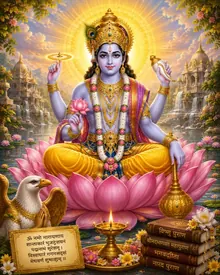
Chapter 1 · The Narada-Brahma Dialogue and the Glory of Prabodhini Ekadashi
Lord Krishna said, 'O Arjuna, I shall narrate to you the dialogue that took place between Narada and Brahma regarding the liberation-granting Prabodhini Ekadashi of the Shukla Paksha of Kartik. Once, Narada asked Brahma, "O father, what is the fruit of observing the vow of Prabodhini Ekadashi? Please explain all of this to me in detail."' Brahma said, 'O son, even that which is difficult to obtain in all three worlds can be obtained through the vow of Prabodhini Ekadashi in the Shukla Paksha of Kartik. By the power of this vow, many evil deeds committed in past births are destroyed in an instant. O son, whoever performs even a little merit with devotion on this day, that merit becomes as unshakable as a mountain, and their ancestors go to Vishnu's abode. Even great sins such as the killing of a Brahmin are destroyed by keeping vigil through the night of Prabodhini Ekadashi.'
'O Narada, to please the Lord, one must certainly observe this Ekadashi vow of the month of Kartik. Whoever observes this Ekadashi vow becomes wealthy, a yogi, an ascetic, and a master of the senses, for Ekadashi is exceedingly dear to Lord Vishnu.'
Chapter 2 · The Vow's Rites and Its Fruit
'Whoever performs charity, penance, fire-offerings, and yajnas on this Ekadashi to attain the Lord receives imperishable merit. Therefore, O Narada, you too should worship Lord Vishnu according to the proper rites. On this Ekadashi, one should rise in the Brahma-muhurta, take the vow's resolve, and perform worship. Through the night, one should spend the time near the Lord with song, dance, and katha-kirtan.'
'On Prabodhini Ekadashi, one should worship the Lord with flowers, agar, and incense, and offer him arghya, the fruit of which is a hundred million times greater than that of pilgrimage or charity. Those who worship Lord Vishnu with rose, bakul, and ashoka flowers, with white and red kaner flowers, with durva grass, shami leaves, and champak flowers, are freed from the cycle of birth and death. Having thus worshipped the Lord through the night, one should, after bathing in the morning, worship one's guru while praying to the Lord, and offer dakshina to virtuous and pure Brahmins before concluding the vow.'
'Whoever has given up some particular thing during the Chaturmasya vow should take it up again from this day onward. Whoever observes the vow of Prabodhini Ekadashi according to the proper rites attains boundless happiness, and in the end goes to heaven.'
How to Read Shri Prabodhini (Devutthana) Ekadashi Vrat Katha
On Prabodhini Ekadashi, rise in the Brahma-muhurta, take the vow's resolve, and worship Lord Vishnu. Keep vigil through the night with song, dance, and katha-kirtan, and worship with flowers, agar, and incense, offering arghya. After bathing in the morning, worship your guru, offer dakshina to Brahmins, and break the fast. From this day, resume any items given up during Chaturmas.
About Shri Prabodhini (Devutthana) Ekadashi Vrat Katha
The Prabodhini Ekadashi Vrat Katha is told across two chapters. In the first, Lord Krishna recounts to Arjuna the glory of this Ekadashi through a dialogue between Narada and Brahma. In the second, the proper method for observing this vow and its fruit are described.
This Ekadashi is observed on the Shukla Paksha of the Kartik month, and it is on this very day that Lord Vishnu awakens from his Chaturmas slumber. This page presents the full text of both chapters in plain Hindi, with adjustable text size and print support.
The Prabodhini (Devutthana) Ekadashi Vrat Katha has no named author. In the text presented here, Lord Krishna recounts to Arjuna the glory of this Ekadashi through a dialogue between Narada and Brahma, notably, this same collection's Devshayani Ekadashi text presents a similar account addressed to Yudhishthira, while here the listener is Arjuna, as in the source itself. Like Devshayani Ekadashi, this too has no character-driven plot of its own, but is instead a direct account of the vow's glory and its rites. The text presented here is a faithful transcription of this glory as printed in a published Hindi vrat-katha collection booklet, with only clear printing errors corrected and no other change made to it. Other printed editions may use different wording.
Frequently asked questions
How many chapters does the Prabodhini Ekadashi Vrat Katha have?
It has two chapters in total, traditionally read or heard together as one complete text.
When is Prabodhini Ekadashi observed?
It is observed on the Shukla Paksha Ekadashi of the Kartik month, and Chaturmas is held to conclude on this very day.
Who narrates the Prabodhini Ekadashi story, and to whom?
In this text, Lord Krishna narrates the Ekadashi's glory to Arjuna, within which a dialogue between Narada and Brahma is also described.
What should be done on Prabodhini Ekadashi?
As the story describes, one should rise in the Brahma-muhurta and take the vow's resolve, keep vigil through the night in worship of the Lord, and after bathing in the morning, offer dakshina to Brahmins before concluding the vow.
Is there one single story for all Ekadashis?
No, there are 24 Ekadashis in a year, and tradition assigns each one its own distinct story or glory. This is Prabodhini Ekadashi's own account of its glory, while the stories of other Ekadashis are available on their own separate pages on this site.