 Astha SangrahASTHA SANGRAHhttps://asthasangrah.com
Shri Rama Ekadashi Vrat Katha
The Rama Ekadashi Vrat Katha is the story of Rama Ekadashi in Kartik's dark fortnight, in which King Muchukunda's son-in-law Shobhan gains a divine city on Mount Mandarachal by the vow's power, and his wife Chandrabhaga makes it stable with the merit of her own Ekadashi fasts.
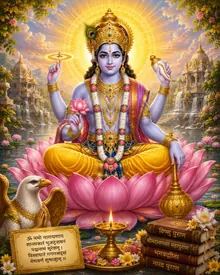
Chapter 1 · King Muchukunda and Shobhan's Fast
Yudhishthira said, 'Janardana, out of your affection for me, kindly tell me which Ekadashi falls in the dark fortnight of Kartik.' Shri Krishna said, 'Listen, lion among kings, I will tell you. In Kartik's dark fortnight there is a most beautiful Ekadashi named Rama, said to remove even the greatest sins. Through the story connected with it, O king, I will tell you its glory.'
Long ago there was a famous king named Muchukunda. He was a friend of Indra, king of the gods, and Yama, Varuna, Kubera and Vibhishana were his companions too. He was a devotee of Vishnu and true to his word. While he ruled thus, free of every foe, Chandrabhaga, the best of rivers, was born in his house as his daughter, and she was given in marriage to Shobhan, the son of Chandrasena.
Once Shobhan came to his father-in-law's house, and just then the day of the Ekadashi fast, giver of great merit, arrived. Seeing the fast day come, Chandrabhaga grew anxious: 'O lord of the gods, what will happen now? My husband is very frail, he cannot bear hunger, and my father's rule is strict.' On Dashami a drum was beaten throughout his kingdom with the proclamation: 'On Hari's day no one is to eat, no one is to eat, no one is to eat.' Hearing the drum's proclamation, Shobhan spoke to his beloved.
Shobhan said, 'My beloved, fair one, tell me what I should do now.' Chandrabhaga said, 'My lord, in my father's house no one may eat today. Even the elephants, the horses, their young and the other animals take no grass, grain or even water on Hari's day, so how could people eat on the day of Hari? My husband, if you eat, you will have to leave this house. Weigh all this in your mind and make your resolve firm.'
Shobhan said, 'Beloved, what you say is true. I will fast. What fate has ordained will come to pass.' Making this firm resolve, he took the vow's discipline. His body was racked with hunger and he suffered greatly. While he brooded so, the sun went down behind the western hills. For the Vaishnavas, devoted to Hari's worship and with hearts set on the night vigil, that night brought rising joy, but for Shobhan, lion among kings, it brought terrible pain, and at the hour of sunrise Shobhan breathed his last. The king had him cremated on wood fit for a king. Chandrabhaga did not burn her body with her husband; she performed his funeral rites and went on living in her father's house.
Chapter 2 · The Divine City on Mandarachal, and Somasharma
Meanwhile, best of kings, by the power of the Rama vow Shobhan gained a delightful city of the gods on the peak of Mount Mandarachal, unsurpassed, unassailable and endowed with countless excellences. It shone with mansions on golden pillars, set with gems and cat's-eye, and with wondrous crystal halls of many shapes. There Shobhan sat upon a throne beneath a white umbrella and whisks, adorned with a crown, earrings, necklaces and armlets, praised by the Gandharvas and attended by the Apsaras.
There Shobhan shone like a second Kubera. In Muchukunda's city lived a well-known brahmin named Somasharma. Wandering on a pilgrimage, he saw Shobhan, and recognising him as the king's son-in-law, went up to him. Shobhan too, knowing the excellent brahmin Somasharma had come, rose at once from his seat and bowed to him, and asked after his father-in-law the king, his beloved Chandrabhaga and the whole city.
Somasharma said, 'O king, all is well in your father-in-law's house, Chandrabhaga is well, and all is well in the city. Now tell me your own story, for here is a great wonder. No one anywhere has seen so marvellous and lovely a city. Tell me, O king, where did you gain it?'
Shobhan said, 'Best of the twice-born, by fasting on the Ekadashi named Rama in Kartik's dark fortnight I gained this city, but it is not stable. Please do whatever will make it stable.' The brahmin asked, 'Lord of kings, why is it unstable, and how will it become stable? Tell me exactly and I will do just that.' Shobhan said, 'O brahmin, I kept this excellent vow without faith, which is why I believe it is unstable. Hear how it will become stable: tell this whole story to Chandrabhaga, Muchukunda's lovely daughter, and it will become stable.'
Chapter 3 · Chandrabhaga's Merit, and the Glory of Rama Ekadashi
Shri Krishna says: hearing his words, the brahmin went to Muchukunda's city and told the whole story before Chandrabhaga. Somasharma said, 'Auspicious one, I have seen your beloved husband with my own eyes, and his city too, unassailable like Indra's. He calls it unstable; you must make it stable.' Chandrabhaga said, 'Wise brahmin, take me there, for I long to see my husband. With the merit of my own vow I will make that city stable. O twice-born, do whatever will bring the two of us together, for great merit is gained by uniting those who are parted.'
Hearing this, Somasharma took her with him to the ashram of the sage Vamadeva near Mount Mandarachal. Vamadeva heard the whole story from the two of them and anointed the radiant Chandrabhaga with Vedic mantras. By the power of the sage's mantra and her keeping of the Ekadashi, her body became divine and she attained a divine state. Her eyes bright with joy, she went to her husband. Seeing his beloved arrive, Shobhan was overjoyed, called her to him and seated her at his left side. Then Chandrabhaga, full of joy, spoke these loving words to her beloved.
'My husband, hear these words for your good. I will tell you the merit that is in me. From the time I passed eight years of age in my father's house, I have kept the Ekadashi fasts with the rites the scriptures prescribe and with a faithful heart. By the power of that merit this city will become stable, and will stay rich in every wish until the dissolution of the world.' And so, lion among kings, she lived happily with her husband. With Chandrabhaga, endowed with divine pleasures, divine beauty and divine ornaments, Shobhan too, in his divine form, rejoices on the peak of Mandarachal by the power of the Rama vow. This Ekadashi is like the wish-fulfilling gem and the wish-granting cow.
O king, I have told you of this Ekadashi named Rama, and you, sinless one, have heard all its glory. I have told you the sin-destroying glory of the Ekadashi fasts of both fortnights. As the Ekadashi of the dark fortnight is, so is that of the bright fortnight; no distinction should be made between them. Kept faithfully, Ekadashi grants people both worldly fulfilment and liberation. Just as the milk of a white cow and a black cow is alike, so both Ekadashis are held to give equal fruit. Whoever hears this glory of the Ekadashi fasts is freed from every sin and is honoured in Vishnu's world.
How to Read Shri Rama Ekadashi Vrat Katha
On Rama Ekadashi, bathe in the morning, take the vow of fasting and worship Lord Vishnu and Maa Lakshmi. Like the Vaishnavas in the katha, spend the night in Hari's worship and vigil, hear this katha, and break the fast the next day, Dwadashi, within the parana muhurat.
About Shri Rama Ekadashi Vrat Katha
The Rama Ekadashi Vrat Katha is told in three chapters. In the first, in King Muchukunda's kingdom his frail son-in-law Shobhan keeps the Ekadashi fast and dies by sunrise. In the second, by the vow's power he gains a divine city on Mandarachal, which the brahmin Somasharma sees, and Shobhan explains that it is unstable because he kept the fast without faith. In the third, Chandrabhaga gains a divine body at the sage Vamadeva's ashram, goes to her husband, and makes the city stable with the merit of her own fasts.
This vow is kept on the Ekadashi of Kartik's dark fortnight, three or four days before Diwali. 'Rama' is a name of Maa Lakshmi, so Maa Lakshmi is worshipped together with Lord Vishnu on this day.
The Rama Ekadashi Vrat Katha has no named author. It is the sixtieth chapter of the Uttara Khanda of the Padma Purana, in which Lord Krishna tells the story to Yudhishthira. The text given here is a verse-by-verse translation of that chapter's 54 Sanskrit verses.
Benefits of the Rama Ekadashi Vrat Katha
At the katha's close Lord Krishna says that this Ekadashi fulfils every wish like the wish-fulfilling gem and the wish-granting cow, grants both worldly fulfilment and liberation, and that whoever hears this glory of the Ekadashi fasts is freed from every sin and honoured in Vishnu's world.
Frequently asked questions
How many chapters does the Rama Ekadashi Vrat Katha have?
It has three chapters, based on the 54 verses of the sixtieth chapter of the Padma Purana's Uttara Khanda, read or heard together as one complete text.
When is Rama Ekadashi in 2026, and when is the parana?
In 2026 the Rama Ekadashi fast is on Thursday, 5 November. Break it on Friday, 6 November, between 6:37 and 8:48 AM (New Delhi).
Why was Shobhan's city unstable?
In the katha Shobhan himself says that he kept the Rama Ekadashi fast without faith, out of compulsion under his father-in-law's rule, so the city he gained was unstable. It became stable through the merit of the Ekadashi fasts Chandrabhaga had kept with faith.
Are the Ekadashis of the dark and bright fortnights equal?
Yes. At the end of this very katha Krishna says that no distinction should be made between the Ekadashis of the two fortnights: just as a white cow and a black cow give the same milk, both give equal fruit.
Why is it called Rama Ekadashi?
'Rama' is a name of Maa Lakshmi. On this Ekadashi, which comes just before Diwali, Maa Lakshmi is worshipped together with Lord Vishnu, and this is the name the Padma Purana gives it.