
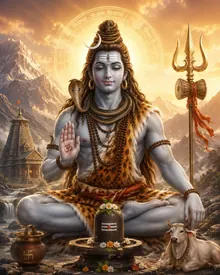
The exact timing of the Nishita Kaal puja changes every year and by city, so check a local panchang. Note that this is the annual Maha Shivratri, considered far more significant than the 'Masik Shivratri' observed every month.
Significance of Maha Shivratri
Several legends are associated with the night of Maha Shivratri. One belief holds that Lord Shiva and Maa Parvati were married on this very night. Another legend recounts that on this day, Lord Shiva consumed the deadly halahal poison that emerged from the Samudra Manthan, which turned his throat blue and earned him the name 'Neelkanth'. A third belief holds that Lord Shiva first manifested as a 'Jyotirlinga', a pillar of light, on this same night.
The night of Maha Shivratri is divided into four watches (prahars), each with its own worship, called the 'Char Prahar Puja'. In each prahar, the Shivling is bathed (abhishek) with a different substance, water, milk, curd, honey, and ghee, accompanied by the chanting of the 'Om Namah Shivaya' mantra.
Devotees observe a waterless fast and stay awake through this night, in the belief that keeping vigil helps overcome tamas (inertia and ignorance). Maha Shivratri is regarded by Shiva's devotees as the most important night of the year.
How Maha Shivratri Is Celebrated
In the morning, after bathing, devotees visit a Shiva temple and offer water, milk, and bel patra (bilva leaves) on the Shivling. A waterless or phalahar fast is observed through the day.
At night, the Char Prahar Puja is performed, in which the Shivling is bathed and the aarti performed in each prahar, along with recitation of the Shiv Chalisa, the Mahamrityunjaya Mantra, and Rudrabhishek.
Many temples host devotional singing and vigils through the night. The next morning, after the Nishita Kaal puja, devotees bathe during Brahma Muhurat and break their fast.
Maha Shivratri Puja Vidhi
Bathe in the morning and offer water, milk, and bel patra at a Shiva temple. Observe a waterless or phalahar fast through the day. At night, bathe the Shivling across the four prahars with water, milk, curd, honey, and ghee, performing the aarti each time and chanting 'Om Namah Shivaya'. The next morning, bathe during Brahma Muhurat and break the fast.
About Maha Shivratri
Maha Shivratri is the most important night of Lord Shiva's worship, observed on Phalgun Krishna Chaturdashi. This page covers Maha Shivratri's significance, the legends of Shiva-Parvati's marriage and Neelkanth, the Char Prahar Puja, and the puja vidhi for observing it at home and in a temple.
The information on this page is presented with easy-to-read sizing and print support, so it can be read comfortably even during the night-long vigil.
Frequently Asked Questions
When is Maha Shivratri observed?
Maha Shivratri is observed every year on the Chaturdashi tithi of the Krishna Paksha of the Phalgun month, usually falling in February–March.
What is Char Prahar Puja?
The night of Maha Shivratri is divided into four watches (prahars), with the Shivling bathed in a different substance and the aarti performed in each one.
What is the difference between Maha Shivratri and Masik Shivratri?
Masik Shivratri falls every Hindu month on Krishna Chaturdashi, while Maha Shivratri occurs once a year, in the Phalgun month, and is considered the most significant of them.
Can water be taken during the fast?
This depends on one's faith and capacity, most devotees keep a waterless fast, while some observe the fast while taking fruits and water.
Why is bel patra offered on the Shivling?
Bel patra is considered especially dear to Lord Shiva, and its three leaves are offered as a symbol of his three eyes or his trident.