
Holi is always celebrated the day after Holika Dahan. In the Braj region (Mathura, Vrindavan, Barsana, Nandgaon), the celebrations begin several days before the main day, including Barsana's famous Lathmar Holi.
Significance of Holi (Rangwali Holi)
Holi is celebrated the morning after Holika Dahan, carrying forward that same celebration of good's victory over evil, now with colour. The festival also marks the arrival of spring and the ripening of the new harvest.
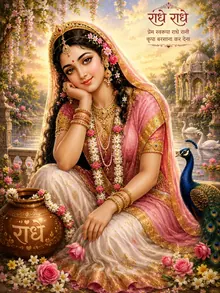
According to a popular legend, the young Krishna was troubled by his dark complexion and compared himself to the fair Radha before his mother Yashoda. Yashoda playfully suggested he colour Radha's face with whatever colour he wished. This episode is believed to be the origin of playing with colours alongside Radha and Krishna, a tradition still celebrated most grandly in the Braj region.
In Mathura, Vrindavan, Barsana, and Nandgaon, Holi celebrations begin days in advance, with Barsana's 'Lathmar Holi' being the most famous, where women playfully chase men with sticks, re-enacting the loving exchanges between Radha and Krishna.
How Holi (Rangwali Holi) Is Celebrated
In the morning, family and friends play with dry and wet colours, gulal, and pichkari water guns. Children and young people fill balloons with water and throw them at one another, and dance to the beat of the dhol.
Special foods such as gujiya and thandai, and in some regions bhang, are prepared and shared on this day. Before playing colours, it is traditional to apply a colour tilak to elders and seek their blessings.
In the afternoon, people bathe and wear new clothes, then visit each other's homes to share sweets, in a tradition called 'Holi Milan', where past grievances are set aside and relationships are renewed.
Holi (Rangwali Holi) Puja Vidhi
In the morning, apply a colour tilak to elders and seek their blessings. Then play Holi with gulal and colours with family and friends. In the afternoon, bathe, wear new clothes, and visit neighbours and relatives to exchange sweets.
About Holi (Rangwali Holi)
Holi is India's most colourful festival, celebrated on Phalgun Shukla Pratipada, the day after Holika Dahan. This page covers Holi's significance, the legend of Radha and Krishna, Braj's Lathmar Holi tradition, and the ritual of Holi Milan.
See the separate page for Holika Dahan, observed the night before. The information on this page is presented with easy-to-read sizing and print support.
Frequently Asked Questions
When is Holi observed?
Holi is observed on Phalgun Shukla Pratipada, the day after Holika Dahan, usually falling in March.
What is the difference between Holi and Dhulandi?
'Dhulandi' is the traditional name for the main day of playing colours, which is commonly just called 'Holi'. In some regions, the word 'Holi' is also used for the Holika Dahan night, so usage can vary by place.
What is Lathmar Holi?
Lathmar Holi is a unique tradition celebrated in Barsana and Nandgaon, in which women playfully chase men with sticks, commemorating the loving exchanges between Radha and Krishna.
Why is Holi celebrated?
Holi carries forward the celebration of evil's end begun with Holika Dahan, marks the arrival of spring and the new harvest, and commemorates the tradition of playing colours with Radha and Krishna.