
Chapter 1 · The Puja Vidhi
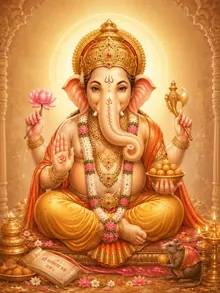
Kartik month's Krishna Paksha Chaturthi tithi is known as Karva Chauth, or Karak Chaturthi. On this day, it is ordained for fortunate married women to worship Lord Ganesh. In Indian tradition, it has always been the custom to worship Lord Ganesh at the start of any undertaking, since among all the gods he is regarded as the beginningless (Anadi) deity. Hence Lord Ganesh's worship comes first.
Lord Shiva and Parvati themselves worshipped Lord Ganesh first, at the time of their own wedding. This is mentioned by the emperor among poets, Goswami Tulsidas, in his epic: 'On the sage's instruction, Shambhu and Bhavani worshipped Ganapati; hearing this, have no doubt, know in your heart that he is the beginningless god.' Lord Ganesh is regarded as the destroyer of obstacles, and so his worship is said to be essential for the obstacle-free completion of any task.
On the day of Karva Chauth, the vrat-observer, having finished her daily routine, should firmly resolve in her mind: 'Today I shall remain without food the whole day, devoted to meditating on Lord Ganesh, and at night I shall keep a waterless fast until the moon rises.'
On the evening of the vrat, the wall of the house should be plastered with cow-dung, and images of Ganesh, Parvati, Shiva, Kartikeya and other deities should be drawn upon it using red ochre ink. Along with this, a banyan tree (vat vriksha) and a human figure should also be drawn on that wall. That human figure should hold a sieve in its hand. An image of the rising moon should also be drawn nearby on that wall.
At the time of worship, two karva pots filled with water should be placed beneath that wall. A thread should be wound around the neck of the karva pot and colored with vermilion, and a stick of sarai wood should be fixed into its spout. After this, a bowl filled with rice, along with betel nut, should be placed atop the karva. As naivedya, place a laddu made of rice (shakkar-pindi) upon it. In addition, puri and kheer should also be offered as naivedya near the image. Besides this, whatever seasonal fruits are available, singhara, banana, orange, sugarcane and so on, should be offered, and the katha should then be heard with devotion.
At the end of the katha, the karva pots that were set up earlier should be turned, the one on the right moved to the left, and the one on the left turned to the right. In common speech, this act is called 'karva ferna' (turning the karva). Worshipping in this manner, according to the full rites, pleases Lord Ganesh, and as a result, the observer's heart's desire is fulfilled and she attains unbroken good fortune.
Chapter 2 · The Merchant's Daughter's Story
A certain merchant had seven sons and one daughter. On the day of Kartik Krishna Chaturthi, the merchant's wife, all his daughters-in-law, and his daughter together performed the observance of the vrat. After the worship, all the merchant's sons sat down to eat. While eating, the sons urged their sister to eat as well.
The sister replied: all of you go ahead and eat. I shall eat only after the moon rises and I have offered it arghya. Hearing his sister's words, the brothers lit a fire some distance away in a field, and, showing its light through a sieve, said: Sister! Look, the moon has risen ahead. Now you too may eat.
Hearing her brother's words, the girl repeated the same thing to her sisters-in-law as well. Her sisters-in-law knew this to be a deceitful trick. They told her, the moon has not yet risen; your brothers have made you believe, through the light of a fire, that the moon has risen. But the girl paid no heed to her sisters-in-law's words, offered the arghya, and then ate her meal as well.
For this act of hers, Lord Ganapati became greatly displeased, and as a result, her husband was struck by a terrible illness. In having him treated, all her accumulated wealth was destroyed, and she fell into deep grief and suffering.
After enduring this suffering, when she came to realize her mistake, she began to repent again and again in her heart. She begged Lord Ganesh's forgiveness for her error and completed the vrat once more with devotion. Pleased by her worship, Lord Ganesh removed all her suffering and filled her home with wealth and grain once more. Hence, whichever soul completes this vrat according to the full rites has all their wishes fulfilled.
Chapter 3 · The Arghya Rite and the Vow's Fruit
After hearing the katha in this way, once the moon has risen, arghya should be offered to Chandra Dev. While offering the arghya, the mantra 'Om Chandraya Namah' should also be recited. After this, circumambulate four times and bow down before Chandra Dev.
Having done this, feed the elders of the house and then eat oneself. The items used in the worship, the naivedya that was offered, and so on, should be given in charity to Brahmins. Thus, those who observe this Chaturthi vrat with devotion have all their wishes fulfilled.
Chapter 4 · Karva Chauth's Udyapan Vidhi
The udyapan (ritual conclusion) of any vrat should be performed only once it has been completed in full. The udyapan is performed on the very tithi of the vrat. In whichever year the udyapan is to be performed, after the vrat concludes on that year's Kartik Krishna Chaturthi, a plate should be colored with kumkum, and thirteen portions should be laid out, each with four puris topped with sugar, and upon this, a nose-ring, a sari, a blouse, dakshina and so on should be placed and offered to one's mother-in-law.
Those who have no mother-in-law should instead give this in charity to some married Brahmin woman. Only after completing this entire rite should one eat food oneself. Doing so keeps one's good fortune ever-unbroken.
How to Read Karva Chauth Vrat Katha
On Karva Chauth, observe a waterless fast, set up images of Ganesh-Parvati-Shiv-Kartikeya and the karva pots on the wall in the evening, hear the katha, and break the fast by offering arghya once the moon rises. The full puja vidhi, arghya vidhi, and udyapan vidhi are given in detail in this page's first, third, and fourth chapters.
About Karva Chauth Vrat Katha
The Karva Chauth Vrat Katha tells the story of a merchant's daughter who, deceived by her brothers, offered arghya and ate before the moon had actually risen, and as a result had to endure hardship, before finally receiving Lord Ganesh's grace by completing the vow again. This page has four chapters, the first covers the puja vidhi, the second the merchant's daughter's story, the third the arghya vidhi and the vow's fruit, and the fourth the udyapan vidhi.
This vow is observed mainly in North India by married women, wishing for their husband's long life. This page presents the full text of all four chapters in plain Hindi, with adjustable text size and print support.
The Karva Chauth Vrat Katha has no single named author. Several differently named stories for this vow circulate across India, such as the tale of the devoted washerwoman named Karva, and the story Lord Krishna narrated to Draupadi, which are not included on this page. The text presented here is a faithful transcription of the 'Merchant's Daughter's Story' (Sahukar-Kanya Ki Katha) as printed in a published Hindi vrat-katha collection booklet, with only clear printing errors corrected and no change made to the story itself. This is regarded as the most widely told Karva Chauth katha across India, though other printed editions may use different wording.
Frequently asked questions
How many chapters does the Karva Chauth Vrat Katha have?
It has four chapters in total, the puja vidhi, the merchant's daughter's story, the arghya vidhi and fruit, and the udyapan vidhi, traditionally read or heard together as one complete text.
When is Karva Chauth observed?
This vow is observed every year on Kartik Krishna Paksha Chaturthi, also called Karak Chaturthi.
What is 'Karva Ferna'?
After hearing the katha, the act of turning the two karva (water pots) set up for worship in opposite directions from each other is called 'Karva Ferna' in common speech, an essential part of the puja vidhi.
Is there only one Karva Chauth katha in circulation?
No, several Karva Chauth kathas circulate across India, such as the story of a washerwoman named Karva, and the story Lord Krishna narrated to Draupadi. This page presents the most widely told version, the 'Merchant's Daughter's Story'.