 Astha SangrahASTHA SANGRAHhttps://asthasangrah.com
Shri Satyanarayan Katha
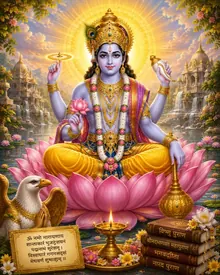
Satyanarayan Katha is the worship-story of Lord Vishnu in his form as Satyanarayan, told in five chapters and recited on Purnima, Ekadashi, or any auspicious occasion, believed to bring wealth and offspring and remove sorrow, presented here in full.
Chapter 1 · Narada's Question
The full context of the Satyanarayan Vrat Katha is this: in ancient times, the sage Shaunak and other sages arrived at the ashram of the great sage Sutaji at Naimisharanya. The sages asked Sutaji: what is the simple means to freedom from worldly suffering, to prosperity in this world, and to the fulfillment of one's goal in the next? Sutaji told the sages that this very question had once been asked of Lord Vishnu by Narada. Lord Vishnu told Narada that there is one single highway to freedom from worldly affliction, to worldly prosperity, and to the fulfillment of one's goal in the next world, and that is the Satyanarayan Vrat. Satyanarayan means truthful conduct, steadfastness in truth, devotion to truth. Prosperity in this world is possible only through truthful conduct. Truth itself is God. Truthful conduct means worship of God, devotion to God. The story begins with Sutaji telling it thus: Narada went to Lord Vishnu and sang his praises. Having heard this praise, Lord Vishnu said to Narada: O fortunate one, for what purpose have you come here, what is on your mind? Tell me, and I will tell you everything. Narada said: Lord, in the mortal world, all beings born into various forms through their own sinful deeds are suffering many kinds of affliction. O Lord, by what small remedy can their sufferings be removed, if you have grace upon me, I wish to hear all of it. Please tell me.
The Lord said: O child, out of your wish to show grace to the world, you have asked a very good question. I shall tell you of the vow by which a being is freed from delusion, listen. O child, there is a great and meritorious vow of Lord Satyanarayan, rare even in heaven and on earth. Because of your affection, I am telling it to you now. By performing the Satyanarayan Vrat properly, according to its rites, a person can quickly attain happiness and, in the next world, attain liberation. Hearing the Lord's words, sage Narada said: Lord, what is the fruit of performing this vow? What is its method? Who has performed it, and when should it be done? Please tell me all this in detail. The Lord said: this Satyanarayan Vrat calms sorrow and grief, increases wealth and grain, grants good fortune and children, and grants victory everywhere. On any day, united with devotion and faith, a person should, together with Brahmins and family, being devoted to dharma, worship Lord Satyanarayan in the evening. As naivedya, food of the finest kind should be offered with devotion, in a quarter-more-than-needed measure. Banana, ghee, milk, wheat flour, or in the absence of wheat flour, sathi rice flour, sugar or jaggery, all this food should be gathered in a quarter-more-than-needed measure and offered. Having heard the story of Lord Satyanarayan together with family, one should give the Brahmins their due gift. Then, the Brahmins should be fed together with the family. Having taken the prasad with devotion, singing and dancing should be arranged. Then, remembering Lord Satyanarayan, one should go home. Doing this certainly fulfills a person's desire. Especially in this age of Kaliyug, this is the smallest remedy there is on earth.
Chapter 2 · The Poor Brahmin and the Woodcutter
Sutaji said: O twice-born ones! Now I shall again tell in full detail of the one who performed this Satyanarayan Vrat in ancient times. In the beautiful city named Kashi lived a certain extremely poor Brahmin. Tormented by hunger and thirst, he wandered the earth every day. Lord Vishnu, who is fond of Brahmins, seeing that sorrowful Brahmin, took the form of an old Brahmin and asked that twice-born one respectfully: O learned one, why do you wander the earth every day, so sorrowful? O best of the twice-born, tell me all this, I wish to hear it. The Brahmin said: Lord, I am an extremely poor Brahmin and wander the earth only to beg. If you know some remedy to remove this poverty of mine, please tell me. The old Brahmin said: O godly Brahmin, Lord Satyanarayan Vishnu is the giver of desired fruit. O learned one, perform his excellent vow, by performing which a person is freed of all sorrows. Having carefully explained the method of the vow to the Brahmin, Lord Vishnu, in the form of the old Brahmin, vanished from that very place. Thinking, I shall perform this vow well, just as the old Brahmin described, that Brahmin could not sleep that night. Rising the next morning with the resolve, I shall perform the Satyanarayan Vrat, the Brahmin set out to beg. That day the Brahmin received a great deal of wealth in alms. With that very wealth, he performed the vow to Lord Satyanarayan together with his family. By the power of this vow, that excellent Brahmin was freed of all sorrows and became endowed with all manner of riches.
From that day on, he performed this vow every month. Thus, by performing this vow to Lord Satyanarayan, that excellent Brahmin was freed of all sins and attained the rare state of liberation. O learned one, whenever any person on this earth performs the vow of Shri Satyanarayan, at that very moment all their sorrows shall be destroyed. O Brahmins, thus I have told you all that Lord Narayan said to the great sage Narada, what more shall I say now? O sage, who else on this earth performed this vow after hearing of it from that Brahmin? We wish to hear all of that, our faith in this vow is growing. Sutaji said: O sages, hear now of the one who performed this vow on earth. Once, that excellent twice-born one, according to his wealth and means, was preparing to perform the vow together with his family and relatives. Just then, a woodcutter came there, and having set down his wood outside, went to that Brahmin's house. Tormented by thirst, seeing the Brahmin performing the vow, he bowed and said to him: Lord, what is it you are doing, what fruit is obtained by doing this, please tell me in detail. The learned one said: this is the vow of Satyanarayan, which grants every wish. It is by its power that I have obtained all this great wealth and grain. Having drunk water and taken the prasad, he went off toward the city, thinking to himself, whatever wealth I obtain today from selling wood, with that very wealth I shall perform this excellent vow of Lord Satyanarayan. Thinking thus in his mind, carrying the wood on his head, he went into that beautiful city, where wealthy people lived. That day he obtained double the price for his wood. After this, with a joyful heart, he came home carrying ripe bananas, sugar, ghee, milk, and wheat flour in a quarter-more-than-needed measure. Then, calling his relatives together, he performed the vow to Lord Satyanarayan according to its rites. By the power of that vow, he became endowed with wealth and sons, and having enjoyed many pleasures in this world, in the end went to Satyapur, that is, Vaikuntha.
Chapter 3 · The Merchant Sadhu and the Imprisonment by Chandraketu
Sutaji said: O excellent sages, now I shall again tell the story further, listen. In ancient times there was a king named Ulkamukh. He was self-controlled, truthful, and extremely wise. That learned king went to the temple every day and satisfied the Brahmins by giving them wealth. His lawful wife, whose face was like a lotus, was endowed with virtues of modesty, humility, and beauty, and was devoted to her husband. One day the king, together with his wife, was performing the vow of Shri Satyanarayan on the bank of the Bhadrashila river. At that very time, a merchant named Sadhu, endowed with abundant wealth of many kinds, came there for trade. Mooring his boat on the bank of the Bhadrashila river, he went near the king, and seeing the king initiated into that vow, began to ask him respectfully. Sadhu said: O king, what is this you are doing with a devoted mind? Please tell me all of it, I wish to hear it now. The king said: O Sadhu, out of a desire to obtain a son and so on, together with my family, I am performing the vow and worship of Lord Vishnu, endowed with incomparable radiance. Hearing the king's words, Sadhu said respectfully: O king, please tell me all of this in detail, I shall perform the vow and worship according to your account. I too have no offspring, surely I shall obtain offspring through this, thinking so, he withdrew from his trade and came home joyfully. He told his wife in detail of this true vow that grants offspring, and saying, when I obtain offspring, then I shall perform this vow, thus that Sadhu spoke to his wife Lilavati. One day, his wife, the chaste and virtuous Lilavati, engaged with her husband in the due observance of the fertile season with a joyful mind, and by the grace of Lord Shri Satyanarayan, his wife conceived. In the tenth month, a jewel of a daughter was born to her, and she began to grow day by day like the moon of the bright fortnight.
That daughter was named Kalavati. After this, one day Lilavati said to her husband in sweet words: why are you not performing the vow of Shri Satyanarayan that you had earlier resolved upon? Sadhu said: my dear, I shall perform the vow at the time of her marriage. Having thus properly reassured his wife, he went off toward the city to conduct his trade. Meanwhile, the girl Kalavati grew up in her father's house. Then, the righteous Sadhu, seeing his daughter, who was playing with her friends in the city, of marriageable age, consulted among his people and sent a messenger at once, telling him to seek out an excellent groom for the girl's marriage. Having received his order, the messenger went to the city named Kanchan, and brought back a merchant's son from there. Seeing that merchant's son to be handsome and endowed with good qualities, Sadhu, with a satisfied mind, together with the people of his own community and his relatives, gave his daughter's hand in marriage to the merchant's son according to due rites. At that time, that merchant Sadhu, unfortunately, forgot that excellent vow of the Lord. Because he did not perform the vow at the time of the marriage, as per his earlier resolve, the Lord became displeased with him. Some time later, that merchant Sadhu, skilled in his trade, driven by the force of time, went with his son-in-law to the beautiful city named Ratnasarpur, situated near the sea, for trade, and began trading there together with his prosperous son-in-law. After that, the two of them went to that delightful city of King Chandraketu. At that very time, Lord Shri Satyanarayan, seeing him to be one whose vow had lapsed, gave him this curse: he shall obtain a terrible, difficult, and great sorrow. One day, a thief, having stolen King Chandraketu's wealth, came to that very place where the two merchants were staying. Seeing the king's men chasing after him, the frightened thief left the wealth right there and quickly hid himself. After this, the king's men arrived at the place where that merchant Sadhu was. Seeing the king's wealth there, those men bound the two merchants and brought them in, and running joyfully, said to the king: Lord, we have caught two thieves, give your command upon seeing them. By the king's command, the two of them were quickly and firmly bound and, without any consideration, thrown into a great prison. By the maya of Lord Satyadev, no one listened to what the two of them said, and King Chandraketu also took their wealth.
By the Lord's curse, the merchant's wife too became extremely distressed at home, and all the wealth that was in their house, the thief stole. Lilavati, afflicted with bodily and mental suffering, distressed by hunger and thirst, worried about food, began to wander from place to place. The girl Kalavati too began going about here and there every day in search of food. One day, tormented by hunger, Kalavati went to a Brahmin's house. Going there, she saw the vow and worship of Shri Satyanarayan being performed. Sitting there, she heard the story and asked for a boon. After that, having taken the prasad, she went home as night was falling. Her mother lovingly asked the girl Kalavati: daughter, where did you stay so late tonight? What is on your mind? The girl Kalavati at once told her mother: mother, I saw a vow at a Brahmin's house that grants one's heart's desire. Hearing the girl's words, the merchant's wife resolved to perform the vow, and with a joyful mind, that virtuous woman performed the vow to Lord Shri Satyanarayan together with her family, and prayed thus: Lord, please forgive the offense of my husband and son-in-law. May the two of them come home quickly. By this vow, Lord Satyanarayan again became pleased, and he showed a dream to the excellent King Chandraketu, and said in the dream: O excellent king, release the two merchants at dawn, and also give back all the wealth that you took from them just now, or else I shall utterly destroy you along with your kingdom, wealth, and sons. Having said this to the king in the dream, Lord Satyanarayan vanished. After this, at dawn, the king, sitting in assembly with his courtiers, told the people of his dream, and said: release the two imprisoned merchants' sons at once. Hearing the king's words, those royal men freed the two great merchants from their bonds, brought them before the king, and said respectfully: Your Majesty, the two merchants' sons have been brought, freed from their chains. After this, the two great merchants, bowing to the excellent King Chandraketu, remembering their earlier ordeal, became overcome with fear and could not speak. The king, seeing the merchants' sons, said respectfully: this great sorrow came upon you by the working of fate, there is no fear now, so saying, he had their chains removed and had them given a shave and grooming. The king satisfied the two merchants' sons by giving them clothes and ornaments, and calling them forward, delighted them greatly with his words. The wealth that had been taken earlier, he gave back doubled, and after that the king said to them again: O Sadhu, now go to your home. Bowing to the king and saying, by your grace we are going, the two great merchants set out toward their home.
Chapter 4 · The Ascetic's Test and Kalavati's Lapse
Sutaji said: the merchant Sadhu, having performed the mangalacharan and given wealth to Brahmins, set out for his own city. When Sadhu had gone some distance, Lord Satyanarayan became curious to test his truthfulness: O Sadhu, what is loaded in your boat? Then, intoxicated with pride of wealth, the two merchants said, laughing contemptuously: O Dandi, why do you ask? Do you wish to take some of the goods? Our boat is filled only with vines and leaves. Hearing such harsh words, the Lord, having taken the form of a Dandi ascetic, said, may your words come true, and going some distance away, sat down near the sea. After the Dandi had gone, having finished his daily rites, Sadhu, seeing the boat riding high in the water, fell into great astonishment, and seeing vines and leaves in the boat, fainted and fell to the ground. Coming to his senses, the merchant's son became troubled. Then his son-in-law spoke thus: why do you grieve? The Dandi has given a curse, and in this situation, if he so wishes, he can do anything, there is no doubt of this. Therefore let us go to his very refuge, there our heart's wish will be fulfilled. Hearing his son-in-law's words, that merchant Sadhu went to him, and seeing the Dandi there, bowed to him with devotion and began to say respectfully: whatever I said before you was a wrong of false speech, please forgive me that offense, so saying, bowing again and again, he became overcome with great grief.
The Dandi, seeing him weeping, said: O fool, do not weep, hear my words. It is because of your indifference toward my worship, and by my own will, that you have suffered again and again. Hearing the Lord's words thus, he began to praise him. Sadhu said: O Lord, it is a wonder that even gods such as Brahma, being deluded by your maya, cannot know your true qualities and forms, then how can I, a fool, know them, being deluded by your maya! Be pleased. I shall worship you according to my means. I have come into your refuge. Whatever wealth of mine was in the boat, please protect that and protect me too. Hearing the merchant's devoted words, Lord Janardan became pleased. Lord Hari, having granted him the boon he desired, vanished from that very place. After that, Sadhu boarded his boat, and seeing it filled with wealth and grain, said, by the grace of Lord Satyadev, our wish has been fulfilled, and together with his family, worshipped the Lord according to due rites. By the grace of Lord Shri Satyanarayan, he became filled with joy, and carefully steering the boat, set out for his own country. The merchant Sadhu said to his son-in-law: look, there, my city of Ratnapuri is coming into view. After this, he sent a messenger, the guardian of his wealth, ahead into his city to give news of his arrival.
After this, that messenger, going into the city and seeing Sadhu's wife, joined his hands and bowed, and told her the news she desired: Sethji, together with his son-in-law and relatives, endowed with a great deal of wealth and grain, has arrived near the city. Hearing this news from the messenger's mouth, she became overcome with great joy, and that virtuous woman, having worshipped Shri Satyanarayan, said to her daughter: I am going to see Sadhu, you come quickly too. Hearing her mother's words, leaving the vow unfinished and abandoning the prasad, Kalavati too set out to see her husband. By this, Lord Satyanarayan became displeased, and he seized her husband and the boat, together with its wealth, and drowned them in the water. After this, the girl Kalavati, not seeing her husband, fell to the ground weeping in great sorrow. Seeing the boat vanished and his daughter in such great sorrow, the merchant Sadhu thought with a fearful mind: what wonder has happened here? All those who steered the boat became troubled too. Then Lilavati too, seeing her daughter, became overcome, and weeping in great sorrow, spoke thus to her husband: how did it vanish just now, together with the boat, who knows by which god's disfavor that boat was seized, or who can know the greatness of Shri Satyanarayan! So saying, she began to lament together with her family, and taking the girl Kalavati into her lap, began to weep.
The girl Kalavati too became sorrowful at her husband's disappearance, and resolved in her mind to take up her husband's sandals and follow him. Seeing his daughter's such conduct, that righteous merchant Sadhu, together with his wife, became greatly stricken with grief, and began to think: either Lord Satyanarayan has caused this seizure, or all of us have been deluded by Lord Satyadev's maya. According to my wealth and power, I shall worship Lord Shri Satyanarayan. Calling everyone and saying this, he expressed the wish of his heart, and bowed again and again in prostration to Lord Satyadev. By this, Lord Satyadev, the protector of the humble, became pleased. The Lord, who cherishes his devotees, said graciously: your daughter left the prasad and came to see her husband, surely it is for this reason that her husband has become invisible. If she goes home, takes the prasad, and comes again, then, O merchant Sadhu, your daughter shall obtain her husband, there is no doubt of this. The girl Kalavati too, hearing such words from the sky, went home at once and took the prasad. Coming again, she saw her family and her husband. Then the girl Kalavati said to her father: let us now go home, why are you delaying? Hearing the girl's words, the merchant's son became satisfied, and having worshipped Lord Satyanarayan according to due rites, went home with his wealth and his family. Then, worshipping Lord Satyanarayan on the festivals of Purnima and Sankranti, having enjoyed happiness in this world, in the end he went to Satyapur, that is, Vaikuntha.
Chapter 5 · King Tungadhwaj's Pride
Sutaji said: O excellent sages, now after this I shall tell another story, listen. There was a king named Tungadhwaj, devoted to the care of his subjects. He obtained sorrow by rejecting Satyadev's prasad. Once, going into the forest and killing many animals there, he came to a banyan tree. There he saw that some cowherds, together with their families, content and devoted, were worshipping Lord Satyadev. Seeing this, the king, out of pride, neither went there nor bowed to Lord Satyanarayan. After the worship, all the cowherds set the Lord's prasad near the king and returned from there, and as they wished, all of them partook of the Lord's prasad. The king, on the other hand, felt great sorrow at having rejected the prasad. All his wealth and grain, and all one hundred of his sons, were destroyed. The king resolved in his mind that surely Lord Satyanarayan had brought this ruin upon them. Therefore I must go to that place where the worship of Shri Satyanarayan was taking place. Having resolved thus in his mind, the king went to the cowherds, and together with them, endowed with devotion and faith, worshipped Lord Satyadev according to due rites. By Lord Satyadev's grace, he again became endowed with wealth and sons, and having enjoyed all pleasures in this world, in the end attained Satyapur, Vaikuntha.
Sutaji says: whoever performs this most rare vow of Shri Satyanarayan, and, filled with devotion, hears the Lord's meritorious and fruit-giving story, obtains wealth and grain and so on by the grace of Lord Satyanarayan. The poor become wealthy, the one bound in chains becomes free of bondage, the one who is afraid becomes free of fear, this is the truth, there is no doubt of it. Having obtained the enjoyment of all desired fruits in this world, in the end one goes to Satyapur, Vaikuntha. O Brahmins, thus I have told you of the vow of Lord Satyanarayan, by performing which a person is freed of all sorrows. In Kaliyug especially, the worship of Lord Satyadev grants special fruit. Some people will call Lord Vishnu himself by the name Kaal, some by the name Satya, some Ish, and some Satyadev, and others will call him by the name Satyanarayan. Taking on many forms, Lord Satyanarayan fulfills the wishes of all. In Kaliyug, the eternal Lord Vishnu himself, taking the form of Satyavrat, shall be the fulfiller of everyone's wishes. O excellent sages, whoever daily reads or hears this vow-story of Lord Satyanarayan, by the grace of Lord Satyanarayan all their sins are destroyed. O sustainers of sages, I shall now tell of the next-birth account of those who performed the vow of Lord Satyanarayan in ancient times, listen. The Brahmin named Shatananda, endowed with great wisdom, by the power of performing the Satyanarayan vow, was born in his next life as a Brahmin named Sudama, and in that birth, by meditating upon Lord Shri Krishna, attained liberation. The woodcutter became the king of the Bhil hill-dwellers, and in his next life, by serving Lord Shri Ram, attained liberation. King Ulkamukh, in his next birth, became King Dashrath, who, by worshipping Shri Ranganath ji, in the end attained Vaikuntha. Likewise, the righteous and truth-vowed Sadhu, by the power of the true vow of his past life, in his next birth became a king named Morodhwaj. He, cutting his son's body in half with a saw, offered it to Lord Vishnu and attained liberation. The great King Tungadhwaj, in another birth, became Swayambhuva Manu, and, performing all works connected to the Lord's service, attained Vaikuntha. Those who were the cowherds, all of them, in another birth, became cowherds dwelling in the Vraj region, and they too, having destroyed all demons, attained the Lord's eternal abode of Goloka. Thus, within the Reva Khanda of the Shri Skanda Purana, this fifth chapter of the Shri Satyanarayan Vrat Katha is complete.
How to Read Shri Satyanarayan Katha
Whoever resolves to worship Satyanarayan should keep a day-long fast. Purify the place of worship with cow dung, draw an alpana, and set the puja stool upon it; plant a banana tree by each of the stool's four legs, and place upon it a Shaligram, or a Thakur ji, or an image of Shri Satyanarayan. In the worship, first worship Ganpati, then the ten guardians of the directions led by Indra, then the five lokpalas, then Ram and Lakshman together with Sita, and Radha-Krishna, then Thakur ji and Satyanarayan, then Mother Lakshmi, and finally Mahadev and Brahma ji. After the worship, perform the aarti of all the deities, distribute the prasad along with charanamrit, and give the priest his due gift and clothing along with a meal, taking his blessing before eating yourself.
About Shri Satyanarayan Katha
The Satyanarayan Katha tells the story and worship-method of Lord Vishnu's form as Satyanarayan, the embodiment of truth, told across five chapters. The first chapter has Narada's question to the Lord, the second describes the fruit a poor Brahmin and a woodcutter received from the vow, the third tells of the merchant Sadhu's forgotten promise and his imprisonment by Chandraketu, the fourth tells of an ascetic's test and Kalavati's own lapse, and the fifth tells of King Tungadhwaj's pride, his repentance, and what became of every character in their next life.
This vow is performed especially on Purnima, Ekadashi, and Thursdays, and is observed with devotion across nearly every region of India, whether at the start or completion of an auspicious undertaking, or on the fulfillment of a wish.
The Satyanarayan Katha has no single named author. It's an ancient Puranic narrative tradition centered on Lord Vishnu which, per this text itself, belongs to the Reva Khanda of the Skanda Purana, while some sources also trace it to the Pratisarga Parva of the Bhavishya Purana. The text presented here is a faithful transcription of a published Hindi Satyanarayan Vrat Katha booklet, with only clear printing errors corrected and no change made to the story itself. The fine details of this centuries-old tradition still vary a little by region and edition, so other printed editions may use somewhat different wording.
Benefits of the Satyanarayan Vrat Katha
According to the katha itself, performing this vow with devotion, or even simply hearing its story with faith, is said to make the poor wealthy, free the bound from bondage, and free the fearful from fear; reciting it especially on Purnima, Ekadashi, and Thursday is considered particularly beneficial.
Frequently asked questions
How many chapters does the Satyanarayan Katha have?
It has five chapters in total, traditionally read or heard together as one complete text.
On which day should the Satyanarayan Vrat be performed?
Purnima (the full moon) is considered the most auspicious day, though Ekadashi and Thursday are also thought to be especially fruitful for this vow.
Which Purana is the Satyanarayan Katha from?
It's traditionally linked to the Reva Khanda of the Skanda Purana, though some sources also connect it to the Bhavishya Purana.
What are the benefits of the Satyanarayan Vrat?
Performing this vow, or even simply hearing its story, with devotion is believed to bring wealth, offspring, and happiness, and to remove sorrow and poverty.
Is it necessary to accept the prasad?
Yes, according to the story, disrespecting or refusing the prasad is considered inauspicious, which is exactly the lesson of King Tungadhwaj's story.
Can the Satyanarayan Katha be heard without keeping the fast?
Yes, simply hearing the story with devotion is itself considered meritorious. Performing the full vow and puja is considered ideal for its complete fruit, but the katha can also be heard alone at home even without keeping the fast.