
Reading details
ॐ जय शिव ओंकारा, स्वामी जय शिव ओंकारा।
ब्रह्मा, विष्णु, सदाशिव, अर्द्धांगी धारा॥
Om jai Shiv Omkara, swami jai Shiv Omkara. Brahma, Vishnu, Sadashiv, ardhangi dhara.
एकानन चतुरानन पंचानन राजे।
हंसासन गरुड़ासन वृषवाहन साजे॥
Ekanan chaturanan panchanan raje. Hansasan Garudasan vrishvahan saje.
दो भुज चार चतुर्भुज दसभुज अति सोहे।
त्रिगुण रूप निरखते त्रिभुवन जन मोहे॥
Do bhuj char chaturbhuj dasbhuj ati sohe. Trigun roop nirakhate tribhuvan jan mohe.
अक्षमाला बनमाला मुण्डमाला धारी।
त्रिपुरारी कंसारी कर माला धारी॥
Akshmala vanmala mundmala dhari. Tripurari Kansari kar mala dhari.
श्वेताम्बर पीताम्बर बाघम्बर अंगे।
सनकादिक गरुणादिक भूतादिक संगे॥
Shvetambar pitambar baghambar ange. Sanakadik Garudadik bhootadik sange.
कर के मध्य कमंडलु चक्र त्रिशूल धर्ता।
जगकर्ता जगभर्ता जगपालनकर्ता॥
Kar ke madhya kamandalu chakra trishul dharta. Jagkarta jagbharta jagpalankarta.
ब्रह्मा विष्णु सदाशिव जानत अविवेका।
प्रणवाक्षर मध्ये ये तीनों एका॥
Brahma Vishnu Sadashiv janat aviveka. Pranavakshar madhye ye teenon eka.
काशी में विराजे विश्वनाथ नंदी ब्रह्मचारी।
नित उठि दर्शन पावत महिमा अति भारी॥
Kashi mein viraje Vishwanath Nandi brahmachari. Nit uthi darshan pavat mahima ati bhari.
त्रिगुण शिवजी की आरती जो कोई नर गावे।
कहत शिवानंद स्वामी मनवांछित फल पावे॥
Trigun Shivji ki aarti jo koi nar gave. Kahat Shivanand Swami manvanchhit fal pave.
For a vrat, some devotees read it several times in one sitting: 11, 21, or 108. Save your reading count with this counter.
How to Read Shri Shiv Aarti
Read it on Mondays, or on Maha Shivratri, with a lamp lit. Repeat the refrain, 'Om Jai Shiv Omkara,' after every stanza.
About Shri Shiv Aarti
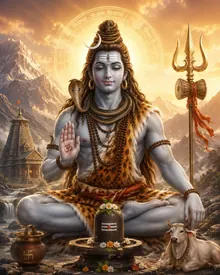
Shiv Aarti, also known by its opening line as "Om Jai Shiv Omkara," describes Lord Shiv as the supreme principle encompassing Brahma, Vishnu, and Sadashiv all at once. The composition opens with a refrain, continues through eight stanzas, repeats the refrain after each one, and closes with a stanza naming its composer.
This page presents the full text in clean Devanagari, with a simple meaning for every stanza. Text size can be adjusted, and the full reading can also be printed.
Benefits of Reciting the Shiv Aarti
It is believed that reciting this aarti daily with devotion removes fear and trouble and fulfils one's wishes; the aarti itself states that whoever sings it attains the fruit of their heart's desire.
About Swami Shivanand
In its final stanza, the composer identifies himself as 'Shivanand Swami', the very same signature found in the closing stanza of the Durga Aarti ('Jai Ambe Gauri'), suggesting both come from the same traditional author. Some sources instead credit Pandit Shraddha Ram Phillauri (composer of Om Jai Jagdish Hare), though his name appears nowhere in the aarti's own closing verse. There's no firm historical record of Shivanand Swami's life.
Frequently asked questions
Who composed the Shiv Aarti?
In its final stanza, the composer identifies himself as 'Shivanand Swami', though his historical identity is not firmly established. Some sources instead credit Pandit Shraddha Ram Phillauri.
Are the Shiv Aarti and "Om Jai Shiv Omkara" the same?
Yes, they're the same aarti, its formal name is Shiv Aarti, but it's also known by its opening line, "Om Jai Shiv Omkara."
What is the structure of the aarti?
It has one refrain and eight stanzas. The refrain is repeated after every stanza.
What's the difference between the Shiv Aarti and the Shiv Chalisa?
Both are dedicated to Lord Shiv, but the Chalisa is a longer, forty-verse hymn, while the Aarti is a shorter refrain-based hymn sung while offering the ceremonial lamp.
Is it necessary to know the meaning?
Not necessary, but reading it with the meaning makes the devotion clearer. This page includes a simple meaning alongside every stanza.
What are the benefits of reciting the Shiv Aarti?
It is believed that reciting this aarti daily with devotion removes fear and trouble and fulfils one's wishes; the aarti itself states that whoever sings it attains the fruit of their heart's desire.