 Astha SangrahASTHA SANGRAHhttps://asthasangrah.com
Shri Ganesh Aarti
Ganesh Aarti, Jai Ganesh Jai Ganesh Jai Ganesh Deva, is the most widely sung aarti to Lord Ganesh, believed to remove obstacles and bring prosperity, presented here in full with a simple meaning for every line.
Reading details
जय गणेश जय गणेश,
जय गणेश देवा।
माता जाकी पार्वती,
पिता महादेवा॥
Jai Ganesh jai Ganesh, jai Ganesh deva. Mata jaki Parvati, pita Mahadeva.
एक दंत दयावंत, चार भुजा धारी।
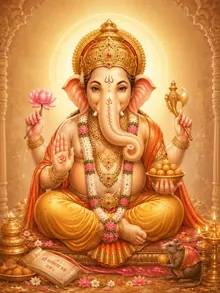
माथे सिंदूर सोहे, मूसे की सवारी॥
Ek dant dayavant, chaar bhuja dhaari. Maathe sindoor sohe, moose ki savaari.
पान चढ़े फूल चढ़े, और चढ़े मेवा।
लड्डुअन का भोग लगे, संत करें सेवा॥
Paan chadhe phool chadhe, aur chadhe mewa. Laddu-an ka bhog lage, sant karein seva.
अंधन को आंख देत, कोढ़िन को काया।
बांझन को पुत्र देत, निर्धन को माया॥
Andhan ko aankh det, kodhin ko kaaya. Baanjhan ko putra det, nirdhan ko maaya.
'सूर' श्याम शरण आए, सफल कीजे सेवा।
'Sur' Shyam sharan aaye, safal kije seva.
दीनन की लाज रखो, शंभु सुतवारी।
कामना को पूर्ण करो, जाऊं बलिहारी॥
Deenan ki laaj rakho, Shambhu sutavaari. Kamana ko poorna karo, jaaun balihari.
For a vrat, some devotees read it several times in one sitting: 11, 21, or 108. Save your reading count with this counter.
How to Read Shri Ganesh Aarti
Read it in the evening on a Wednesday or Sankashti Chaturthi, with a lamp lit. Repeat the refrain, 'Jai Ganesh jai Ganesh,' after every stanza and again at the very end.
About Shri Ganesh Aarti
Jai Ganesh Jai Ganesh Jai Ganesh Deva is the most widely sung aarti to Lord Ganesh, describing his form, a single tusk, four arms, a vermilion mark, and his mouse mount, along with the offerings made to him and the blessings his grace grants. The composition opens with a refrain, continues through five stanzas, and repeats the refrain after each one.
This page presents the full text in clean Devanagari, with a simple meaning for every stanza. Text size can be adjusted, and the full reading can also be printed.
No composer names himself within the aarti, so it's considered a traditional composition of unknown authorship. Some versions include the name 'Sur' in one stanza, as devotional verse often does, but this doesn't conclusively establish a specific poet as its author. It describes Lord Ganesh's form, the offerings made to him, and the blessings his grace grants. The aarti is sung daily by Ganesh's devotees, and especially on Wednesdays and Sankashti Chaturthi.
Benefits of Reciting the Ganesh Aarti
It is believed that reciting this aarti daily with devotion removes all obstacles from one's life and brings happiness, prosperity, and success; reciting it especially on Wednesdays and Sankashti Chaturthi is considered particularly beneficial.
Frequently asked questions
Who composed the Ganesh Aarti?
No composer names himself within the text, so it's considered a traditional composition of unknown authorship.
What is the structure of the aarti?
It has one refrain and five stanzas. The refrain is repeated after every stanza.
What is the best day and time to read it?
Singing it in the evening, with a lamp lit, on a Wednesday or Sankashti Chaturthi is considered ideal.
Is it necessary to know the meaning?
Not necessary, but reading it with the meaning makes the devotion clearer. This page includes a simple meaning alongside every stanza.
What are the benefits of the Ganesh Aarti?
It is believed that reciting this aarti daily with devotion removes all obstacles from one's life and brings happiness, prosperity, and success; reciting it especially on Wednesdays and Sankashti Chaturthi is considered particularly beneficial.