 Astha SangrahASTHA SANGRAHhttps://asthasangrah.com
Shri Durga Aarti
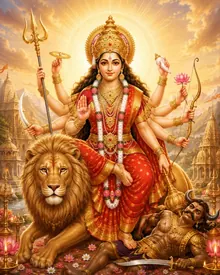
Durga Aarti, Jai Ambe Gauri, is the most widely sung aarti to Maa Durga, believed to remove fear and negativity and bring happiness and prosperity, presented here in full with a simple meaning for every line.
Reading details
जय अम्बे गौरी, मैया जय श्यामा गौरी।
तुमको निशदिन ध्यावत, हरि ब्रह्मा शिवरी॥
Jai Ambe Gauri, maiya jai Shyama Gauri. Tumko nishadin dhyavat, Hari Brahma Shivari.
मांग सिंदूर विराजत, टीको मृगमद को।
उज्ज्वल से दोउ नैना, चंद्रवदन नीको॥
Maang sindoor virajat, tiko mrigmad ko. Ujjwal se dou naina, chandravadan neeko.
कनक समान कलेवर, रक्तांबर राजे।
रक्तपुष्प गल माला, कंठन पर साजे॥
Kanak saman kalevar, raktambar raje. Raktapushp gal mala, kanthan par saje.
केहरि वाहन राजत, खड्ग खप्पर धारी।
सुर-नर-मुनिजन सेवत, तिनके दुःखहारी॥
Kehari vahan rajat, khadg khappar dhari. Sur-nar-munijan sevat, tinke dukh-hari.
कानन कुंडल शोभित, नासाग्रे मोती।
कोटिक चंद्र दिवाकर, राजत सम ज्योति॥
Kanan kundal shobhit, nasagre moti. Kotik chandra divakar, rajat sam jyoti.
शुंभ-निशुंभ बिदारे, महिषासुर घाती।
धूम्र विलोचन नैना, निसदिन मदमाती॥
Shumbh-Nishumbh bidare, Mahishasur ghati. Dhoomra vilochan naina, nisadin madmati.
चंड-मुंड संहारे, शोणित बीज हरे।
मधु-कैटभ दोउ मारे, सुर भय दूर करे॥
Chand-Mund sanhare, shonit beej hare. Madhu-Kaitabh dou mare, sur bhay door kare.
ब्रह्माणी, रुद्राणी, तुम कमला रानी।
आगम निगम बखानी, तुम शिव पटरानी॥
Brahmani, Rudrani, tum Kamla rani. Aagam nigam bakhani, tum Shiv patrani.
चौंसठ योगिनि मंगल गावत, नृत्य करत भैरू।
बाजत ताल मृदंगा, अरू बाजत डमरू॥
Chaunsath yogini mangal gavat, nritya karat Bhairu. Baajat taal mridanga, aru baajat damru.
तुम ही जग की माता, तुम ही हो भरता।
भक्तन की दुःख हरता, सुख संपत्ति करता॥
Tum hi jag ki mata, tum hi ho bharta. Bhaktan ki dukh harta, sukh sampatti karta.
भुजा चार अति शोभित, खड्ग खप्पर धारी।
मनवांछित फल पावत, सेवत नर-नारी॥
Bhuja char ati shobhit, khadg khappar dhari. Manvanchhit fal pavat, sevat nar-nari.
कंचन थार विराजत, अगर कपूर की बाती।
श्री मालकेतु में राजत, कोटि रतन ज्योति॥
Kanchan thaar virajat, agar kapoor ki baati. Shri Malketu mein rajat, koti ratan jyoti.
श्री अम्बेजी की आरती, जो कोई नर गावे।
कहत शिवानंद स्वामी, सुख संपत्ति पावे॥
Shri Ambeji ki aarti, jo koi nar gave. Kahat Shivanand Swami, sukh sampatti pave.
For a vrat, some devotees read it several times in one sitting: 11, 21, or 108. Save your reading count with this counter.
How to Read Shri Durga Aarti
Read it on Tuesdays, Fridays, or during Navratri, with a lamp lit. Repeat the refrain, 'Jai Ambe Gauri,' after every stanza.
About Shri Durga Aarti
Durga Aarti, also known by its opening line as "Jai Ambe Gauri," describes Maa Durga's form, her weapons, and her victories over the demons Shumbh-Nishumbh, Mahishasur, Chand-Mund, Raktabeej, and Madhu-Kaitabh. The composition opens with a refrain, continues through twelve stanzas, repeats the refrain after each one, and closes with a stanza naming its composer.
This page presents the full text in clean Devanagari, with a simple meaning for every stanza. Text size can be adjusted, and the full reading can also be printed.
Benefits of Reciting the Durga Aarti
It is believed that reciting this aarti daily with devotion destroys fear and negative energies and grants happiness, prosperity, and one's heart's desire; reciting it especially during Navratri and on Tuesdays and Fridays is considered particularly beneficial.
About Swami Shivanand
In its final stanza, the composer identifies himself as 'Shivanand Swami', though there's no firm historical record confirming his identity, the name has been associated with more than one saint. This is the most widely sung aarti to Maa Durga (Amba), performed during Navratri, Durga Puja, and virtually every ritual devoted to the Goddess.
Frequently asked questions
Who composed the Durga Aarti?
In its final stanza, the composer identifies himself as 'Shivanand Swami', though his historical identity is not firmly established.
Are the Durga Aarti and "Jai Ambe Gauri" the same?
Yes, they're the same aarti, its formal name is Durga Aarti, but it's also known by its opening line, "Jai Ambe Gauri, Maiya Jai Shyama Gauri."
What is the structure of the aarti?
It has one refrain and twelve stanzas. The refrain is repeated after every stanza.
What's the difference between the Durga Aarti and the Durga Chalisa?
Both are dedicated to Maa Durga, but the Chalisa is a longer, forty-verse hymn, while the Aarti is a shorter refrain-based hymn sung while offering the ceremonial lamp.
Is it necessary to know the meaning?
Not necessary, but reading it with the meaning makes the devotion clearer. This page includes a simple meaning alongside every stanza.
What are the benefits of the Durga Aarti?
It is believed that reciting this aarti daily with devotion destroys fear and negative energies and grants happiness, prosperity, and one's heart's desire; reciting it especially during Navratri and on Tuesdays and Fridays is considered particularly beneficial.