 Astha SangrahASTHA SANGRAHhttps://asthasangrah.com
Maha Shivratri Vrat Katha
Maha Shivratri Vrat Katha is the story of the hunter Chitrabhanu, who unknowingly worshipped Lord Shiva while seated in a bel tree, recited on Phalguna Krishna Chaturdashi, presented here in full.
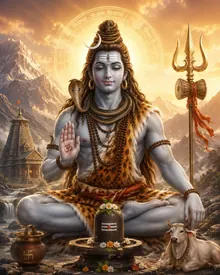
Chapter 1 · The Hunter Chitrabhanu's Predicament
There once lived a hunter named Chitrabhanu, who killed wild animals for a living. He owed money to a moneylender, and when he failed to repay it in time, the enraged lender seized him and locked him up in a Shiva monastery, as it happened, that very day was Shivratri.
During his time in captivity, the hunter kept overhearing discourses on Shiva and an account of the Shivratri vow. Come evening, the moneylender arrived to press his demand once more, and the hunter swore to repay the entire sum by the next day. The moneylender accepted this and set him free. No sooner was he released than the hunter headed into the forest in search of game, though a whole day's confinement had left him weak with hunger and thirst.
As dusk fell, he reached a pond and climbed a tree standing by its bank, hoping some animal or other would surely come there at night to drink. That tree was a bel tree, and right at its base lay a Shivling hidden beneath a covering of dried bel leaves, of which the hunter had no idea at all. Worn out with hunger and thirst, he settled onto a platform built among its branches.
The twigs he snapped off while building his platform happened to fall directly onto the Shivling below, and so, without his knowing it at all, the hungry, thirsty hunter's fast and the offering of bel leaves upon the Shivling both proceeded together.
As the first prahar of the night drew to a close, a pregnant doe came to the pond to drink. The very instant the hunter fitted an arrow and drew his bowstring, the motion sent a few bel leaves and drops of water scattering down onto the Shivling, and so, quite without his knowledge, his worship for the first prahar was complete.
The doe pleaded, I am with child and will give birth very soon; killing me would take not one life but two, and that would not be right. Once I have given birth, I shall come back to you myself, and you may kill me then. The hunter slackened his bowstring, and the doe vanished into the bushes.
Chapter 2 · The Test of the Does and the Stag
A little while later, a second doe happened to pass that way, and the hunter could hardly contain his delight. As she drew near, he raised his bow once more, and again the disturbance sent bel leaves falling onto the Shivling below, so that his worship for the second prahar too was completed without his knowing it.
Seeing this, the doe too spoke humbly, I have only just come out of my season, and I wander now in search of my mate, longing for him; once I have found him, I shall return to you at once. The hunter let her go as well.
Having lost his prey twice over, he grew inwardly restless. The last prahar of the night was passing when yet another doe came along that path with her little fawns. The hunter had already drawn his bow when the doe spoke up, grant me only enough time to hand these little ones over to their father; do not kill me just yet.
The hunter laughed and said: I am not fool enough to let go the game already in my grasp; I have missed my mark twice already, and at home my own children must be wailing with hunger. To this the doe replied: the love you feel for your children, I feel just the same for mine; it is only for their sake that I ask this brief reprieve. Trust me, the moment I have left them with their father, I shall return. Moved by her humble plea, the hunter's heart softened, and he let this one go too.
With no catch to show for it, the hunter sat idly plucking bel leaves and letting them fall, and so his worship for the third prahar too came to be completed on its own.
As dawn was about to break, a powerfully built stag appeared on that same path, and the hunter resolved that this time the prey would not escape him. Seeing the bowstring drawn taut, the stag spoke with humility, friend, if you have already killed the three does and their fawns who came before me, then kill me too right now, so that I need not bear even a moment's grief at their loss. I am their mate; and if instead you spared their lives, then grant me too a little more time, I shall find them and come straight back before you.
The hunter told him the whole matter. The stag then said: the promise on which my three wives have gone cannot be honoured while I remain unable to help them; so, just as you trusted them and let them go, let me go too, I shall bring them all back with me very soon.
Chapter 3 · The Change of Heart and Lord Shiva's Boon
By now, the fast, the night-long vigil, and the bel leaves unwittingly offered upon the Shivling had washed away the violence in the hunter's heart, and a divine awareness had stirred within him. The bow and arrow slipped from his hands on their own, and he let the stag go too. Within moments, the stag returned with his entire family, all three does and their fawns, and stood before the hunter, ready for him to kill them all if he wished.
But at the sight of such faithfulness, simplicity, and mutual love among these wild creatures, the hunter's heart filled with remorse, and tears began to flow from his eyes. He granted the whole family their lives, and in that very moment his once-hardened mind turned gentle and compassionate forever.
The gods in heaven had been watching all this unfold. Pleased by the hunter's change of heart, Lord Shankar appeared before him at once in his own divine form, blessed him with happiness and prosperity, and gave him the name 'Guh'. It was this same Guh who, in time, became the close friend of Lord Shri Ram.
How to Read Maha Shivratri Vrat Katha
On Maha Shivratri, observe a day-long fast, and at night, across four prahars, bathe the Shivling with water, milk, curd, honey, and ghee, offering bel leaves. Keep a night-long vigil, chanting 'Om Namah Shivaya' and listening to the story of Shiva, and break the fast the next morning after bathing in the Brahma Muhurat.
About Maha Shivratri Vrat Katha
The Maha Shivratri Vrat Katha is the story of the hunter Chitrabhanu, who, after being freed from captivity for debt, spent a night in a bel tree in search of prey, and unknowingly worshipped Lord Shiva through fasting, a night vigil, and the offering of bel leaves. This page has three chapters, the first covers his predicament and his encounter with the first doe, the second the test posed by the remaining does and the stag, and the third his change of heart and Lord Shiva's boon.
This vow is observed on Phalguna Krishna Chaturdashi for the worship of Lord Shiva. This page presents the full text of all three chapters in plain Hindi, with adjustable text size and print support.
The Maha Shivratri Vrat Katha has no single named author. It is traditionally presented as the story of the hunter Chitrabhanu's unintentional worship of Shiva, and is conventionally linked to the Shiv Purana. The story given here follows the events, characters, and sequence of this widely circulated account, but its wording has been composed independently, so that it is not a word-for-word copy of any single website's or publication's text. Other printed and popular versions may give the hunter's name and details with slight variation.
Frequently asked questions
How many chapters does the Maha Shivratri Vrat Katha have?
It has three chapters in total, traditionally read or heard together as one complete text.
How did the hunter Chitrabhanu unknowingly worship Shiva?
Distraught with hunger and thirst, the hunter sat all night in a bel tree, beneath which lay a hidden Shivling. As he drew his bow and broke off leaves, water and bel leaves kept falling upon the Shivling by coincidence, completing his worship across all four prahars without his knowledge.
What name did the hunter Chitrabhanu ultimately receive?
Pleased by his compassion in sparing the deer family, Lord Shiva gave him the name 'Guh', this was the same Guh who later formed a friendship with Lord Shri Ram.
What is the main teaching of the Maha Shivratri Vrat Katha?
This story teaches that Lord Shiva's grace can be attained even through unintentional worship and an act of compassion, and that a true change of heart can soften even the most hardened of hearts.