 Astha SangrahASTHA SANGRAHhttps://asthasangrah.com
Shri Solah Somvar Vrat Katha
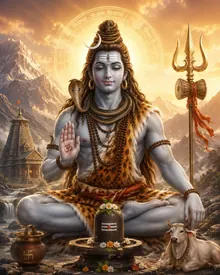
Solah Somvar Vrat Katha, also known as the Shiv Manasa Vrat Katha, is a chain story that begins with a cursed temple priest and passes through Parvati, Swami Kartikeya, a Brahmin, and finally a king and queen, recited alongside the sixteen-Monday vow, presented here in full.
Chapter 1 · The Dice Game at Amravati and the Curse on Gurav
Once, the great sage Sutaji Maharaj said to the sages Shaunaka and the others that in the land of Vidarbha there is a most beautiful city named Amravati, where a vast and most delightful temple of the god of gods, Lord Mahadev, stands, whose glory is renowned across nearly all three worlds. There, once, the ever-content Lord Shiva, together with Parvati, roaming from Kailash, suddenly arrived, and seeing that sacred, enchanting place, Parvati said to Shiva, 'My lord, here we should set out the chaupar board and dice and play.' Hearing this, Shiva at once had his attendants bring the chaupar board and dice, and the game began, and as they played, the goddess Parvati won the round of chaupar. Seeing this, Mahadev said, this round I have won. After this they began to play a second time, and still Parvati won.
Then Parvati asked the priest of that temple, named Gurav, who was nearby, 'Who has won this round this time, tell me truly, why do you sit silent?' Then the priest Gurav said, 'This round has been won by Shiva.' Hearing this, Uma, enraged, cursed the priest, that his entire body would become leprous, and this would happen without any delay at all, because he had spoken falsely. Having given Gurav this terrible curse, Shiva, together with Uma, departed for the abode of Kailash.
Chapter 2 · The Vow's Method from an Apsara, and Gurav's Cure
After this, when Gurav the priest looked at his own body, he found leprosy showing over his entire form from Sati's curse, and because of this terrible affliction he began to worry within himself, where should I go, to whom should I speak, what remedy should I seek. While Gurav was thus troubled and worrying within his own mind, an apsara came down from heaven to that temple, carrying materials of worship, to worship Pashupatinath, that is, Lord Mahadev, and as soon as she arrived at the temple she asked that greatly sorrowful priest Gurav how and why he had gotten this leprosy. Then Gurav, with great humility and courtesy, said that he was very frightened, and told her truthfully that Parvati had cursed him. 'O Mother, if there is any remedy, please tell me quickly,' saying this, sorrowful, Gurav fell at the apsara's feet.
Then the apsara said, 'Do not be afraid in any way, and with a pure heart and with faith and devotion, lovingly observe the sixteen-Monday Manasa Vrat, and by this your leprosy will be removed at once.' And that lovely one told him the vow's glory and its method, that on Mondays one should remain without food through the day, and then in the evening, at the pradosh hour, worship Shiva together with Parvati according to the scriptural rites, and chant the five-syllable great mantra (Om Namah Shivaya) as one is able, and also sing Shiva's praises. After that, one should take half a ser of good wheat flour, make three flatbreads without salt, roast them over the fire, mix in ghee and jaggery, and prepare a churma, dividing it into three portions, and, leaving a bilva leaf in each, offer it with faith and devotion as naivedya to Lord Bhavanishankar, the first portion should be offered at Shiva's water-vessel, the second portion distributed as prasad only to brahmachari boys, and the third portion the one observing the vow should eat themselves. In this way one should keep observing this sixteen-Monday Manasa Vrat lovingly, without a single break. When the seventeenth Monday comes, on that auspicious day, one must certainly perform the udyapan of this great vow, with the family, according to the rites and as one is able.
Saying this, the apsara worshipped Shankar and departed for the heavenly realm. After this, Gurav observed this vow with a truthful heart and with faith and devotion, and as soon as the vow was completed, that priest Gurav's leprosy was entirely removed by the power of this vow, and his body became as clear and clean as before, blessed indeed is that sixteen-Monday Manasa Vrat.
Chapter 3 · Parvati's Own Vow and Kartikeya's Return
After some days, Shiva and Parvati, roaming from Kailash, once again arrived one day near that same temple in the mortal world, and there Parvati recalled the curse she had once given Gurav, and seeing Gurav free of leprosy and in good health, Parvati asked, 'O Gurav, by what method and what remedy has your leprosy gone?' Then the priest Gurav, joining his hands, agitated, fell at her feet and said, 'O Mother, meditating on Lord Shankar who dwells at Kailash, I have observed the sixteen-Monday Manasa Vrat, and it is by the full grace of that very Bhavanishankar that all my affliction was removed, that lord's divine play is endless and boundless.' Saying this, choked with feeling, he began describing the vow's method from beginning to end. Hearing the vow's method and glory from the mouth of the priest Gurav in this way, Parvati, greatly astonished, said to herself that the glory of this vow is truly wondrous, and that she too would observe it lovingly with its full rites, because her son Swami Kartik, angry with her, had gone off alone into the forest. Wishing for his quick return, Parvati began the vow, and as soon as the vow was completed, Swami Kartik, while living in the forest, began to think to himself that it was not right to be angry with his mother, and, resolving this, at that very moment came back from the forest and offered full prostration at his mother's feet, and seeing her dear son Kartik Swami, Parvati could not contain her joy within her heart.
After this, Swami Kartik said to Mother Parvati, 'My mind did not wish to stay away from you even for a moment, but today suddenly a feeling arose within me that I ought to have your auspicious darshan at once, so, O Mother, what is the reason for this?' Hearing this, Girija said, 'O excellent son, I have observed the sixteen-Monday Manasa Vrat, and it is entirely the effect of that vow that a good feeling arose in your heart to meet me.' Kartik Swami listened to this account with great attention, and said, 'O Mother, I too wish to perform this excellent vow, please tell me its complete method from start to end, because I have a most dear Brahmin friend, Devmitra, who has gone off somewhere, I know not where, for a long time now, and I have a great longing to meet him.' Then Parvati told him the vow's method. After this, Swami Kartik too began observing the sixteen-Monday Manasa Vrat properly and with a devoted heart, and as soon as the vow was completed, that very day, roaming in a beautiful forest, Kartik Swami happened by chance to meet his dear friend, the Brahmin Devmitra. The two met each other with great affection, and after asking after each other's welfare, the Brahmin said, 'My friend, this chance meeting of yours and mine on the road is truly astonishing.' Then Swami Kartik said, 'Brother, I have performed a wondrous sixteen-Monday Manasa Vrat, this is the fruit of that very vow's glory.' Hearing this, that friend, astonished within himself, said to Kartik Swami, 'My friend, my wish is to make an excellent marriage, so please tell me too the method of this vow.'
Chapter 4 · Devmitra's Marriage and the Birth of a Son
Hearing this, Swami Kartik told his dear Brahmin friend the complete method. The Brahmin began the vow with faith, devotion, and love, and set out wandering through various lands. The workings of one's deeds are strange and deep indeed, as soon as the vow was completed, wandering about, the Brahmin one day came upon a beautiful city on the road, and, seeing its unmatched divine splendour, stopped there to rest. The king of that city was most devoted to righteousness, and he had a daughter, endowed with every virtue, well-mannered and exceedingly beautiful. O listeners, at that time the king had arranged a grand swayamvar festival for that daughter, and princes from many lands, and countless people of all eighteen varnas, had gathered there. The Brahmin too went to see that swayamvar. There the king had a beautiful female elephant fully adorned, and, placing a victory garland in her trunk, released her into the assembly, that elephant, wandering about, came to where the Brahmin stood, and as soon as she reached him, placed the victory garland around the Brahmin's neck, and lifted him onto her head. Seeing this, the king rejoiced greatly, and with delight had the marriage rite performed with the girl according to Vedic rites, and also gave the two of them a splendid mansion to live in, together with boundless wealth, grain, and ornaments. In this way the Brahmin, having obtained the beautiful princess, began to live his life in happiness.
One day the princess asked her husband, the Brahmin, 'My lord, what great merit did you perform, by whose power I came to you?' Hearing this, the Brahmin said, 'My beloved, meditating on the ever-content Lord Shankar, I observed the sixteen-Monday Manasa Vrat, and it is by the merit of that great vow that I obtained you as my wife.' Hearing this, the princess, astonished, said again and again, blessed, blessed, that this vow bears such fruit and is truly wondrous, and that she too would observe it with heartfelt faith and devotion, wishing for a long-lived son. Saying this, the king's wife began that vow, and as soon as the vow was completed, within a few days, by the boundless grace of Lord Shankar, the origin of all beings, a son was born to the princess, one destined to live a hundred years, well-mannered, learned, virtuous, mighty, devoted to serving his parents, obedient, and beautiful. The couple, describing to themselves the glory of this great vow of Shiva, and gazing again and again upon their son, were filled with great joy.
Chapter 5 · The Son Becomes King, and the Queen Breaks the Vow
In this way, when the Brahmin's son had grown a little, and within a short time, having studied, became accomplished in complete knowledge, one day he humbly joined his hands and asked his mother, 'O Mother, by the power of what merit and penance did I, endowed with every virtue, come to you?' Hearing this, his mother answered, 'O righteous son, I observed the excellent vow of Shiva, the sixteen-Monday Manasa Vrat, with devotion and a focused mind, by which the trident-bearer, Mahadev, was pleased and fulfilled our wish.' Hearing this, the son asked again with humility, 'O Mother, please tell me too the method of this most excellent vow, I too shall certainly observe it with a pure heart, for my wish is to obtain a vast kingdom, free of sorrows.' Then his mother told her dear son the complete method of that great vow from beginning to end, and the Brahmin's son then began observing this vow according to its rites. The vow had not even been completed when the king of a great land, who had reached extreme old age and had no son, only a daughter, announced throughout his whole kingdom that he would give his daughter, together with the kingdom, through a swayamvar. Hearing this, the Brahmin's son too went there, and at the swayamvar, by the grace of Lord Shankar who dwells at Kailash, that princess chose that Brahmin's son, endowed with every virtue, and the excellent king had the marriage rite performed with a grand festival according to Vedic rites, and, handing over the entire authority of the kingdom along with the kingdom itself, went off to the forest to perform penance.
Meanwhile, the Brahmin, now a king, by the power of the vow, was ruling righteously with his lawfully wedded queen, enjoying many happinesses, and at that same time, as the vow was nearing completion, and the seventeenth Monday arrived, on that auspicious day the king asked his beloved queen to gather all the materials, prepare a churma of five ser of wheat flour, and divide it into three equal portions, and set out with him for Lord Shankar's temple. The queen thought to herself, why is the king being so miserly, why does he not fill a plate with five ser of coins and go to the Shiva temple with that instead, resolving this firmly, the queen filled a plate with five ser of coins and, along with the other materials, sent it to the temple with the manservants and maidservants, and did not go herself with her husband for the worship of Shiva. Because of this the vow was broken, and Lord Shiva, enraged at that very moment, took the form of a yati, a staff-bearing ascetic, and came to the king, the Brahmin, and said, 'O king, your queen has broken the vow of Shiva, so cast her out of the royal palace at once, or else your entire kingdom will be ruined and come to terrible calamity.' While Shiva, in the form of the ascetic, was saying this to the king, the elder chief ministers spoke up in between, saying that this kingdom had been given by the queen's own father, and so it was entirely improper to banish the queen. Then Shiva, greatly enraged again, said, 'O foolish ministers, one who has broken Lord Shankar's vow should not be kept in the house any longer.' Then the king, weighing both sides, at that very moment cast the queen out of the royal palace, and the queen, greatly wretched and sorrowful, set out from there on foot alone.
Chapter 6 · The Queen's Exile and the Vow Fulfilled Again
Walking on and on, going a great distance, a village came into view, and the queen, going into that village, began living in the house of an old woman. The old woman, seeing the queen, was pleased and said, I entrust a task to you, here are some bundles of raw cotton, take these to the market and sell them. Hearing this, the queen happily took the cotton bundles and went to sell them at the market, but there, by Lord Shankar's wrath, such a terrible storm blew up at that very moment that all the cotton bundles blew away. The queen then came back and told the old woman, 'Mother, those cotton bundles all blew away in a strange wind that came up.' The old woman, hearing this astonishing account, said to the queen, 'Now leave my house at once.' The queen, leaving there, went and began living in the house of an oil-presser, where jars full of oil were kept, and as soon as the queen's gaze fell upon the oil, by Shiva's great wrath all the oil in the jars vanished at once. Seeing this, the oil-presser, astonished, said that this wretched woman lives in my house, and as soon as she looks at the oil-filled jars, all the oil in every one of them disappears, and so he said to the queen, 'Please leave my house, and go live somewhere else, for if you stay here I shall certainly become a beggar.' Saying this, the oil-presser too cast the queen out of his house. The queen, walking on from there, reached the bank of a river, and there, as soon as her gaze fell upon it, all the water of that river dried up at once, and the queen, greatly astonished within her heart, began to think that all this is the fruit of my own great sins.
After this, the queen, enduring many kinds of great troubles, wandered here and there through forest after forest, driven from place to place, and wandering thus, she suddenly saw a beautiful pond filled with clear water. The queen came near that pond, and as soon as her gaze fell upon the water, countless worms appeared in it, and seeing this she grew even more distressed. At that very moment some cowherd boys, grazing cows and calves, had come there to water them, and they too saw the countless worms within that water, and said to one another that this water should not be given to drink, and, saying this, went away with their animals unwatered. Just then a tapasvi, a Gusainji Maharaj, also came there to draw water, and he too witnessed this occurrence, and great compassion arose in him at the queen's state, and, filling his water vessel elsewhere, he brought the queen along with him to his ashram. Gusainji said to the queen, 'Daughter, you are like my own daughter, you shall lack nothing in food or clothing, stay here with a settled mind.' Hearing this, the queen began living at that holy man Gusainji's ashram, doing all the work of the ashram, but because she had broken the vow of Shiva, she bore many sorrows, for whatever food or drink she touched, worms would appear in that very thing. Seeing this, Gusainji became greatly troubled and astonished, and began to think what remedy should now be tried, what fault could lie upon this helpless, wretched, sorrowful woman, some remedy must be found quickly, by which all her faults and troubles might be removed. Resolving this firmly, Gusainji Maharaj at once began a fierce penance to Lord Shankar, and within a short time Bholenath was pleased, and, appearing in visible form, said, 'Ask for whatever boon is in your heart.' Then Gusainji fell at his feet, joined his hands, and prayed, 'Lord, what fault lies upon this unfortunate woman, and how may she be freed from it, Lord, please tell me this.' Then Shiva, compassionate to the humble, said, 'O ascetic, this queen has broken my sixteen-Monday Manasa Vrat, and it is from this very great fault that she has come to suffer many troubles and reached such a terrible state, if this queen, with heartfelt devotion, observes this, my most beloved sixteen-Monday Manasa Vrat, properly and without a single break, then, O holy one, only once the vow is completed will she be freed from all her faults and sorrows, and her own husband will himself come here and take her away at once, and she will obtain boundless happiness and comfort as before.' O listeners, having given this boon, Mahadev vanished from sight, back to the abode of Kailash.
After this, Gusainji Maharaj had the queen observe this sixteen-Monday Manasa Vrat properly, with unbroken faith and devotion, and as soon as this great vow was completed, all the queen's troubles were removed. By the power of this vow, meanwhile, after some days, the king one day began to think within himself that a search should be made for the queen somewhere, and resolving this, he at once called his messengers and sent them out in every direction, through many lands, to search for the queen. The messengers, searching and searching, at last arrived at the place where the queen was living at Gusainji's ashram, and the queen and the messengers recognised one another, and then the messengers went and told the king the queen's whole auspicious account from beginning to end. Hearing this news from the messengers, the king, greatly pleased, came to that forest with his chief minister and met Gusainji Maharaj, and made ready to take the queen back with him. At that time the king offered Gusainji cloth and other gifts, and humbly asked his forgiveness. Then Gusainji said to the king, 'O king, until today I have kept and raised this queen as my own daughter, now you take up her care.' Saying this, he was overcome, tears of affection falling, and at that time the king and queen offered full prostration at Gusainji Maharaj's feet, and, comforting him with sweet words, set out with the queen in their chariot for their own city, and all around the city, celebrations of joy began at every house. As soon as the king and queen arrived, many kinds of instruments began to play in the royal palace, and auspicious dance and song began, and the king held such a festival with great joy, and at that same time pleased the brahmins with food, gifts and offerings, and pleased guests and beggars with whatever gifts they desired, along with wealth and grain. In this way, at the reunion of the king and queen, all the subjects rejoiced greatly, and the king went on ruling without hindrance, righteously and wisely.
Sutaji Maharaj, telling this story to the sages Shaunaka and the others, went on to say that whoever on this earth observes this sixteen-Monday Manasa Vrat with faith, devotion, and according to its rites, upon that person the ever-content Lord Shiva will soon be pleased, and will remove all their sins, faults, poverty, illness, and every kind of trouble across their births, and whoever completes the vow with respect, for the sake of some wish, all their wishes shall be fulfilled, this is entirely true. O listeners, by observing this great vow of Shiva wholeheartedly and without a break, one gains boundless wealth and grain, sons and grandsons, daughters, fame, health, and long life, obtains many kinds of happiness in this world, and in the end attains the supreme abode, Shivlok, and whoever hears or recites this story with faith and a focused mind, upon them Uma and Mahesh shall always remain pleased.
How to Read Shri Solah Somvar Vrat Katha
Begin this vow on the first Monday of Shravan, Chaitra, Vaishakh, Kartik, or Margashirsh. Each Monday, stay without food through the day, and in the evening, at the pradosh hour, worship Shiva and Parvati, chant the five-syllable mantra (Om Namah Shivaya), and make a churma of wheat flour without salt, dividing it into three parts offered to Shiva, to brahmachari children, and to oneself. Once all sixteen Mondays are complete, perform the udyapan with full rites on the seventeenth Monday, and be present in person for the worship that day, since sending it by another is held to break the vow.
About Shri Solah Somvar Vrat Katha
The Solah Somvar Vrat Katha is a chain story told across six chapters. In the first chapter, during a dice game between Shiva and Parvati at the Amravati temple, the priest Gurav is cursed with leprosy for lying. In the second, an apsara teaches Gurav the method of the sixteen-Monday vow, curing him. In the third, Parvati herself performs the vow to call back her estranged son Kartikeya, and Kartikeya, performing it in turn, is reunited with his friend, the Brahmin Devmitra. In the fourth, Devmitra performs the vow and marries a princess, and a son is born to them. In the fifth, that son performs the vow and becomes a king, but on the seventeenth Monday his queen breaks the vow. In the sixth, the queen endures exile, completes the vow again, and is reunited with the king.
This vow is observed continuously for sixteen Mondays, with its udyapan performed on the seventeenth Monday. This page presents the full text of all six chapters in plain Hindi, with adjustable text size and print support.
About Compiled by: Pt. Siddhanath Sharma Shastri
The Solah Somvar Vrat Katha, also known as the Shiv-Manasa Vrat Katha, is traditionally presented as the story Sutaji narrated to the sages Shaunaka and others, and is conventionally linked to the Bhavishya Purana. The text presented here is a faithful transcription of the Hindi booklet 'Solah Somvar Vrat Katha, that is, Shiv Manasa Vrat Katha', compiled by Pt. Siddhanath Sharma Shastri and published by the respected Mumbai publisher Khemraj Shrikrishnadass (Shri Venkateshwar Press), with only clear printing errors corrected and no change made to the story itself. The Shiva hymns and mantras given at the start of the booklet are not included here, only the story portion is presented in translation. Other printed editions may use different wording.
Frequently asked questions
How many chapters does the Solah Somvar Vrat Katha have?
It has six chapters in total, traditionally read or heard together as one complete text.
How long does the Solah Somvar Vrat last?
This vow continues for sixteen consecutive Mondays, with its udyapan performed on the seventeenth Monday.
Are the Solah Somvar Vrat Katha and the Somvar Vrat Katha the same story?
No, these are two separate stories. The ordinary weekly Monday vow has its own, different story, available on the 'Somvar Vrat Katha' page, while this is a separate, longer chain story specifically associated with the sixteen-Monday vow.
Why was the queen banished from the kingdom in the story?
As the story's fifth chapter describes, on the seventeenth Monday's udyapan the queen sends only the offerings rather than going to the temple herself, which breaks the vow, and Lord Shiva, taking the form of an ascetic, orders the king to banish her from the kingdom.
What should be done at the udyapan of the Solah Somvar Vrat?
As described in the puja vidhi, on the seventeenth Monday a churma of five ser of wheat flour should be prepared, and the udyapan should be performed in person, with proper worship and havan of Lord Shiva.