
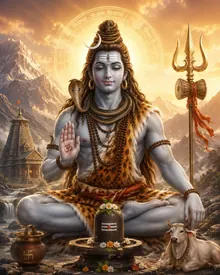
Chapter 1 · The Boon of a Son
There was a very wealthy merchant, whose house lacked nothing at all in wealth, but he carried one sorrow, that he had no son. He remained troubled by this worry night and day, and for the wish of a son he observed Shiva's vow and worship every Monday, and in the evening would go to the Shiva temple and light a lamp before Shiva's holy image. Seeing his devotion, Parvati once said to Lord Shiva, 'My lord, this merchant is your devoted follower and always performs your vow and worship with great faith, his wish ought to be fulfilled.' Shiva said, 'O Parvati, this world is a field of action, just as a farmer reaps whatever seed he sows in his field, so too in this world one reaps whatever deeds one does.' Parvati insisted most earnestly, 'My lord, since he is your devoted follower, and if he has some sorrow, it must surely be removed, for you are always compassionate toward your devotees and remove their sorrows, if you do not do this, why would people serve and observe your vow at all?'
Seeing Parvati's such insistence, Shiva said, 'O Parvati, he has no son, and this very worry keeps him greatly sorrowful, even though it is not in his fate to have a son, I grant him the boon of obtaining a son, but this son will live only until the age of twelve years, after which he shall meet death, more than this I cannot do for him.' The merchant was hearing all of this, and it brought him neither much joy nor much sorrow, and he went on observing Shiva's vow and worship just as before. After some time had passed, the merchant's wife conceived, and in the tenth month a very beautiful son was born from her womb. Great joy was celebrated in the merchant's house, but the merchant, knowing his son's age would be only twelve years, did not show much joy, nor did he tell anyone the secret.
Chapter 2 · The Journey to Kashi and the Disguised Marriage
When the boy turned eleven years old, his mother spoke to his father about his marriage, but the merchant said, 'I shall not have him married yet, I will send my son to study at Kashi.' The merchant then called his brother-in-law, that is, the boy's maternal uncle, gave him a great deal of money, and said, 'Take the boy to Kashi to study, and wherever you stop along the way, perform yagnas and feed the brahmins.' The uncle and nephew went along performing yagnas and feeding brahmins. On the way they came to a city, where the king's daughter was to be married, and the other king's son, who had come with the wedding procession to be married, was blind in one eye. His father was greatly worried that the bride's parents might see the groom and raise some objection to the marriage. So when he saw this very handsome son of the merchant, he thought to himself, why not have this boy stand in as the groom at the door-ceremony? Thinking this, the groom's father spoke to the boy and his uncle, and they agreed. Then they dressed the boy in the groom's clothes, seated him on the mare, and took him to the door, and the whole ceremony was completed happily.
Then the groom's parents thought, if the marriage rites too were performed by this same boy, what harm would there be? Thinking this, they said to the boy and his uncle, 'If you would also perform the rounds of the fire and the giving away of the bride, it would be a great kindness of yours, and I shall give you a great deal of money in return,' and they agreed, and the marriage rites too were completed very well. But just as the boy was about to leave, he wrote on the end of the princess's veil that her marriage had indeed taken place with him, but the prince she would be sent away with was blind in one eye, and that he himself was going to study at Kashi. After the boy had gone, when the princess found this written on her veil, she refused to go with the prince, and said, 'This is not my husband, my marriage did not take place with him, he has gone to study at Kashi.' The princess's parents did not send their daughter away, and the wedding procession went back empty-handed.
Chapter 3 · Death at Kashi, Revival, and the Return Home
Meanwhile, the merchant's boy and his uncle reached Kashi, and there they began performing yagnas, and the boy began his studies. When the boy turned twelve years of age, on that very day they had arranged a yagna, and the boy said to his uncle, 'Uncle, I am not feeling quite well today.' The uncle said, 'Go inside and sleep.' The boy went inside and slept, and within a short while his life left him. When his uncle came and looked, he found him lying dead, and this brought him great sorrow, and he thought that if he raised a cry of mourning right then, the work of the yagna would remain unfinished, so he quickly finished the yagna, and once the brahmins had left, he began to weep and mourn. By chance, Shiva and Parvati happened to be passing that way at that very moment, and when they heard the sound of loud weeping, Parvati said, 'My lord, someone sorrowful is weeping, remove their trouble.' When Shiva and Parvati went near and looked, they found a boy lying dead there. Parvati said, 'My lord, this is that very merchant's son who was born by your boon.' Shiva said, 'O Parvati, his allotted years were only this many, and he has now lived them out.' Then Parvati said, 'My lord, give this boy more years of life, or else his parents will die writhing in grief.' At Parvati's repeated insistence, Shiva granted him the boon of life, and by Shiva's grace the boy came back to life, and Shiva and Parvati went on to Mount Kailash.
Then the boy and his uncle, performing yagnas and feeding brahmins just as before, set out toward their home. On the way they came to that same city where his marriage had taken place, and there they began a yagna, and the boy's father-in-law recognised him, and took him into his palace and treated him with great honour, and with many manservants and maidservants sent off his daughter and son-in-law with due respect. When they drew near their own city, the uncle said that he would go ahead to their home and give the news. When the boy's uncle reached home, the boy's parents were sitting on the roof of the house, having made a vow that if their son returned safely, they would come down gladly, but otherwise would throw themselves from the roof and give up their lives. Just then the boy's uncle arrived and gave the news that their son had returned, but they could not believe it, so the uncle swore an oath that their son had come with his wife and a great deal of wealth, and then the merchant welcomed him with joy, and they lived on in great happiness. In just this way, whoever observes the Monday vow, or reads or recites this story, has all their wishes fulfilled.
How to Read Shri Somvar Vrat Katha
The Monday vow is generally observed until the third watch of the day. It has no special rule about fruit-only meals or a full fast, but one should eat only once in a day and night. Shiva and Parvati should be worshipped during this vow, and the story should be heard after the worship. There are three kinds of Monday vow, the ordinary weekly Monday, the Saumya Pradosh, and the Solah Somvar, the method is the same for all three.
About Shri Somvar Vrat Katha
The Somvar Vrat Katha is the story of a wealthy but childless merchant and his son, born by Lord Shiva's boon, told across three chapters. In the first chapter, pleased by the merchant's devotion, Shiva grants him a son whose life will last only twelve years. In the second, the merchant's son, on his way to study at Kashi, is made to stand in as the groom in a disguised marriage, and leaves the truth written on the princess's veil. In the third, as his twelfth year is completed, he dies at Kashi, Parvati pleads with Shiva to revive him, and he returns home with his wife to be reunited with his parents.
This vow is observed especially on Mondays, seeking Lord Shiva's grace and the fulfilment of one's wishes. This page presents the full text of all three chapters in plain Hindi, with adjustable text size and print support.
The Somvar Vrat Katha has no named author. It is a folk story that circulates both orally and in print alongside the Monday vow, part of the tradition of weekday vrat kathas. The text presented here is a faithful transcription of the Somvar Vrat Katha as printed in a published Hindi vrat-katha collection booklet, with only clear printing errors corrected and no change made to the story itself. Since this story has no single ancient original text, other printed editions may use different wording. The separate, longer story specifically associated with the sixteen-Monday vow is not on this page, it is given on the 'Solah Somvar Vrat Katha' page.
Frequently asked questions
How many chapters does the Somvar Vrat Katha have?
It has three chapters in total, traditionally read or heard together as one complete text.
When is the Somvar Vrat observed?
This vow is observed on every Monday, with only one meal taken during the day.
How many kinds of Somvar Vrat are there?
As described in the puja vidhi, there are three kinds of Somvar Vrat, the ordinary weekly Monday, the Saumya Pradosh, and the Solah Somvar, the method is the same for all three.
Are the Somvar Vrat Katha and the Solah Somvar Vrat Katha the same story?
No, these are two separate stories. A different, longer story is specifically associated with the sixteen-Monday vow, available on the 'Solah Somvar Vrat Katha' page.
Why was the merchant's son's life limited in the Somvar Vrat Katha?
As the story's first chapter explains, a son was not in the merchant's fate at all, so Shiva, at Parvati's insistence, granted him one only as a special boon, with a life limited to twelve years.