
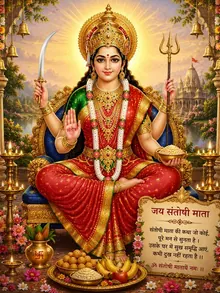
Chapter 1 · Ganga's Neglect in the Household
There was a village named Shrirangpur. An old woman lived there, who had seven sons. The old woman had gotten all of them married, daughters-in-law had come into the house, and because of this the old woman's home felt full and lively. A mother should hold the same affection for all her sons, all the boys should be equal to her, but this old woman held greater affection for her six elder sons, and held not the slightest affection for the seventh, treating him as though he were a stepson. When the cooking was ready, the old woman would seat the six elder sons to eat first, feed them well, and then gather up whatever leftovers remained on their plates onto one plate and give that to the youngest son to eat. The youngest son, Gordhan, did not know this, so whatever his mother gave him, he ate happily. But that youngest son's wife, Ganga, was sharp-eyed. She observed this discrimination by the old woman for many days, and then her heart grew very troubled, this is a very wicked thing, to treat one's own born son this way?
One day, finding the right moment, she said this to her husband: 'If I tell you something, you won't be angry with me, will you?' Gordhan said, 'No, I won't be angry over the truth, tell me, what is it?' She said, 'Your mother feeds you your brothers' leftovers every single day, do you know this? How long will you go on being so innocent? How can one stay even a moment where there is such discrimination?' Gordhan said, 'I cannot accept this.' She said, 'If that's so, tomorrow I shall show you with your own eyes, then you will believe it, won't you?' The next day, the old woman seated her six elder sons to eat in the kitchen, and the youngest son hid behind the door of the adjoining room and watched the kitchen. That day kheer had been made, so the old woman fondly fed it to all six sons. After they had eaten, she gathered up the leftover bits from their plates onto one plate. Seeing all this, the youngest son understood that his wife's words were true, now mother will call me to eat, and if this same plate is placed before me, then I shall not eat, deciding this, he went into the other room. At that very moment the old woman called out, 'Son Gordhan, come eat, the plate is served.' Gordhan came into the kitchen. He was very angry at his mother, but so that his mother's heart would not be hurt, he stayed composed. 'Son, why are you standing, sit down to eat,' the old woman said, feigning affection. 'Mother, my stomach hurts today, so I won't eat anything.' Saying this, Gordhan went to his wife Ganga and said, 'What you said is true, I should not stay in this house any longer, where there is no respect, even a morsel of gold is worthless. I shall set out from here this very day to another place to try my fortune.' At that same moment the old woman called out to Ganga and said, 'Daughter-in-law, talk less, there are many days ahead yet, first go plaster the cow-dung.' Ganga went at once to the yard behind the house and began plastering cow-dung cakes.
Meanwhile, that youngest son Gordhan dressed and made ready to go to another village. He felt no need to take anyone in the house's leave, for he had already seen just how much sweetness there was in these family ties. He went out through the back door into the yard, and seeing Ganga plastering cow-dung cakes, stopped and said, 'I am going now, you spend your days here through joy and sorrow, and when I am settled somewhere I shall come back for you,' and as he said this, tears welled up in his eyes. Ganga said through her sobs, 'Without you I shall have no peace, I shall have sorrow here, and then before whom shall I lighten my heart's burden? Still, go with a glad heart, but do not forget me after you go.' Gordhan drew a gold ring shaped like a betel leaf off his finger and put it onto Ganga's finger, and said, 'Keep this token of mine with you, it will keep you from feeling alone, now you too give some token from your side.' 'Here is my token,' said Ganga, and pressed the mark of her cow-dung-smeared hand onto the back of Gordhan's kurta, and Gordhan set off from there with a heavy heart.
Chapter 2 · Gordhan's Journey Abroad and Ganga Learns of the Vow
The next day, by noon, Gordhan arrived in a town named Madhavpur. He looked for work there and found employment with a merchant Seth. Food, drink, and lodging were provided at the Seth's own house, so Gordhan had no worries. Every day he went to the shop first thing in the morning, and in the evening went to the Seth's house to eat after everyone else. He was skilled at every task, and also at keeping the ledger accounts, so within a short time the Seth made him his accountant and entrusted him with the entire management. Time too began to flow like the current of water, and meanwhile the merchant Seth handed the whole shop over to Gordhan and set out on pilgrimage. He had earned a great deal of wealth, now he had set out to earn merit, truly, it is the merit one has earned that goes along with a person, money never goes along at all.
Meanwhile, in Shrirangpur, Gordhan's wife Ganga was sunk in sorrow. With her husband away from the house, the old woman had loaded all the housework onto her alone. She did all the work of the whole house, and in return received coarse bran-flour bread, half-cooked, and water to drink from a broken coconut shell, and she bore such hardship silently. One day Ganga was drawing water at the well outside the village, when she saw some women standing with plates in their hands. Ganga understood that they must be observing some vow. She left her water pot right there and went up to them and asked, 'Sister, it seems to me you are observing some vow, I too wish to observe a vow, tell me which vow you are observing.' One good-natured woman said, 'Sister, we are observing the vow of Santoshi Maa. This vow is so simple and plain that even a poor woman or man can observe it at little expense.' Ganga said, 'Sister, then the glory of such a vow must be great, tell me what benefit comes from observing this vow.' That good woman said, 'Sister, the effect of Santoshi Maa's vow is beyond words, whatever anyone's wish, Santoshi Maa fulfills it. The poor obtain wealth, the unemployed obtain work, the sick are freed of their illness, a family's suffering is removed, a childless home's cradle comes to be tied, an unmarried girl obtains the husband she desires, separated loved ones are reunited, such are the many benefits within Santoshi Mata's vow.' Ganga said, 'Sister, my husband has been away earning a living for a long time now, but there is no news from him at all, and this troubles me greatly. Sister, my sorrow has no end, will observing this vow bring me news of him?' The good woman said, 'Sister, you too begin Santoshi Maa's vow, and within a short time you will get news from your husband, and little by little your sorrow will begin to lessen.'
A strong desire arose in Ganga's heart to observe Santoshi Maa's vow, but she did not know the method by which this vow should be performed, and a vow does not bear fruit without its complete method. So she asked that good woman, 'Sister, I have taken up much of your time talking, now tell me the method of Santoshi Maa's vow, so that I may begin the vow.' The good woman said, 'Sister, this vow may be done at home or outdoors in a peaceful setting, and it may be begun on any Friday. Wherever it is comfortable to sit, light a ghee lamp there, place a water-filled kalash before it, and on top of the kalash place a bowl with jaggery and roasted chickpeas in it. Then, sitting there with a focused mind, one should tell or listen to the story of Santoshi Maa, and once the story is complete, perform Maa's aarti, and after that distribute the jaggery and chickpeas from the bowl as prasad to everyone nearby, young and old. Anyone can offer devotion to Santoshi Maa according to their own means, if one can afford it, one should distribute a sava-panch ser of jaggery and chickpeas, and if one's means are modest, even a sava-panch anna's worth may be distributed.' Ganga asked in between, 'What in particular should be kept in mind during Santoshi Maa's vow?' The good woman said, 'One should remain hungry and tell or listen to Santoshi Maa's story, and only after that may one eat. If the vow is observed this way, properly, every Friday, its fruit is certain to come, if Santoshi Maa is gracious, the fruit may come even within three days, within three weeks, within three months, and if one's circumstance is unfavorable and the planets are not favorable, the fruit comes after three years. Santoshi Maa surely grants peace and happiness to whoever observes the vow.' Ganga asked, 'Sister, if by Maa's grace the wish is fulfilled, does anything remain to be done then?' The good woman said, 'Yes, sister, once the wish is fulfilled, do not forget to perform the udyapan, the vow's completion. For the udyapan, one should make plain sweet cakes from a sava ser of flour, or sweet puris fried in ghee, and, as needed, kheer and a chickpea preparation. All this should be fed to eight children, called for the purpose, children of one's own family if possible, otherwise the neighborhood's children may also be called. After feeding them, no cash should be given as a gift, but cloth or fruit should be given, and they should be sent off pleased. This is how this vow's udyapan is performed. But keep this in mind, that at the time of the udyapan, no tamarind, kokum, or any such sour thing should be put into the kitchen, nor should anyone be given lemon, pickle, or anything sour to eat, nor should one eat it oneself.' Ganga thanked that good woman, then quickly took her water pot and went home. She had firmly resolved to observe Santoshi Maa's vow.
Chapter 3 · The First Vow and Gordhan's Return
Six days later Friday came. That day Ganga ate nothing, because today she had to observe the vow. She had already brought a sava-anna's worth of jaggery and roasted chickpeas for Maa's prasad. When evening came she bathed and put on clean clothes, lit a lamp in Santoshi Maa's name in a corner of her room, placed a water-filled kalash near it, set a bowl atop the kalash, and put jaggery and chickpeas in it. Then, saying victory to Santoshi Maa, she prayed to Maa: 'O Santoshi Maa! You know my sorrow, fulfill my wish and remove my sorrow.' After this prayer, Ganga performed Santoshi Maa's aarti, then took the prasad herself and distributed the rest among the children. She had eaten nothing since morning. What her mother-in-law had given her to eat, she had kept covered, and she ate it a watch later and then went back to work. Today her joy had no bounds, for she had faith that Santoshi Maa would surely remove her troubles.
On the third Friday, Ganga completed the offering of her vow, and at that time a man arrived there from Madhavpur, bringing two hundred rupees with him. Those rupees Gordhan had sent for Ganga, and he had also sent word that he himself would come to Shrirangpur in a few days. On this day Ganga's joy grew even more, and in the evening she lit the lamp in Maa's name and sang Maa's garba and gave her much thanks. But Ganga's sisters-in-law began to grow jealous of her, because today Ganga's husband had sent two hundred rupees. Ganga had no need of the money, what she wanted was to see her husband, so she began praying to Mother every day: 'O Mother, only when my husband comes shall I eat grain, I cannot bear this separation from him.' That very night, Santoshi Maa appeared in a dream to Ganga's husband Gordhan in Madhavpur and said, 'Son, you have earned well here, and in Shrirangpur your wife is spending her days in sorrow, she has grown weak in her longing for you, so wind up all your business and go there quickly.'
By Maa's grace, it did not take Gordhan long to wind up his business. Making all arrangements, he set out the very next day for Shrirangpur with his goods and capital, hitching up two bullock carts and setting off. The next day, by noon, Gordhan arrived at the edge of Shrirangpur. At that time Ganga had come to cut wood, and having tied up a bundle of wood, she was sitting in the courtyard of Santoshi Maa's temple to rest from her fatigue. Today it kept occurring to her mind that today her husband would surely arrive. At that very moment she heard the sound of the bullocks' bells, and so she went before the image of the goddess in the temple and began pleading, 'Mother, the limit of my patience has now come, today it feels to me that my husband will come, is this true?' Then, as though the very image of the goddess were speaking, an unseen voice was heard: 'Daughter, it is true, your husband has already returned safely and is on his way to your home. But do not hurry to go home, after an hour you should put the bundle of wood on your head and go home, and setting the bundle down in the courtyard, say to your mother-in-law, Mother-in-law, oh mother-in-law, today too, as every day, I have cut wood and brought it with great trouble, now give me a thick bread of flour to eat, and do not give me water in a coconut shell.' Hearing this, Ganga fell into confusion over how such a thing could be said to her mother-in-law. Then the same unseen voice came again: 'Daughter, do not be afraid, your own good lies in this, only by doing this will your husband come to know how much hardship you have endured.' Ganga went mad with joy, for the whole of Maa's grace had descended upon her. After this she sat right there, singing Maa's garba songs and hymns. Before she knew it, a whole hour had passed, and Ganga, placing the bundle of wood on her head, set out for home, filled with delight.
Chapter 4 · The Homecoming and the Truth Revealed
Meanwhile Gordhan reached home, and his mother was making preparations with great eagerness to feed him, but Gordhan remembered the bitter experience of before, so, refusing to eat, he sat at the door waiting for Ganga. The old woman had told Gordhan that Ganga was happy, said that she had no sorrow at all, but Gordhan could not bring himself to believe this, because Santoshi Maa had told him of Ganga's sorrow in the dream, and it was for this very reason he had wound everything up and come home quickly. The old woman grew anxious that as soon as Ganga arrived home carrying her bundle, the whole truth would come out, so she kept urging Gordhan to go sit inside in the parlour, but Gordhan stayed sitting right there at the door, so that he might see Ganga's face as soon as possible.
At that very moment Ganga arrived carrying her bundle of wood. Seeing her state and her frail body, tears came to Gordhan's eyes, it felt as though this were not Ganga at all. As soon as she arrived, Ganga said, 'Mother-in-law, oh mother-in-law, today too, as every day, I have cut wood with great hardship and brought it, now give me a thick bread of flour to eat, and give me water to drink in a coconut shell.' Hearing this, the old woman's state became such that if you cut her, no blood would come out, her daughter-in-law had exposed her completely. But Gordhan said nothing, he took Ganga into his room. There Ganga told him the whole story of her sorrow, and also told him that she herself observed Santoshi Maa's vow. Santoshi Maa had appeared to Gordhan too in a dream, and today he had come to full confidence that by the effect of Maa's vow his household would become happy. While he was thinking this, Ganga finished cleaning the room.
The old woman's mind still held its fear, so she came to Gordhan and began to say, 'You two eat something first.' Gordhan said, 'We are not going to eat, from today our kitchen will be separate, so mother, do not concern yourself over us.' The old woman went away crestfallen. Gordhan brought all the provisions from the market, and that day, after many days, Gordhan and Ganga sat together and ate lapsi. Ganga too ate her fill for the first time that day, and both felt immense joy that day.
In the evening, when Gordhan's six brothers returned home from their work, they heard the news of Gordhan's arrival. They met Gordhan, and all the brothers talked at length of their joys and sorrows. At night Ganga lit Santoshi Maa's lamp, prayed, and sang the garba. Gordhan watched all of this, and respect for Ganga's religious devotion arose in his heart.
Chapter 5 · The Test of the Udyapan and the Birth of a Son
Days passed and Friday came. Today Ganga decided to perform the udyapan of Santoshi Maa's vow, so she went and told her sisters-in-law, 'Today is the udyapan of Maa's vow, so between all of you send eight children in the evening for the meal.' Ganga's jealous sisters-in-law had been looking for just such a chance, they wanted by any means to break Ganga's vow, and this could easily be done through the children. All of them instructed their sons: 'When you sit down to eat at your aunt's house, ask for something sour, and if she does not give you anything sour, ask for money, and with that money buy something sour and eat it.'
In the evening, Ganga lit the lamp in Santoshi Maa's name, bowed, and filled the plates of food. After that she seated the boys to eat, serving khaja, kheer, and a chickpea preparation on everyone's plate, but no one touched the food. Ganga said, 'Everything has come, now begin eating.' Then all the boys spoke up together, 'Such flavourless food will not go down our throats, so give us pickle, preserve, or something sour like lemon to eat.' Ganga said gently, 'Sour things are not eaten at the time of Maa's vow's udyapan, that is exactly why I did not put anything sour in the cooking either.' The boys insisted stubbornly on something sour, and when she would not give it, they asked for money instead. Kind Ganga, to keep them content, gave each of them a paisa. No sooner had the boys taken the money than they ran off to the grocer's shop and bought tamarind, and sat right in Ganga's own room and ate it. Ganga was occupied with work at the time, so she did not notice. Having eaten, the boys went to their own mothers and told them, 'Mother, mother, we asked aunt for something sour and she wouldn't give it, then we asked for money and she gave that, and we bought tamarind and ate it, is that all right, mother?' Ganga's sisters-in-law were overjoyed, for they had succeeded in their plan.
The next morning, a summons from the king came for Ganga's husband. Ganga grew afraid, wondering what the matter could be, whether some fault had fallen upon him. She sat down to pray to Maa. Meanwhile Gordhan got ready and went to the king's court, and bowing, stood there with proper respect. Ganga's sisters-in-law spread word in the neighbourhood that Ganga's husband had not paid the kingdom's tax, and so had been summoned to be punished. Hearing this, Ganga's fear grew still more. She lit the lamp in Maa's name and began to pray, 'O Santoshi Maa! If any fault has occurred in your vow or in its udyapan, forgive it.' After much prayer in this way, an unseen voice was heard: 'Daughter, you performed the udyapan of my vow, and at that time you did not give your sisters-in-law's sons anything sour to eat, this you did well, but you gave them money, by which they got tamarind and ate it sitting in your own room, did this break the vow or not?' Ganga said, 'A fault has occurred, Mother, yet I did not do this knowingly, I gave the boys money out of innocent-heartedness. O Mother, I shall not make this mistake again. My husband has received a summons from the king, he has gone there, and this worries me, when will he return?' The unseen voice came: 'Daughter, your devotion is true, even your enemies shall become your servants, those who are strong shall become weak, in just this way the king too will hold no anger toward him, it shall never happen that my devotees come to sorrow.'
An hour later Gordhan reached home. The king, charmed by his cleverness, had already presented him with a diamond-studded ring, and seeing the ring glittering on his finger, Ganga understood that there was good news. Hearing this news, Ganga's sisters-in-law grew even more consumed with envy. Friday came again, and Ganga performed Maa's vow's udyapan once more. This time she called the Brahmin neighbourhood's children for the meal, and fed them all well, gave them clothes, and sent them off. Seeing Ganga's unshaken devotion and unwavering faith, Santoshi Maa was pleased with her. She had every happiness, but lacked a son, and Santoshi Maa removed this lack as well. Ganga's good days arrived, and nine months later Ganga gave birth to a beautiful son. This made Ganga's husband Gordhan so joyful that he brought sava-panch maunds of peda sweets and had them distributed through the village. Everyone's mouths were sweetened, but Ganga's sisters-in-law neither ate the pedas themselves nor let their sons eat them, and that day food would not go down anyone's throat, because their younger brother's wife had borne a son. When the child was a month and a quarter old, Ganga bathed and, taking her son, went to Santoshi Maa's temple. There she placed the child before the image of the goddess and began to say, 'Mother, this is the fruit of your vow, now grant us your blessing that we may all live in happiness and contentment and forever remain devoted to you.' At that moment an unseen voice was heard: 'Daughter, not today, I shall myself come there at some time and give you my blessing, but at that time do not fail to recognise me, or it will be your misfortune, keep this in mind.'
Chapter 6 · Santoshi Maa's Disguised Visit
Ganga brought her son home, and from that day she began paying close attention to every single person who came into the courtyard of the house.
One day an old woman of eighty years, eating jaggery and roasted chickpeas as she went, calling out, came before her house. Flies buzzed about her mouth, and such a foul smell came from her body that one's head might split. Everyone began beating her and driving her off, hurling abuse at her, but that old woman stood firm right before the house. At that moment Ganga was standing near the window with her son. It occurred to her that Santoshi Maa had come wearing just such a form, so she came downstairs to receive her blessing, but her mother-in-law shut the doors of the house, for everyone was afraid of that old woman who had come.
Ganga fell into confusion over what to do now. Then she came to the window of the upper floor, and, trusting in Santoshi Maa, stretched out her arms to drop her son down. The old woman standing below also spread out her arms, and just as Ganga dropped her son down, that old woman caught him. At the same instant, the sound of the doors opening was heard. Ganga came down and went to the old woman, and saw that light had spread all around that old woman, and her son was playing in her hands.
Ganga fell at the old woman's feet, that old woman was Santoshi Maa herself. She raised Ganga up and blessed her, 'May you prosper, and rejoice for as long as you live.' Saying this, that old woman vanished. Everyone saw this miracle with their own eyes, and then repented deeply within themselves, for they had lost the golden chance to receive Maa's blessing. From that very day, Ganga's respect grew throughout the whole village. Within the house too, her sisters-in-law and mother-in-law gave up their ill will, and they too began observing Santoshi Maa's vow, and within a short time peace was established throughout the household, and by Santoshi Mata's grace, prosperity returned once more to every housewife's home.
O Santoshi Maa! Just as you were pleased with Ganga and fulfilled her wish, so too, on Santoshi Maa's Friday, fulfill the wishes of all who tell or hear this story. Victory to you, Santoshi Maiya, your glory is boundless, Santoshi Maiya.
How to Read Santoshi Mata Vrat Katha
Begin this vow on any Friday. In the evening, bathe and light a ghee lamp, set out a water-filled kalash with a bowl of jaggery and roasted chickpeas on top, listen to the vow's story with a focused mind, then perform the aarti and distribute the prasad. Stay without food until the story is heard, and avoid anything sour on vow days until the udyapan. Once the wish is fulfilled, complete the udyapan by feeding and gifting clothes to eight children.
About Santoshi Mata Vrat Katha
The Santoshi Mata Vrat Katha is the story of Ganga, a young housewife, told across six chapters. In the first chapter, Ganga uncovers the disrespect shown to her husband Gordhan in his own home, which leads him to leave to earn a living elsewhere. In the second, Gordhan prospers in trade at Madhavpur while Ganga learns the method of the Santoshi Mata vow from another woman. The third has Ganga's first vow and Gordhan's return by Santoshi Mata's grace. The fourth has the truth of her mother-in-law's neglect coming out after the homecoming. The fifth tells of the sisters-in-law's attempt to break her vow's completion, the king's summons, and the birth of a son, and the sixth has Santoshi Mata herself, disguised as an old woman, testing Ganga's devotion.
This vow is observed especially on Fridays, seeking prosperity and the fulfilment of one's wishes. This page presents the full text of all six chapters in plain Hindi, with adjustable text size and print support.
The Santoshi Mata Vrat Katha has no ancient Puranic source. Worship of Santoshi Mata is a folk tradition that spread through households across the 20th century, especially after the 1975 film 'Jai Santoshi Maa', and this story has circulated both orally and in print alongside the Friday vrat. The text presented here is a faithful transcription of the Santoshi Mata Vrat Katha as printed in a published Hindi vrat-katha collection booklet, with only clear printing errors corrected and no change made to the story itself. Since this story has no single ancient original text, other printed editions may use different character names or wording.
Frequently asked questions
How many chapters does the Santoshi Mata Vrat Katha have?
It has six chapters in total, telling the story of the housewife Ganga in sequence, traditionally read or heard together as one complete text.
When is the Santoshi Mata Vrat observed?
This vow is observed on Fridays, often continued for sixteen consecutive Fridays.
Why is sour food avoided during the Santoshi Mata Vrat?
As described in the story's fifth chapter, sour foods (tamarind, lemon, pickle, and the like) are traditionally avoided during the vow, especially at its udyapan, since eating them is believed to break the vow.
Who is Ganga in the Santoshi Mata Vrat Katha?
Ganga is a young housewife whose devotion and patience are tested throughout the story. Her faith and endurance please Santoshi Mata, who restores happiness and prosperity to her home.
Does the Santoshi Mata Vrat need any special puja items?
No, as the story itself explains, the vow needs only simple items like a ghee lamp, a water-filled kalash, and jaggery with roasted chickpeas, so even the poorest person can perform it.