
Holika Dahan's muhurat is always fixed within a Bhadra-free Pradosh Kaal window, since lighting the bonfire during Bhadra is considered inauspicious. In years when Bhadra spans most of the night, some panchangs push the bonfire a day later, so confirm the exact muhurat with a local panchang.
Significance of Holika Dahan
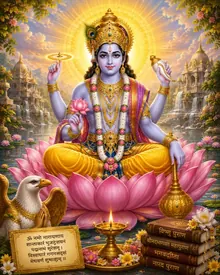
According to legend, the demon king Hiranyakashyap wanted to be worshipped as god himself, but his son Prahlad remained a devoted follower of Lord Vishnu. Enraged, Hiranyakashyap made repeated attempts to kill Prahlad, but each time, by Vishnu's grace, the boy survived unharmed.
Finally, Hiranyakashyap sought the help of his sister Holika, who possessed a cloak that made her immune to fire. Holika sat in a fire with Prahlad on her lap, but by Lord Vishnu's grace, the cloak flew onto Prahlad instead, and Holika was burned to ashes while Prahlad emerged unharmed. Holika Dahan is observed every year in remembrance of this event.
This legend symbolizes the power of devotion and the victory of good over evil. Wood and cow-dung cakes are gathered for weeks ahead of time, and on the night of Phalgun Purnima, this pile is set ablaze, celebrating the end of evil.
How Holika Dahan Is Celebrated
In an open crossroad or ground in the village or neighbourhood, a pile of wood and cow-dung cakes, gathered over the preceding weeks, is built up, this pile itself is called 'Holika'.
During the auspicious Bhadra-free muhurat, this pile is worshipped with roli, akshat, flowers, coconut, and gulal, circumambulated, and then formally set alight.
In the blazing flames, people roast barley, gram, and corn cobs to eat as prasad. The following morning, the celebration of Rangwali Holi begins, drawing on the ash from this very fire.
Holika Dahan Puja Vidhi
During the Bhadra-free Pradosh Kaal, offer roli, akshat, flowers, raw cotton thread, coconut, and gulal before the Holika pile. Circumambulate it with a pot of water, then formally light the fire. Roast barley and gram in the fire and take it as prasad.
About Holika Dahan
Holika Dahan is observed on the night of Phalgun Purnima, commemorating the legend of Bhakt Prahlad's protection and Holika's burning. This page covers the festival's significance, the importance of the Bhadra-free muhurat, and the Holika puja vidhi.
See the separate page for Rangwali Holi, observed the following day. The information on this page is presented with easy-to-read sizing and print support.
Frequently Asked Questions
When is Holika Dahan observed?
Holika Dahan is observed on the night of Phalgun Purnima, one day before Rangwali Holi.
What is Bhadra Kaal, and why isn't the bonfire lit during it?
Bhadra Kaal is considered an inauspicious period, during which no auspicious activity is undertaken. It is believed that lighting Holika Dahan during Bhadra brings misfortune, so it is always performed outside that window.
How did Prahlad survive the fire?
Holika possessed a cloak that made her fire-proof, but by Lord Vishnu's grace, the cloak flew onto Prahlad instead, so Holika burned while Prahlad remained unharmed.
What is the difference between Holika Dahan and Holi?
Holika Dahan is the bonfire ritual performed on the night of Purnima, while Holi (Dhulandi) is the festival of colours celebrated the following day. Together, the two are regarded as two stages of the same celebration.