
Reading details
आरती कुंजबिहारी की,
श्री गिरिधर कृष्णमुरारी की॥
Aarti Kunjbihari ki, Shri Girdhar Krishnamurari ki.
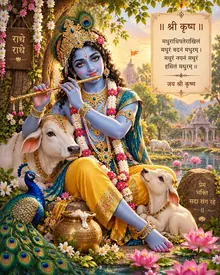
गले में बैजंती माला, बजावै मुरली मधुर बाला।
श्रवण में कुण्डल झलकाला, नंद के आनंद नंदलाला।
गगन सम अंग कांति काली, राधिका चमक रही आली, लतन में ठाढ़े बनमाली,
भ्रमर सी अलक, कस्तूरी तिलक, चंद्र सी झलक, ललित छवि श्यामा प्यारी की,
श्री गिरिधर कृष्णमुरारी की॥
Gale mein baijanti mala, bajaave murli madhur bala. Shravan mein kundal jhalkala, Nand ke anand Nandlala. Gagan sam ang kaanti kaali, Radhika chamak rahi aali, latan mein thaadhe banmaali, Bhramar si alak, kastoori tilak, chandra si jhalak, lalit chhavi Shyama pyari ki, Shri Girdhar Krishnamurari ki.
कनकमय मोर मुकुट बिलसै, देवता दरसन को तरसैं।
गगन सों सुमन रासि बरसै, बजे मुरचंग, मधुर मिरदंग, ग्वालिन संग,
अतुल रति गोप कुमारी की,
श्री गिरिधर कृष्णमुरारी की॥
Kanakmay mor mukut bilsai, devta darsan ko tarsain. Gagan son suman raasi barsai, baje murchang, madhur mirdang, gwalin sang, Atul rati gop kumari ki, Shri Girdhar Krishnamurari ki.
जहां ते प्रकट भई गंगा, कलुष कलि हारिणि श्रीगंगा।
स्मरन ते होत मोह भंगा, बसी सिव सीस, जटा के बीच, हरै अघ कीच,
चरन छवि श्रीबनवारी की,
श्री गिरिधर कृष्णमुरारी की॥
Jahaan te prakat bhai Ganga, kalush kali haarini Shri Ganga. Smaran te hot moh bhanga, basi Siv sees, jata ke beech, harai agh keech, Charan chhavi Shri Banwari ki, Shri Girdhar Krishnamurari ki.
चमकती उज्ज्वल तट रेनू, बज रही वृंदावन बेनू।
चहुं दिसि गोपि ग्वाल धेनू, हंसत मृदु मंद, चांदनी चंद, कटत भव फंद,
टेर सुन दीन भिखारी की,
श्री गिरिधर कृष्णमुरारी की॥
Chamakti ujjwal tat renu, baj rahi Vrindavan benu. Chahun disi gopi gwal dhenu, hansat mridu mand, chandni chand, katat bhav fand, Ter sun deen bhikhari ki, Shri Girdhar Krishnamurari ki.
For a vrat, some devotees read it several times in one sitting: 11, 21, or 108. Save your reading count with this counter.
How to Read Shri Krishna Aarti
Read it in the evening daily, or especially on Janmashtami, with a lamp lit. Repeat the refrain, 'Aarti Kunj Bihari Ki,' after every stanza and again at the very end.
About Shri Krishna Aarti
Aarti Kunj Bihari Ki is the most widely sung hymn of praise to Lord Krishna, composed in Braj Bhasha, poetically describing his adornment, his flute-playing, his raas with the gopis, and the story of the Ganga's origin. It is composed as a refrain followed by four stanzas, with the refrain repeated after each one.
This page presents the full text in clean Devanagari, with a simple meaning for every stanza. Text size can be adjusted, and the full reading can also be printed.
No composer names himself within the aarti, so it's considered a traditional composition of unknown authorship. It is composed in Braj Bhasha and sung daily at the Kunj Bihari temple in Vrindavan. It poetically describes Krishna's adornment, his flute-playing, his raas with the gopis, and the origin of the Ganga.
Frequently asked questions
Who composed Aarti Kunj Bihari Ki?
No composer names himself within the text, so it's considered a traditional composition of unknown authorship. It is composed in Braj Bhasha.
What is the structure of the aarti?
It has one refrain and four stanzas. The refrain is repeated after every stanza.
What is the best time to read the Krishna Aarti?
Singing it in the evening daily, and especially on Janmashtami, with a lamp lit, is considered ideal.
Is it necessary to know the meaning?
Not necessary, but reading it with the meaning makes the devotion clearer. This page includes a simple meaning alongside every stanza.