 Astha SangrahASTHA SANGRAHhttps://asthasangrah.com
Shri Mokshada Ekadashi Vrat Katha
Mokshada Ekadashi Vrat Katha is the story of King Vaikhanas and the liberation of his ancestors from hell, recited on the Shukla Paksha of the Margashirsh month, presented here in full.
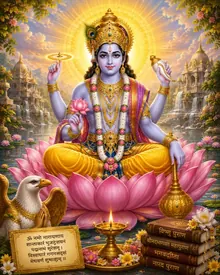
Chapter 1 · King Vaikhanas's Dream
Yudhishthira said, 'O lord of lords, which Ekadashi falls in the Shukla Paksha of the Margashirsh month, what is its method, and which deity is worshipped on it, my lord, please tell me all this truly.' Krishna said, 'O best of kings, I shall describe the Ekadashi of the Shukla Paksha of Margashirsh, merely hearing of which grants the merit of the Vajapeya sacrifice, its name is Mokshada Ekadashi, and it takes away every sin. O king, on that day one should worship Lord Damodar with great care, using tulsi buds and incense and lamps, Mokshada Ekadashi destroys even the gravest of sins, and on that night one should keep vigil with dance, song, and hymns of praise for my pleasure. Whoever's ancestors, on account of their sins, have fallen into a lowly existence, let their descendants observe this Ekadashi and offer its merit to their ancestors, and the ancestors shall attain liberation, of this there is not the slightest doubt.'
In ancient times, in the most delightful city of Champak, adorned with Vaishnavas, there lived a king named Vaikhanas, who protected his subjects as though they were his own children. Ruling thus, one night the king saw in a dream his own ancestors fallen into a lowly existence, and, seeing them all in this state, great astonishment arose in the king's mind, and in the morning he told the Brahmins the whole account of that dream. The king said, 'O Brahmins, I have seen my ancestors fallen into hell, and, weeping again and again, they said to me thus, you are our own offspring, so deliver us from this ocean of hell. O best of the twice-born, having had this vision of my ancestors, I find no peace, what should I do, where should I go, my heart feels choked. O foremost of the twice-born, please tell me of some vow, some penance, some discipline, by which my forefathers may at once be freed from hell, while I, their strong and brave son, am alive, my parents lie in terrible hell, so of what use is such a son?' The Brahmins said, 'O king, nearby is the great ashram of the sage Parvat, who knows both the past and the future, O best of kings, go to him.'
Chapter 2 · Sage Parvat's Remedy, and the Ancestors' Liberation
Hearing the Brahmins' words, King Vaikhanas quickly went to the sage Parvat's ashram, and, seeing that foremost of sages there, prostrated fully and touched the sage's feet, and the sage in turn asked the king after the welfare of the seven limbs of his kingdom. The king said, 'My lord, by your grace the seven limbs of my kingdom are all well, but I have seen in a dream that my ancestors have fallen into hell, so please tell me by the power of what merit they may be delivered from there.' Hearing the king's words, the sage Parvat remained absorbed in meditation for a moment, and then said to the king, 'O king, all of you should observe the Ekadashi named Mokshada, which falls in the Shukla Paksha of Margashirsh, and offer its merit to your ancestors, by the power of that merit they shall be delivered from hell.'
Lord Krishna continues: Yudhishthira, hearing the sage's words, the king returned home again, and when the excellent month of Margashirsh arrived, King Vaikhanas observed the vow of Mokshada Ekadashi just as the sage had instructed, and offered its merit to his father, together with all his ancestors. As soon as the merit was offered, flowers began raining from the sky, and Vaikhanas's father, together with the ancestors, was delivered from hell, and, coming into the sky, spoke this sacred word to the king, 'My son, may you be blessed.' Saying this, he departed for heaven. O king, whoever observes this most auspicious Mokshada Ekadashi in this way has their sins destroyed, and attains liberation after death, this liberation-granting Mokshada Ekadashi is, for humankind, like a wish-fulfilling gem, granting every desire.
How to Read Shri Mokshada Ekadashi Vrat Katha
On Mokshada Ekadashi, worship Lord Damodar with tulsi buds and incense and lamps, and keep a night vigil with dance, song, and hymns of praise. Whoever's ancestors are in a state of suffering should formally dedicate the merit of this vow to them, by which the ancestors attain liberation. Merely reading or hearing this glory grants the merit of the Vajapeya sacrifice.
About Shri Mokshada Ekadashi Vrat Katha
The Mokshada Ekadashi Vrat Katha is the story of King Vaikhanas, told across two chapters. In the first, the king sees his ancestors fallen into hell in a dream, and, on the Brahmins' advice, goes to the ashram of the accomplished sage Parvat. In the second, the sage Parvat tells him the method of dedicating the merit of the Mokshada Ekadashi vow to his ancestors, by which the king's ancestors are freed from hell and attain heaven.
This vow is observed on the Shukla Paksha Ekadashi of Margashirsh, seeking the liberation of one's ancestors and the attainment of moksha. This page presents the full text of both chapters in plain Hindi, with adjustable text size and print support.
The Mokshada Ekadashi Vrat Katha has no named author. It is traditionally presented as the story Lord Krishna narrated to Yudhishthira, and is conventionally linked to the Ekadashi-mahatmya tradition of the Padma Purana and Bhavishya Purana. The text presented here is a faithful transcription of the Mokshada Ekadashi Vrat Katha as printed in a published Hindi vrat-katha collection booklet, with only clear printing errors corrected and no change made to the story itself. Other printed editions may use different wording.
Frequently asked questions
How many chapters does the Mokshada Ekadashi Vrat Katha have?
It has two chapters in total, traditionally read or heard together as one complete text.
When is Mokshada Ekadashi observed?
It is observed on the Shukla Paksha Ekadashi of the Margashirsh month, the same tithi that is also celebrated as Gita Jayanti.
Why is the Mokshada Ekadashi vow observed?
As the story describes, this vow is observed especially to free one's ancestors from suffering and grant them liberation, which is why it is named Mokshada, 'the giver of moksha.'
Is there one single story for all Ekadashis?
No, there are 24 Ekadashis in a year, and tradition assigns each one its own distinct story. This is Mokshada Ekadashi's story of ancestral liberation, while the stories of other Ekadashis are available on their own separate pages on this site.