 Astha SangrahASTHA SANGRAHhttps://asthasangrah.com
Shri Devshayani Ekadashi Vrat Katha
The Devshayani Ekadashi Vrat Katha is the story of Shayani Ekadashi in Ashadha's bright fortnight, in which Lord Krishna tells Yudhishthira how, as Vamana, he took the earth from King Bali, why from this day one of his forms stays with Bali while another sleeps on Shesha in the ocean of milk until Kartika, and what rules should be kept in Chaturmas.
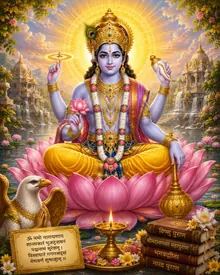
Chapter 1 · The Glory of Shayani Ekadashi
Yudhishthira said, 'Which Ekadashi falls in Ashadha's bright fortnight? What is its name and what its rite? Tell me in detail.' Shri Krishna said, 'I will tell you of an Ekadashi of great merit that gives heaven and liberation; it is known by the name Shayani and is the finest of tithis, taking away every sin. By merely hearing of it one gains the fruit of the Vajapeya sacrifice. I tell you truly, truly: there is nothing greater for people. The Creator made this great tithi to destroy the sins of the sinful. King of kings, there is no tithi beyond it that gives liberation. So, O king, listen: even by hearing its story, those who hear it reach the highest end. O king, they are Vaishnavas, ever devoted to me. In Ashadha Lord Vamana is worshipped. One who, in Ashadha's bright fortnight, on this wish-granting day, has worshipped the lotus-eyed Vamana with lotuses, and has kept this finest Ekadashi, the day of Hari, has worshipped the whole world and the three eternal gods.'
Chapter 2 · King Bali and Vamana's Three and a Half Steps
Yudhishthira said, 'Best of beings, I have a great doubt; hear it. Lord of gods, how do you sleep, and how do you dwell under Bali's shelter? Why do people sleep on the ground, and what do others do? Most wise one, tell me this, for my doubt is great.' Shri Krishna said, 'Tiger among kings, hear this excellent, sin-removing story, by merely hearing which every sin is wiped out. O king, in the Treta age there was a daitya named Bali. He was my devotee, given to me, and worshipped me every day. O king, that daitya with supreme devotion worshipped me, the eternal one, with many kinds of sacrifice, and kept sacrifices and vows. Then the teacher Brihaspati and the gods, after much deliberation with me, worshipped me many times with hymns. Then, in my fifth avatar, I took the form of Vamana, a form most fierce, the form of the whole universe. The daityas were won by a trick of words; Bali stood firm on truth. Shukra tried to stop him, saying: this is Narayana. O king, I asked him for three and a half steps of land, and the moment he placed the water of the vow in my hand,'
'O king, hear the form I took then: I set my feet in Bhurloka, my knees in Bhuvarloka, my waist in Svarloka, my belly in Maharloka, my heart in Janaloka, my throat in Tapoloka, my face in Satyaloka, and my head above it. The moon, the sun, the planets, the stars, the gods with Indra, the serpents, yakshas, gandharvas and kinnaras praised me with many hymns born of the Vedas. Taking Bali by the hand, I filled the earth with three steps, and set the half step on his back. O king, that danava who worshipped me went down to Rasatala. Sent below, what did the danava do then? He bowed in humility, and Janardana was greatly pleased. In Ashadha's bright fortnight is this wish-granting day of Hari.'
Chapter 3 · The Lord's Sleep and the Rules of Chaturmas
'On that day one of my forms dwells under Bali's shelter, and another on the back of Shesha in the midst of the ocean of milk. Great king, I sleep in this way until the coming Ekadashi of Kartika. Until then, the righteous person who keeps this vow, the finest of all dharmas, reaches the supreme state. So, O king, it should be kept with care. No tithi is holier or more destructive of sin than this one, on which the lord of gods, who bears the conch, discus and mace, goes to sleep. On it one should worship the Lord who bears the conch, discus and mace, and keep vigil at night with special devotion. Not even four-faced Brahma can count its merit. O king, one who keeps in this way this finest Ekadashi vow, which takes away every sin and gives enjoyment and liberation, is ever dear to me in the world, even if he is an outcaste.'
'Those who spend Chaturmas here giving lamps, eating from palasha leaves and keeping vows are dear to me. In Chaturmas, while Hari sleeps, one should sleep on the ground. In Shravana give up leafy greens, in Bhadrapada curd, in Ashvina milk and in Kartika pulses. Or one who lives in celibacy reaches the supreme state. By the Ekadashi vow alone a person is freed from sin. O king, it should always be kept and never forgotten. The dark-fortnight Ekadashis that fall between Shayani and Bodhini are the ones a householder should fast on, and never any other dark Ekadashi. O king, one who hears this excellent, sin-removing story gains the fruit of the Ashvamedha sacrifice.'
How to Read Shri Devshayani Ekadashi Vrat Katha
On Ashadha Shukla Ekadashi, bathe in the morning, take the vow of fasting and worship Lord Vamana (Vishnu) with lotuses. Keep vigil at night with special devotion, and break the fast the next day, Dwadashi, within the parana muhurat. Chaturmas begins on this day; per the katha, during it one sleeps on the ground, gives lamps, eats from palasha leaves, and gives up leafy greens in Shravana, curd in Bhadrapada, milk in Ashvina and pulses in Kartika.
About Shri Devshayani Ekadashi Vrat Katha
The Devshayani Ekadashi Vrat Katha is told in three chapters. In the first, Lord Krishna tells the glory of Shayani Ekadashi and the fruit of worshipping Vamana with lotuses on this day. In the second, at Yudhishthira's question, he tells of King Bali's devotion, how as Vamana he asked for three and a half steps of land, his cosmic form across the worlds, and Bali's going down to Rasatala. The third tells how one form of the Lord stays with Bali and another sleeps on Shesha until Kartika, and gives the rules of Chaturmas.
This vow is kept on the Ekadashi of Ashadha's bright fortnight, also called Harishayani, Padma or Ashadhi Ekadashi. Chaturmas begins on this day and ends on Devutthana Ekadashi in Kartika's bright fortnight. The story of King Mandhata and the drought that is sometimes attached to this Ekadashi is not in this chapter of the Padma Purana; it is the story of Parivartini (Padma) Ekadashi in Bhadrapada's bright fortnight.
The Devshayani Ekadashi Vrat Katha has no named author. It is the fifty-third chapter of the Uttara Khanda of the Padma Purana, in which Lord Krishna himself tells Yudhishthira the story of King Bali and the Vamana avatar, the reason for his sleep, and the rules of Chaturmas. The text given here is a verse-by-verse translation of that chapter's 37 Sanskrit verses.
Benefits of the Devshayani Ekadashi Vrat Katha
According to the katha, Shayani Ekadashi gives heaven and liberation, and hearing of it brings the fruit of the Vajapeya sacrifice; one who worships Vamana with lotuses has worshipped the three worlds and the three gods; not even Brahma can count its merit; and hearing this katha brings the fruit of the Ashvamedha sacrifice.
Frequently asked questions
How many chapters does the Devshayani Ekadashi Vrat Katha have?
It has three chapters, based on the 37 verses of the fifty-third chapter of the Padma Purana's Uttara Khanda.
Why does Lord Vishnu go to sleep on Devshayani Ekadashi?
In the katha the Lord explains that as Vamana he took the whole earth from his devotee King Bali in three and a half steps and sent him to Rasatala. Pleased by Bali's humility, from this day one of his forms stays with Bali, while another sleeps on Shesha in the ocean of milk until the Ekadashi of Kartika.
What rules should be followed during Chaturmas?
According to the katha, during Chaturmas one should sleep on the ground, give lamps and eat from palasha leaves, and give up leafy greens in Shravana, curd in Bhadrapada, milk in Ashvina and pulses in Kartika, or else keep celibacy.
Why are weddings and other auspicious ceremonies not performed during Chaturmas?
In Hindu wedding rites Lord Vishnu is invoked as witness, and from Devshayani Ekadashi he enters his yogic sleep, so by tradition auspicious ceremonies such as weddings and housewarmings are not held in this period, resuming only after he wakes on Devutthana Ekadashi.