
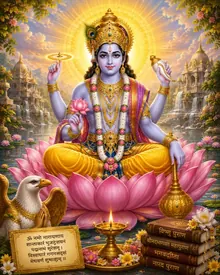
Chapter 1 · Narada's Question, and the Glory of Kamika Ekadashi
Yudhishthira asked, 'O Govinda, O Vasudev, salutations to you, which Ekadashi falls in the Krishna Paksha of Shravan, please describe it to me.' Lord Krishna said, 'O king, listen, I shall tell you a sin-destroying account, which Brahma once told to Narada when he asked. Narada asked, "O Lord, O lotus-seated one, I wish to hear from you the name of the Ekadashi that falls in the Krishna Paksha of Shravan, who its presiding deity is, and what merit comes from it, my lord, please tell me all this." Brahma said, "Narada, listen, out of a wish for the good of all the worlds I answer your question, the Ekadashi that falls in the Krishna Paksha of the Shravan month is named Kamika, merely remembering it grants the merit of the Vajapeya sacrifice, and on that day the Lord should be worshipped under the names Shridhar, Hari, Vishnu, Madhav, and Madhusudan, and others."'
The merit obtained from worshipping Lord Krishna is not easily found even at the Ganga, Kashi, Naimisharanya, or the sacred field of Pushkar. Whatever merit is obtained by bathing in the Godavari when Jupiter is in Leo, and during Vyatipat and Dandayoga, that very merit is also obtained by worshipping Lord Krishna. Whoever gives away the whole earth, together with its oceans and forests, and whoever observes the vow of Kamika Ekadashi, these two are held to receive equal merit. Whatever merit a person receives from donating a milch cow along with other gifts, that very merit comes to one who observes the Kamika Ekadashi vow, and whichever excellent man worships Lord Shridhar in the month of Shravan, through him all the gods, together with the gandharvas and the nagas, are worshipped. Therefore, those who fear sin should make every effort, according to their ability, to worship Shri Hari on the day of Kamika Ekadashi, for those who are drowning in the ocean of the world, filled with the mire of sin, the vow of Kamika Ekadashi is the most excellent means of deliverance. Those devoted to spiritual knowledge receive great merit, but those who observe the Kamika Ekadashi vow receive merit far greater still. A person who observes the vow of Kamika Ekadashi and keeps vigil through the night never beholds the terrible messengers of Yama, nor ever falls into a wretched state.
Chapter 2 · The Glory of Tulsi, and the Merit of Offering Lamps
Even worshipped with rubies, pearls, cat's-eye gems, and coral, Lord Vishnu is not as pleased as when worshipped with tulsi leaves, whoever has worshipped Shri Keshav with tulsi buds has, without doubt, all the sins of their whole life destroyed. On this a verse is recited, 'Ya drishta nikhilaghasangha-shamani sprishta vapuh-pavani, roganam abhivandita nirasani siktantaka-trasini, pratyasatti-vidhayini bhagavatah krishnasya saropita, nyasta tach-charane vimukti-phalada tasyai tulasyai namah.' This means: salutations to that goddess Tulsi, who, when merely beheld, destroys the whole mass of sin, who, when touched, purifies the body, who, when bowed to, removes disease, who, when watered, strikes fear even into Yama, who, when planted, draws one near to Lord Krishna, and who, when offered at the Lord's feet, bestows the fruit of liberation.
Even Chitragupta does not know the full measure of merit earned by one who offers lamps day and night on Ekadashi. Whoever lights a lamp before Lord Krishna on the day of Ekadashi has their ancestors established in heaven, satisfied by drinking nectar; a person who lights a lamp before the Lord with ghee or sesame oil is, after leaving the body, worshipped with millions of lamps and goes to heaven. Lord Krishna continues: Yudhishthira, I have now described to you the glory of Kamika Ekadashi. Kamika takes away every sin, so it must certainly be observed by mankind, it grants heaven and great merit. Whoever hears its glory with faith is freed from all sins and goes to the abode of Vishnu.
How to Read Shri Kamika Ekadashi Vrat Katha
On Kamika Ekadashi, worship the Lord under the names Shridhar, Hari, Vishnu, Madhav, or Madhusudan, offer tulsi buds, and keep a night vigil with the lighting of lamps. It is held that the merit of this vow equals donating the entire earth, or bathing in the Godavari during a special planetary alignment. (In the Amanta calendars of Gujarat and Maharashtra, this falls in the Krishna Paksha of Ashadh.)
About Shri Kamika Ekadashi Vrat Katha
The Kamika Ekadashi Vrat Katha is told across two chapters. In the first, on Yudhishthira's asking, Lord Krishna recounts the glory of Kamika Ekadashi as Brahma once told it to Narada, describing its merit as equal to donating the entire earth or bathing in the Godavari. In the second, the glory of worshipping tulsi is described, along with a Sanskrit verse, and the merit of offering lamps on Ekadashi is described.
This vow is observed on the Krishna Paksha Ekadashi of the Shravan month (in Gujarat and Maharashtra, it falls in the Krishna Paksha of Ashadh). This page presents the full text of both chapters in plain Hindi, with adjustable text size and print support.
The Kamika Ekadashi Vrat Katha has no named author. It is traditionally presented as the dialogue between Brahma and Narada, as narrated by Lord Krishna to Yudhishthira, and is conventionally linked to the Ekadashi-mahatmya tradition of the Padma Purana and Bhavishya Purana. Like some other Ekadashis, it has no character-driven plot of its own, instead, as in the source itself, it is a direct account of its glory and of the greatness of worshipping tulsi. The text presented here is a faithful transcription of this glory as printed in a published Hindi vrat-katha collection booklet, with only clear printing errors corrected and no change made to it. Other printed editions may use different wording.
Frequently asked questions
How many chapters does the Kamika Ekadashi Vrat Katha have?
It has two chapters in total, traditionally read or heard together as one complete text.
When is Kamika Ekadashi observed?
It is observed on the Krishna Paksha Ekadashi of the Shravan month. In the Amanta calendars followed in Gujarat and Maharashtra, it falls in the Krishna Paksha of Ashadh.
What is the significance of tulsi in Kamika Ekadashi?
As described in the story's second chapter, Lord Vishnu is pleased by worship with tulsi leaves more than by worship with precious gems, so offering tulsi buds holds special significance on this day.
Is there one single story for all Ekadashis?
No, there are 24 Ekadashis in a year, and tradition assigns each one its own distinct story or glory. This is Kamika Ekadashi's own account of its glory through the Brahma-Narada dialogue, while the stories of other Ekadashis are available on their own separate pages on this site.