
Reading details
जय जय तुलसी माता, मैया जय तुलसी माता।
सब जग की सुख दाता, सबकी वर माता॥
Jai jai Tulsi mata, maiya jai Tulsi mata. Sab jag ki sukh data, sabki var mata.
सब योगों से ऊपर, सब रोगों से ऊपर।
रज से रक्ष करके, सबकी भव त्राता॥
Sab yogon se upar, sab rogon se upar. Raj se raksh karke, sabki bhav trata.
बटु पुत्री है श्यामा, सूर बल्ली है ग्राम्या।
विष्णुप्रिय जो नर तुमको सेवे, सो नर तर जाता॥
Batu putri hai Shyama, sur balli hai gramya. Vishnupriya jo nar tumko seve, so nar tar jata.
हरि के शीश विराजत, त्रिभुवन से हो वंदित।
पतित जनों की तारिणी, तुम हो विख्याता॥
Hari ke sheesh virajat, tribhuvan se ho vandit. Patit janon ki tarini, tum ho vikhyata.
लेकर जन्म विजन में, आई दिव्य भवन में।
मानव लोक तुम्हीं से, सुख-संपति पाता॥
Lekar janm vijan mein, aai divya bhavan mein. Manav lok tumhin se, sukh-sampatti pata.
हरि को तुम अति प्यारी, श्याम वर्ण सुकुमारी।
प्रेम अजब है उनका, तुमसे कैसा नाता॥
हमारी विपद हरो तुम, कृपा करो माता॥
Hari ko tum ati pyari, shyam varn sukumari. Prem ajab hai unka, tumse kaisa nata. Hamari vipad haro tum, kripa karo mata.
For a vrat, some devotees read it several times in one sitting: 11, 21, or 108. Save your reading count with this counter.
How to Read Shri Tulsi Aarti
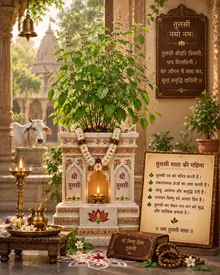
Read it each evening before the Tulsi plant, with a lamp lit, especially on Dev Uthani Ekadashi and through the month of Kartik. Repeat the refrain, 'Jai Jai Tulsi Mata,' after every stanza.
About Shri Tulsi Aarti
Tulsi Aarti, also known by its opening line as "Jai Jai Tulsi Mata," describes Tulsi Mata as the beloved of Lord Vishnu, revered by all three worlds, and the deliverer of the fallen. The composition opens with a refrain, continues through five stanzas, and repeats the refrain after each one.
This page presents the full text in clean Devanagari, with a simple meaning for every stanza. Text size can be adjusted, and the full reading can also be printed.
There's no firm historical record of who composed this aarti, and no stanza carries a poet's signature. It's the most widely sung aarti in the daily evening Tulsi puja performed in North Indian households. Note that Gaudiya Vaishnav tradition and ISKCON temples sing a different Sanskrit aarti, 'Namo Namah Tulsi Krishna-Preyasi,' which is a separate composition from this one.
Benefits of Reciting the Tulsi Aarti
It is believed that reciting this aarti daily with devotion removes disease and trouble and carries the devotee across the ocean of worldly existence into the Mother's grace; reciting it especially on Dev Uthani Ekadashi and through Kartik is considered particularly beneficial.
Frequently asked questions
Who composed the Tulsi Aarti?
There's no firm historical record of its composer, no stanza carries a poet's signature.
Are the Tulsi Aarti and the ISKCON Tulsi Aarti the same?
No, they're two different compositions. This page presents "Jai Jai Tulsi Mata", the aarti sung across North India, while Gaudiya Vaishnav and ISKCON tradition sing a different Sanskrit aarti, "Namo Namah Tulsi Krishna-Preyasi".
What is the structure of the aarti?
It has one refrain and five stanzas. The refrain is repeated after every stanza.
When should Tulsi puja be performed?
It's considered best to light a lamp and perform the aarti before the Tulsi plant every evening, especially on Dev Uthani Ekadashi and through the month of Kartik.
Is it necessary to know the meaning?
Not necessary, but reading it with the meaning makes the devotion clearer. This page includes a simple meaning alongside every stanza.
What are the benefits of the Tulsi Aarti?
It is believed that reciting this aarti daily with devotion removes disease and trouble and carries the devotee across the ocean of worldly existence into the Mother's grace; reciting it especially on Dev Uthani Ekadashi and through Kartik is considered particularly beneficial.