 Astha SangrahASTHA SANGRAHhttps://asthasangrah.com
Tulsi Vivah
Tulsi Vivah is celebrated on Kartik Shukla Dwadashi, the day on which Mata Tulsi is ceremonially wed to Lord Vishnu in his Shaligram form, with full wedding rites.
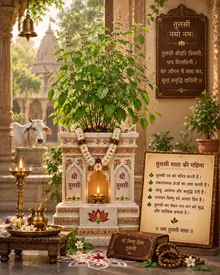
This festival falls the day after Devuthani Ekadashi, and marks the end of Chaturmas and the resumption of auspicious ceremonies. Check a local panchang for the exact date.
Significance of Tulsi Vivah
According to legend, a devoted and virtuous woman named Vrinda was married to the demon king Jalandhar. Vrinda's chastity made Jalandhar invincible, so for the welfare of the gods, Lord Vishnu took Jalandhar's form and broke Vrinda's chastity, making it possible for Jalandhar to be slain.
On learning the truth, Vrinda was deeply anguished and cursed Lord Vishnu to become a stone, and gave up her own life. Lord Vishnu accepted Vrinda's curse and took the form of the Shaligram stone, and from Vrinda's ashes, the Tulsi plant arose.
Lord Vishnu promised Vrinda that he would remain with her forever in the form of Tulsi, and would wed her every year on Kartik Shukla Dwadashi, in his Shaligram form. In remembrance of this legend, Tulsi Vivah is observed every year.
How Tulsi Vivah Is Celebrated
At homes and temples, the Tulsi plant's pot is placed in the courtyard and decorated like a wedding canopy with sugarcane stalks, flowers, and rangoli. A Shaligram or an image of Lord Vishnu is placed beside the Tulsi plant.
In the evening, the wedding of Tulsi and Shaligram is performed with full rites, including kanyadaan, the wedding rounds, and all the auspicious wedding songs. After the puja, the aarti is performed.
This day marks the end of Chaturmas, and the resumption of weddings and other auspicious ceremonies that were considered inauspicious during Chaturmas. After the puja, sugarcane and sweets are distributed as prasad.
Tulsi Vivah Puja Vidhi
Place the Tulsi plant's pot in the courtyard and decorate it like a wedding canopy with sugarcane and flowers. Place a Shaligram or an image of Vishnu beside the Tulsi plant. In the evening, perform the Tulsi-Shaligram wedding with full rites, including kanyadaan and the wedding rounds, then perform the aarti and distribute prasad.
About Tulsi Vivah
Tulsi Vivah is celebrated on Kartik Shukla Dwadashi, the day on which Mata Tulsi is wed to Lord Vishnu's Shaligram form. This page covers the festival's significance, the legend of Vrinda, and the wedding ritual.
The information on this page is presented with easy-to-read sizing and print support.
Frequently Asked Questions
When is Tulsi Vivah observed?
Tulsi Vivah is observed every year on Kartik Shukla Dwadashi, the day after Devuthani Ekadashi.
Why is Tulsi Vivah performed?
In remembrance of the legend of Vrinda, Mata Tulsi is wed to Lord Vishnu's Shaligram form every year, and this day marks the start of the season for auspicious ceremonies.
What is a Shaligram?
A Shaligram is a special kind of stone, worshipped as the direct form of Lord Vishnu, and it is with this stone that Tulsi is ceremonially wed in Tulsi Vivah.
What begins after Tulsi Vivah?
After Tulsi Vivah, Chaturmas comes to an end, and weddings and other auspicious ceremonies resume, which were considered inauspicious before this.