
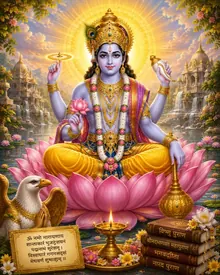
Chapter 1 · Bhimasena's Distress
Yudhishthira said, 'O Janardan, please describe the Ekadashi that falls in the Shukla Paksha of the Jyeshtha month.' Lord Krishna said, 'O king, it is the most righteous Vyasa, son of Satyavati, who shall describe this, for he is the knower of the essence of all scriptures and a scholar accomplished in the Vedas and Vedangas.' Then Vedavyasa said, 'Do not eat on the Ekadashi of either fortnight; on Dwadashi, after purifying oneself with bathing and the like, worship Lord Keshav with flowers, and then, once one's daily duties are complete, feed the Brahmins first and eat oneself only afterward. O king, one should not eat on Ekadashi even during the period of ritual impurity following a birth or death in the family.'
Hearing this, Bhimasena said, 'O most wise grandsire, hear my earnest word, King Yudhishthira, Mother Kunti, Draupadi, Arjuna, Nakula, and Sahadeva never eat on Ekadashi, and they always tell me too, "Bhimasena, you too must not eat on Ekadashi", but I always tell them that I cannot bear my hunger.' Hearing Bhimasena's words, Vyasa said, 'If you desire to attain heaven, and consider hell to be foul, then do not eat on the Ekadashis of either fortnight.' Bhimasena said, 'O most wise grandsire, I tell you the plain truth, I cannot even keep a vow by eating just once, so how could I possibly manage a full fast, within my belly burns a fire named Vrika, which is only calmed when I eat a great deal, so, O great sage, I can observe only a single fast in the whole year, please decide upon and tell me some one vow, by which heaven may be easily attained, and by observing which I too may share in this blessing, and I shall follow it properly.'
Chapter 2 · Sage Vyasa Prescribes the Waterless Vow
Vyasa said, 'O Bhima, whether the sun be in Taurus or Gemini in the month of Jyeshtha, whichever Ekadashi falls in the Shukla Paksha, observe its waterless vow with great care, one may put water in the mouth only to rinse it or for a sip, and, apart from that, a wise man should put no other water in his mouth, or else the vow is broken. If a person gives up water from the sunrise of Ekadashi until the sunrise of the following day, this vow is fulfilled, and then, on Dwadashi, one should bathe at dawn and duly give Brahmins the gift of water and gold, and, having completed all this, a self-controlled man should then eat together with the Brahmins. Whatever merit lies in all the Ekadashis of the whole year, a person obtains all of it by observing Nirjala Ekadashi alone, of this there is not the slightest doubt. Lord Keshav, who bears the conch, discus, and mace, told me himself that if a person gives up everything and takes refuge in me alone, and remains without food on Ekadashi, he is freed from all sins.'
The terrible messengers of Yama, huge in form, ferocious in appearance, dark of colour, and bearing staff and noose, do not approach a man who observes the Ekadashi vow, at the final hour, it is the gentle-natured messengers of Vishnu, clad in yellow, bearing the Sudarshan in hand and swift as thought, who finally lead this devotee of Vishnu to the Lord's own abode. Therefore observe the fast of Nirjala Ekadashi with full effort, and worship Shri Hari, whether man or woman, even if one has committed a sin as great as Mount Meru, all of it is burnt away by the power of this Ekadashi vow. O son of Kunti, hear now the special charitable acts and duties laid down for faithful men and women on the day of Nirjala Ekadashi, on that day, one should worship Lord Vishnu, who rests upon the waters, and give the gift of a water-filled clay cow, or, alternatively, the gift of an actual cow or a ghee-filled clay cow is fitting; Brahmins should be satisfied with ample gifts and various sweets, offered with care. This prayer should be offered to the Lord, 'Devadeva Hrishikesha, samsararnavatarak, udakumbhapradanena naya mam paramam gatim', that is, 'O lord of lords, Hrishikesh, who ferries souls across the ocean of this world, by this gift of a water-filled pot, lead me to the supreme destination.'
Chapter 3 · Bhimasena's Vow, and the Naming of Pandava Dwadashi
'O Bhima, one should observe the waterless vow of this auspicious Ekadashi that falls in the Shukla Paksha of Jyeshtha, and on that day one should give excellent Brahmins the gift of water-pots along with sugar, doing this, a person draws near to Lord Vishnu and experiences bliss, and thereafter, on Dwadashi, one should eat only after feeding the Brahmins. Whoever observes this sin-destroying Ekadashi fully in this way is freed from all sin and attains a state of everlasting joy.'
Hearing this, Bhimasena too began observing this auspicious Ekadashi, and from that time it became renowned in this world by the name of Pandava Dwadashi. Whoever hears or recounts the glory of this Ekadashi with devotion goes to the abode of heaven, and those who have fasted on Ekadashi are freed from all sins, even if they be killers of Brahmins, drunkards, thieves, or betrayers of their teachers.
How to Read Shri Nirjala Ekadashi Vrat Katha
On the Shukla Ekadashi of Jyeshtha, give up water completely from sunrise until the next day's sunrise, with only a sip for rinsing the mouth permitted. On Dwadashi, bathe and give Brahmins a water-filled pot, gold, and a gift, then eat only after feeding them. It is believed that this single vow yields the merit of all twenty-four Ekadashis of the year.
About Shri Nirjala Ekadashi Vrat Katha
The Nirjala Ekadashi Vrat Katha tells of the dialogue between Bhimasena and the great sage Vyasa, across three chapters. In the first, Bhimasena admits that his hunger prevents him from observing every Ekadashi of the year, and asks for a single vow that could grant the merit of them all. In the second, Vyasa gives him the complete method of the waterless vow of Jyeshtha Shukla Ekadashi. In the third, Bhimasena adopts this vow, and it comes to be known also as Pandava Dwadashi.
This vow is observed on the Shukla Paksha Ekadashi of Jyeshtha, with a most rigorous waterless resolve, in the wish to obtain the merit of all twenty-four Ekadashis of the year. This page presents the full text of all three chapters in plain Hindi, with adjustable text size and print support.
The Nirjala Ekadashi Vrat Katha has no named author. It is traditionally presented as the story Lord Krishna narrated to Yudhishthira, within which the sage Vyasa in turn instructs Bhimasena, and is conventionally linked to the Ekadashi-mahatmya tradition of the Padma Purana and Bhavishya Purana. The text presented here is a faithful transcription of the Nirjala Ekadashi Vrat Katha as printed in a published Hindi vrat-katha collection booklet, with only clear printing errors corrected and no change made to the story itself. Other printed editions may use different wording.
Frequently asked questions
How many chapters does the Nirjala Ekadashi Vrat Katha have?
It has three chapters in total, traditionally read or heard together as one complete text.
When is Nirjala Ekadashi observed?
It is observed on the Shukla Paksha Ekadashi of the Jyeshtha month.
Why is Nirjala Ekadashi also called Pandava Dwadashi?
As the story's third chapter describes, Bhimasena adopted this single vow, and in his name it also became renowned as Pandava Dwadashi.
How is the Nirjala Ekadashi vow observed?
As described in the puja vidhi, water is given up entirely from the sunrise of Ekadashi until the next day's sunrise, with only a sip permitted for rinsing the mouth.
Is there one single story for all Ekadashis?
No, there are 24 Ekadashis in a year, and tradition assigns each one its own distinct story. This is Nirjala Ekadashi's story of Bhimasena, while the stories of other Ekadashis are available on their own separate pages on this site.