
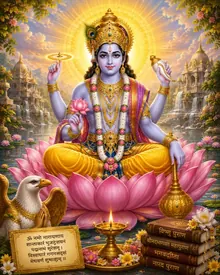
Chapter 1 · The Demon Mura's Tyranny, and the Gods Seek Refuge
Yudhishthira asked Lord Krishna, 'My lord, how did the sacred Ekadashi tithi come into being? Why did it come to be regarded as holy in this world, and how did it become dear to the gods?' The Lord said, 'O son of Kunti, in ancient times, in the Satya Yuga, there lived a demon named Mura, who was most extraordinary, exceedingly fierce, and terrible to all the gods. That great, time-like, evil-souled demon had even defeated Indra, and all the gods, overpowered by him, had been driven out of heaven, and wandered the earth in fear and dread. One day all the gods went to Mahadev, and there Indra told Lord Shiva the whole account. Indra said, "O Maheshwar, these gods, having been driven from heaven, are wandering the earth, and it does not befit them to dwell among mortals, O Lord, please tell us some remedy, on whom should the gods rely?" Mahadev said, "O king of the gods, go to where the lord of the world, Garudadhwaj, the giver of refuge to all and ever intent on protecting all, resides, he shall protect you all."
Lord Krishna continues: Yudhishthira, hearing Mahadev's words, the most wise Indra, king of the gods, went with all the gods to the Ocean of Milk, where Lord Gadadhar was sleeping, and Indra, joining his hands, praised him. Indra said, "O lord of lords, salutations to you, O Lord, you alone are husband, you alone are wisdom, you alone are the doer, and you alone are the cause, you alone are the mother of all beings, and you alone are the father of this world, both gods and demons worship you, O lotus-eyed one, you are the enemy of demons, O Madhusudan, protect us, O Lord, O Jagannath, the mighty and most fierce demon named Mura has conquered all these gods and cast them out of heaven, O Lord, lord of lords, you who are fond of those who take refuge in you, the gods, in fear, have come to your refuge, O destroyer of demons, O beloved of your devotees, lord of lords, Janardan, protect us, protect us, O Lord, help these gods who have come to your refuge."
Chapter 2 · Vishnu's Assault on Chandravati, and His Rest in the Cave
Hearing Indra's words, Lord Vishnu said, 'O king of the gods, what kind of demon is this, what is his form and his strength, and where does that wicked one dwell?' Indra said, 'O lord of the gods, in former times, in Brahma's own lineage, there was born a great demon named Taljangha, who was most terrible, and his son is known by the name of the demon Mura, who is likewise most fierce, exceedingly powerful, and terrible to the gods. There is a city renowned by the name Chandravati, and it is there that he has made his dwelling. That demon has defeated all the gods and cast them out of heaven, he has seated another Indra upon the throne of heaven, he has made new gods of fire, moon, sun, wind, and water as well, O Janardan, I tell you the plain truth, he has replaced every one of them, he has deprived the gods of every one of their places.'
Hearing Indra's words, Lord Janardan grew greatly enraged, and, taking the gods with him, entered the city of Chandravati. Lord Gadadhar saw that the demon king was roaring again and again, and that all the gods, overpowered by him, were fleeing in all ten directions. Now that demon, seeing Lord Vishnu, said, 'Stand still, stand still.' Hearing this challenge, the Lord's eyes turned red with rage, and he said, 'O wicked demon, behold these arms of mine.' Saying this, Vishnu began slaying with his divine arrows the wicked demons who came before him, and the demons grew faint with fear. O son of Pandu, Vishnu then struck the demon army with his discus, and hundreds of warriors, cut to pieces, met their death. After this, Lord Madhusudan went to Badrikashram, where there was a cave named Simhavati, twelve yojanas long, and, O son of Pandu, that cave had but a single door, and Lord Vishnu went to sleep within it. That demon Mura, in his effort to kill the Lord, had been following close behind him, and so he too entered that same cave, and, seeing the Lord asleep there, was overjoyed, and thought to himself, 'This is the very god who strikes fear into demons, so without doubt I shall kill him now.'
Chapter 3 · The Goddess Ekadashi's Appearance, and the Slaying of Mura
Yudhishthira, as the demon thought this, a maiden appeared from Lord Vishnu's own body, most beautiful, most fortunate, and equipped with divine weapons, born of a portion of the Lord's own splendour, and her strength and valour were immense. Yudhishthira, the demon king Mura saw that maiden, and the maiden, resolving to fight, challenged the demon to battle. The battle broke out, and the maiden was skilled in every art of war, and that great demon named Mura was reduced to a heap of ash by her mere battle-cry. When the demon was slain, the Lord woke up, and, seeing the demon lying lifeless upon the ground, asked the maiden, 'This enemy of mine was most fierce and terrible, who has slain him?' The maiden said, 'My lord, it is by your own grace that I have slain this great demon.'
The Lord said, 'O blessed one, by this deed of yours the sages and gods of the three worlds have been filled with joy, so ask of me whatever boon your heart desires, and even if it be a boon rare even for the gods, I shall grant it to you, of this there is not the slightest doubt.' That maiden was none other than Ekadashi herself. She said, 'My lord, if you are pleased, then by your grace let me become the foremost among all sacred places, the destroyer of every obstacle, and the giver of every kind of accomplishment. O Janardan, let those who, holding devotion to you, fast upon my day, attain every accomplishment. O Madhava, let those who observe my vow, whether by fasting, eating only at night, or eating but once, be granted by you wealth, righteousness, and liberation.' Lord Vishnu said, 'O blessed one, all that you have said shall come to pass.' Lord Krishna continues: Yudhishthira, having received such a boon, the great vow Ekadashi was greatly pleased. Whoever fasts on Ekadashi goes to the abode of Vaikuntha, where Garudadhwaj himself resides, and whoever hears this glory with devotion is, without doubt, freed from all sins, there is no vow that destroys sin as Ekadashi does.
How to Read Shri Utpanna Ekadashi Vrat Katha
Ekadashi is held to be equally auspicious in both fortnights, Shukla and Krishna, with no distinction drawn between them. Eat lightly on Dashami and observe the fast on Ekadashi, and on Dwadashi, after bathing, eat only once worship is complete. Whoever reads or hears this story daily receives the merit of donating a thousand cows, and is freed even from sins as grave as the killing of a Brahmin.
About Shri Utpanna Ekadashi Vrat Katha
The Utpanna Ekadashi Vrat Katha tells the story of the origin of the Ekadashi tithi, across three chapters. In the first, the demon Mura drives the gods from heaven, and, on Shiva's advice, they take refuge with Lord Vishnu. In the second, Vishnu destroys Mura's army and rests in a cave at Badrikashram, where Mura follows and finds him. In the third, a maiden appears from Vishnu's own body and slays Mura, and the Lord grants her the boon of becoming Ekadashi, the most sacred of all vows.
This vow is observed on the Krishna Paksha Ekadashi of the Margashirsh month, and is regarded as the very first Ekadashi of the year's cycle. This page presents the full text of all three chapters in plain Hindi, with adjustable text size and print support.
The Utpanna Ekadashi Vrat Katha has no named author. It is traditionally presented as the story Lord Krishna narrated to Yudhishthira, and is conventionally linked to the Ekadashi-mahatmya tradition of the Padma Purana and Bhavishya Purana. The text presented here is a faithful transcription of the Utpanna Ekadashi Vrat Katha as printed in a published Hindi vrat-katha collection booklet, with only clear printing errors corrected and no change made to the story itself. Other printed editions may use different wording.
Frequently asked questions
How many chapters does the Utpanna Ekadashi Vrat Katha have?
It has three chapters in total, traditionally read or heard together as one complete text.
When is Utpanna Ekadashi observed?
It is observed on the Krishna Paksha Ekadashi of the Margashirsh month, and is considered the first Ekadashi of the year's cycle.
Why is it called Utpanna Ekadashi?
As the story describes, it was on this day that the goddess Ekadashi was born (utpanna) from Lord Vishnu's own body, which is why it is called Utpanna Ekadashi.
Is there one single story for all Ekadashis?
No, there are 24 Ekadashis in a year, and tradition assigns each one its own distinct story. Utpanna Ekadashi tells of the origin of the tithi itself, while the stories of other Ekadashis are available on their own separate pages on this site.