 Astha SangrahASTHA SANGRAHhttps://asthasangrah.com
Vaikuntha Chaturdashi Vrat Katha
Vaikuntha Chaturdashi is observed on Kartik Shukla Chaturdashi, the day on which the story of Lord Vishnu and Lord Shiva's meeting is recited, and observing this vow is believed to grant the boon of reaching Vaikuntha. The complete text is presented here.
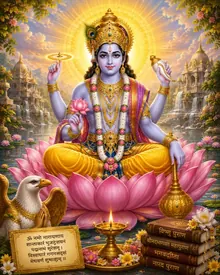
Chapter 1 · Narada's Question and the Promise of Vaikuntha's Open Gates
Once, the divine sage Narada, having wandered through the mortal world, arrived at Vaikuntha. Lord Vishnu received him with great honor and, pleased to see him, asked the purpose of his visit. Narada said, 'O Lord, one of your names is Kripanidhan, yet liberation still appears to reach only your most exceptional devotees, ordinary men and women are often left without it. Kindly show me some simple path by which even an ordinary devotee may easily find refuge in you.'
Lord Vishnu smiled and said, 'O Narada, whichever man or woman keeps a fast on the Chaturdashi of the Shukla Paksha of Kartik and worships me with devotion, for them the gates of Vaikuntha will open of their own accord.' So saying, he summoned his gatekeepers Jaya and Vijaya and instructed them to keep Vaikuntha's gate open on this Chaturdashi, so that any devotee who so much as remembered or worshipped him a little that day could reach Vaikuntha directly. It is because of this promise that Kartik Shukla Chaturdashi came to be known as 'Vaikuntha Chaturdashi'.
Chapter 2 · Lord Vishnu's Worship of Shiva at Kashi and the Gift of the Sudarshan Chakra
According to another account, Lord Vishnu himself came to Kashi to worship the great Lord Shiva. Bathing at Manikarnika Ghat, he took a vow to worship Lord Vishwanath with a thousand golden lotuses. But to test his devotion, Shiva secretly removed one lotus at the very moment of the vow. As Vishnu worshipped, he sensed that one flower was missing, and it occurred to him that he himself was called 'Kamalnayan' and 'Pundarikaksh', the lotus-eyed one, whose own eyes were said to resemble lotuses. Without a moment's hesitation, he moved to pluck out one of his own eyes and offer it upon the Shivalinga in place of the missing flower.
Seeing such boundless devotion in one so dear to him, Lord Shiva at once appeared and caught his hand. He said, 'O Vishnu, there is no devotee in this world equal to you. From today, this Kartik Shukla Chaturdashi shall be revered as Vaikuntha Chaturdashi, and whoever worships you first on this day, keeping a fast, is assured of reaching Vaikuntha.' It was on this same occasion that Lord Shiva bestowed upon Lord Vishnu the Sudarshan Chakra, radiant as a million suns. For this reason, the festival is also called the meeting of Hari and Har, and both Shiva and Vishnu promised that on this day, the gates of heaven would remain open, and that whoever in the mortal world observed this vow would have their place in Vaikuntha secured.
Chapter 3 · The Liberation of Dhaneshwar the Brahmin
A third story is also told to illustrate the glory of Vaikuntha Chaturdashi. There was a Brahmin named Dhaneshwar, who committed many sins throughout his life. One day, by coincidence on Vaikuntha Chaturdashi itself, he went to bathe in the Godavari river. On that day, many devout pilgrims had gathered at the Godavari's banks after their worship, to bathe there, and Dhaneshwar happened to join that very crowd. By the mere touch of those meritorious devotees, Dhaneshwar too came to share, quite unknowingly, in some of their merit.
When Dhaneshwar's time came and he died, the messengers of Yama began leading him toward hell. At that moment, Lord Vishnu declared, 'Though this man has been a great sinner, he bathed in the Godavari on Vaikuntha Chaturdashi, and through the merit of the devout pilgrims present there that day, all his sins have already been destroyed, so let him attain not hell, but Vaikuntha.' In this way, Dhaneshwar too, without any special practice of his own, attained liberation solely through the glory of Vaikuntha Chaturdashi and the company of devotees. This is why the day is regarded as both a destroyer of sin and a giver of liberation.
How to Read Vaikuntha Chaturdashi Vrat Katha
On Vaikuntha Chaturdashi, bathe in a sacred river or at home in the morning and observe a fast through the day. Worship both Lord Vishnu and Lord Shiva, and keep vigil through the night with katha and kirtan. Worship performed around midnight is considered the most important part of this vow. Break the fast the next morning after bathing and giving alms.
About Vaikuntha Chaturdashi Vrat Katha
The Vaikuntha Chaturdashi Vrat Katha is told across three chapters. In the first, Lord Vishnu grants the boon of Vaikuntha's gates opening, in answer to Narada's question. In the second is the story of Lord Vishnu's worship of Shiva at Kashi and his receiving the Sudarshan Chakra, also called the meeting of Hari and Har. In the third is the story of a Brahmin named Dhaneshwar's liberation.
This vow is observed on Kartik Shukla Chaturdashi, and observing it is believed to grant the boon of reaching Vaikuntha. This page presents the full text of all three chapters in plain Hindi, with adjustable text size and print support.
The Vaikuntha Chaturdashi Vrat Katha has no single named author. Three stories are principally told about it in the Puranic tradition, the boon of Vaikuntha's gates opening in answer to Narada's question, the story of Lord Vishnu's worship of Shiva at Kashi and his receiving the Sudarshan Chakra, and the story of the Brahmin Dhaneshwar's liberation, recounted across many Hindi religious websites. No old printed booklet on this subject could be found, so the story given here follows the events, characters, and sequence of these widely circulating accounts, but its wording has been composed independently, so that it is not a word-for-word copy of any single website's or publication's text.
Frequently asked questions
When is Vaikuntha Chaturdashi observed?
It is observed on Kartik Shukla Chaturdashi, which falls a few days after Devutthana Ekadashi.
How many chapters does the Vaikuntha Chaturdashi Vrat Katha have?
It has three chapters in total, traditionally read or heard together as one complete text.
Why is Vaikuntha Chaturdashi called the festival of Hari-Har milan?
As described in the story's second chapter, it was on this day at Kashi that Lord Shiva, pleased by Lord Vishnu's worship, bestowed the Sudarshan Chakra upon him, which is why the day is also called the festival of the meeting of Vishnu (Hari) and Shiva (Har).
What is the fruit of observing Vaikuntha Chaturdashi?
It is believed that for those who keep the fast and worship Lord Vishnu and Shiva with devotion on this day, the gates of Vaikuntha remain open, and they attain the abode of Vaikuntha.
What should be done on Vaikuntha Chaturdashi?
As described in the vow's rites, one should bathe and observe a fast on this day, worship both Lord Vishnu and Shiva, keep vigil through the night with katha and kirtan, and break the fast the next day after bathing and giving alms.