 Astha SangrahASTHA SANGRAHhttps://asthasangrah.com
Shri Saphala Ekadashi Vrat Katha
The Saphala Ekadashi Vrat Katha is the story of Saphala Ekadashi in Paush's dark fortnight, in which Lumpaka, a sinful prince driven from the kingdom, unknowingly keeps the fast and the night vigil because of cold and hunger, and by that merit gains a kingdom and a divine form.
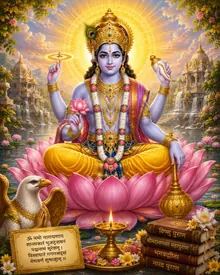
Chapter 1 · The Glory of Saphala Ekadashi and Its Puja
Yudhishthira said, 'Which Ekadashi falls in the dark fortnight of Paush, what is its name, what are its rites and which god is worshipped on it? My lord, tell me all this at length.' Shri Krishna said, 'Lord of kings, out of affection for you I will tell you. O king, even sacrifices with rich gifts do not please me as much as the Ekadashi vow; so the day of Hari should be kept with every effort. Best of the knowers of dharma, this is true, not false: the Ekadashi of Paush's dark fortnight is named Saphala. On that day Lord Narayana should be worshipped with due rites, and this auspicious Ekadashi kept by the method described before.'
'As Shesha is foremost among serpents, Garuda among birds, Vishnu among the gods and the brahmin among people, so, O king, the Ekadashi tithi is foremost among vows, and it is to be honoured by all. Those devoted to the day of Hari who keep the Ekadashi vow gain wealth in this world and liberation after death.'
'O king, on the day of Saphala, Hari should be worshipped by name with fruits: coconut, areca nut, citron, jambira lemon, pomegranate, the auspicious amla, cloves, ber and above all mango. Worship the lord of gods with incense and lamps too, and on Saphala especially give lamps. The night vigil should be kept with Vaishnavas; hear with a focused mind the merit of one who stays awake at night without closing his eyes.'
'There is no sacrifice and no tirtha equal to it. Lord of kings, all other vows are not worth a sixteenth part of it. The fruit won by thousands of years of austerity is gained by one who keeps this vigil. Lion among kings, now hear the auspicious story of Saphala.'
Chapter 2 · Prince Lumpaka Is Driven Out
'There was a famous city named Champavati belonging to the royal sage Mahishmata, and he had five sons. The eldest of them was always given to grave sin: he went to other men's wives, was addicted to courtesans and drank liquor. He wasted his father's wealth in sinful deeds. He lived always in misconduct and reviled the gods, the brahmins and the Vaishnavas. Seeing his son so, King Mahishmata gave him the name Lumpaka among the princes, and his father and brothers drove him out of the kingdom.'
'His family cast him off like a highway robber. Then the abandoned Lumpaka thought: my kinsmen and my father have cast me off and driven me from the kingdom. Thinking so, the sinner resolved: I must go to the dreadful deep forest, and from there I will plunder my father's whole city. Having so resolved, as fate would have it, Lumpaka left the city and went into the deep forest. There he killed creatures every day, and, skilled in theft and gambling, the sinner robbed the whole city.'
'One night, while he was stealing, the city's guards caught him. He told them: I am the son of King Mahishmata. They let him go, and the sinner went back to the forest, where he lived each day on meat and the fruit of trees. The wicked one's shelter was near Lord Vasudeva: there stood a very old pipal tree, many years in age, which was held to be a great deity in that forest. There the sinful-minded Lumpaka lived.'
Chapter 3 · The Unintended Fast, and Lumpaka's Kingdom
'After a long time, by some store of former merit, on the Dashami of Paush's dark fortnight he ate the fruit of trees by day. At night, having no clothes, the sinner Lumpaka was racked by the cold. Tormented by bitter cold beside Hari's tree, the pipal, he had neither sleep nor ease and became like one dead. All night his teeth were clenched, and even at sunrise the sinner did not come to his senses. On the day of Saphala, Lumpaka lay senseless, and only when the sun reached the middle of the sky did he regain consciousness.'
'He looked this way and that, and rising from where he lay, he went stumbling, falling again and again like a lame man. Going into the forest, he grew weak and racked by hunger and thirst. The wicked Lumpaka no longer had the strength even to kill creatures. Then he brought back fruit, but by the time he returned, the sun had set. Crying, 'O father, what will become of me now,' he lamented, and laid the many fruits at the root of that tree. He said: may Lord Hari, husband of Lakshmi, be pleased with these fruits. Even after saying this, Lumpaka got no sleep that night.'
'Sinless Yudhishthira, Vishnu accepted that wicked one's night vigil and his worship with fruit as the vow of Saphala. In this way, without intending it, Lumpaka kept this vow, and by the power of that merit he gained a kingdom free of foes. The moment the sun rose, a bodiless voice spoke in the sky: prince, by the grace of Saphala you will gain a kingdom. As soon as it spoke, he took on a divine form. Then, O king, his mind became supremely devoted to Vishnu, and adorned with divine ornaments he gained a kingdom free of foes.'
'He ruled for fifteen years, and by Shri Krishna's grace his sons and wives were lovely. Then, soon giving up the kingdom and handing it to his son, he went into Shri Krishna's presence, from which no one who goes there grieves. O king, one who keeps the excellent vow of Saphala in this way gains happiness in this world and liberation after death. Blessed in the world are those devoted to Saphala; their birth is fruitful, of this there is no question. Protector of the people, by reading, hearing and keeping it a person gains the fruit of the Rajasuya sacrifice.'
How to Read Shri Saphala Ekadashi Vrat Katha
On Paush Krishna Ekadashi, bathe in the morning, take the vow of fasting and worship Lord Narayana. Offer fruits by name, such as coconut, areca nut, citron, pomegranate, amla, cloves, ber and mango, worship with incense and lamps, and above all give lamps. Spend the night in vigil with Vaishnavas, and break the fast the next day, Dwadashi, within the parana muhurat.
About Shri Saphala Ekadashi Vrat Katha
The Saphala Ekadashi Vrat Katha is told in three chapters. In the first, Krishna says that Ekadashi is foremost among vows as Shesha is among serpents and Garuda among birds, and gives the rite for Saphala: worship with fruits, the gift of lamps and the vigil. In the second, King Mahishmata's sinful son Lumpaka is driven from the kingdom and comes to live beside an old pipal tree in the forest. In the third, Lumpaka, lying senseless through a cold Paush night, can eat nothing on Saphala day, offers fruit to the Lord at the pipal's roots at dusk and stays awake all night, and by this unintended fast he gains a kingdom.
This vow is kept on the Ekadashi of Paush's dark fortnight, a few days before Makar Sankranti. 'Saphala' means the one that makes things fruitful.
The Saphala Ekadashi Vrat Katha has no named author. It is the fortieth chapter of the Uttara Khanda of the Padma Purana, in which Lord Krishna tells the story to Yudhishthira. The text given here is a verse-by-verse translation of that chapter's 49 Sanskrit verses.
Benefits of the Saphala Ekadashi Vrat Katha
The katha closes by saying that one who keeps the Saphala vow gains happiness in this world and liberation after death, that the birth of those devoted to Saphala is fruitful, and that reading, hearing and keeping it brings the fruit of the Rajasuya sacrifice.
Frequently asked questions
How many chapters does the Saphala Ekadashi Vrat Katha have?
It has three chapters, based on the 49 verses of the fortieth chapter of the Padma Purana's Uttara Khanda.
Which fruits are offered on Saphala Ekadashi?
The katha names coconut, areca nut, citron, jambira lemon, pomegranate, amla, cloves, ber and above all mango. The Lord is worshipped with these, naming each, and giving lamps also has special importance on this day.
Does a fast kept unknowingly also bear fruit?
In this katha Lumpaka never vowed to fast; cold and weakness kept him from eating, and he stayed awake all night. Even so, Lord Vishnu accepted his vigil and his offering of fruit as the Saphala vow and gave him a kingdom.
When is Saphala Ekadashi in 2027?
Saphala Ekadashi falls on Sunday, 3 January 2027. The parana time will be given on the festival page as the date approaches.