 Astha SangrahASTHA SANGRAHhttps://asthasangrah.com
Shri Parivartini (Padma) Ekadashi Vrat Katha
The Parivartini Ekadashi Vrat Katha is the story of the Ekadashi of Bhadrapada's bright fortnight, which the Padma Purana calls Padma Ekadashi. In it Brahma tells Narada how, when no rain fell for three years in the kingdom of the righteous King Mandhata, the sage Angiras taught him this vow, and when he kept it with all his people, abundant rain fell.
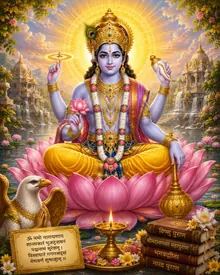
Chapter 1 · Drought in King Mandhata's Kingdom
Yudhishthira said, 'Keshava, what is the Ekadashi of Bhadrapada's bright fortnight called? Tell me its deity and its rite.' Shri Krishna said, 'Lord of the earth, I will tell you the wondrous story that Brahma told the great soul Narada.' Narada said, 'Four-faced one, salutations to you; out of your grace tell me the name of the Ekadashi of Bhadrapada's bright fortnight. I wish to hear it for the worship of Vishnu.' Brahma said, 'Best of sages, you are a Vaishnava, and you have asked well. In the world there is nothing holier than the day of Hari. The bright Ekadashi of Bhadrapada is renowned by the name Padma. On it Lord Hrishikesha is worshipped, and this excellent vow should be kept. I will tell you an auspicious story from the Puranas, by merely hearing which a great sin is destroyed.'
'In the solar line there was a royal sage named Mandhata, an emperor true to his word and full of valour. He cared for his people by dharma as for his own sons. In his kingdom there was no famine, no anguish of mind and no disease. His people were fearless and rich in wealth and grain, and the king's treasury held only wealth earned by just means. Every varna and ashrama kept to its own dharma, and the land of his kingdom was like the wish-granting cow. Many years passed as he ruled in this way. Then once, when the fruit of some deed ripened, no cloud rained on his kingdom for three years. His people were broken by it and tormented by hunger. In that land, struck by fate, the offerings of svaha, svadha and vashat and the recitation of the Vedas ceased. Then the people came to the king and said:'
The people said, 'Tiger among kings, you should hear what your people say. In the Puranas the wise have called the waters nara. They are the Lord's ayana, his dwelling, and so he is called Narayana. The all-pervading Lord Vishnu himself abides in the form of the rain cloud. He alone makes the rain; from rain comes grain, and from grain the people. Best of kings, without it the people are perishing. Best of kings, do something by which our livelihood and welfare may go on.' The king said, 'You have spoken the truth; nothing you have said is false. Grain is called Brahman; on grain everything rests. From grain beings are born, and by grain the world goes on. In the world and at length in the Puranas it is said that people suffer for the faults of their kings. Yet even reflecting with care, I see no fault of my own making. Still, for the good of my people, I will make every effort.' Resolving so, the king set out with a few companions.
Chapter 2 · The Counsel of the Sage Angiras
'Bowing to the Creator, he went into the deep forest and wandered among the hermitages of the great sages where ascetics dwelt. Then the king saw the sage Angiras, son of Brahma, lighting up the quarters with his radiance like a second Brahma. Seeing him, the self-controlled king was glad, got down from his carriage and with joined palms bowed at his feet. The sage greeted the king with blessings and asked after the welfare of the seven limbs of his kingdom. The king told of his welfare and asked after the sage's. The sage gave him a seat and arghya, and as the king sat beside him, asked why he had come. The king said: Lord, I was ruling the earth by the rule of dharma, yet drought has come, and I do not know the cause. I have come to you to clear this doubt. Give my people ease by providing for their livelihood and welfare.'
'The sage said: O king, this is the Krita age, held to be the finest of the ages. In it people are devoted to Brahman, and dharma stands on all four of its feet. In this age only brahmins practise austerity, and no others. King of kings, in your realm a shudra is practising austerity, and that is why the clouds do not rain. Make an effort to kill him, so that this fault may be quieted. The king said: I will not kill this innocent man who is practising austerity. Tell me a remedy rooted in dharma that will end this calamity.'
Chapter 3 · The Padma Ekadashi Vow and the Rain
'The sage said: If that is so, O king, keep the vow of Ekadashi. In the bright fortnight of Bhadrapada is the Ekadashi renowned by the name Padma. By the power of its vow there will surely be good rain. It grants every success and destroys every calamity. O king, keep its vow with your people and household. Hearing the sage's words, the king returned home, and in the bright fortnight of Bhadrapada kept the vow of Padma together with all his people of the four varnas. O king, when the vow was kept in this way, the clouds began to rain, the earth was flooded with water and grew rich with crops. Through the power of that great sage the people found happiness. So this excellent vow should be kept.'
'On this day give a brahmin a pot full of water wrapped in cloth, with curd and rice, together with an umbrella and shoes, and say this mantra: Govinda, called Budha-Shravana, salutations to you again and again. Destroy the flood of sins and grant every happiness. You give enjoyment and liberation and bring happiness to the world. O king, by reading and hearing this a person is freed from every sin.'
How to Read Shri Parivartini (Padma) Ekadashi Vrat Katha
On Bhadrapada Shukla Ekadashi, bathe in the morning, take the vow of fasting and worship Lord Hrishikesha (Vishnu). In the katha, King Mandhata kept this vow together with all his people. On this same day give a brahmin a pot of water wrapped in cloth, curd and rice, an umbrella and shoes, say the mantra 'namo namaste Govinda', and break the fast the next day, Dwadashi, within the parana muhurat.
About Shri Parivartini (Padma) Ekadashi Vrat Katha
The Parivartini (Padma) Ekadashi Vrat Katha is told in three chapters. In the first, no rain falls for three years in the kingdom of the righteous King Mandhata, and his hungry people ask him for a remedy. In the second, in the forest, the sage Angiras names a cause of the drought, and the king refuses to kill an innocent ascetic and asks for a remedy rooted in dharma instead. In the third, the sage teaches the Padma Ekadashi vow, rain falls when the king keeps it with his people, and the mantra for the gift follows.
This vow is kept on the Ekadashi of Bhadrapada's bright fortnight, also called Parivartini, Parsva, Padma, Jaljhulni or Vamana Ekadashi. Tradition holds that on this day Lord Vishnu turns over in his sleep. That episode is not in this chapter of the Padma Purana, which gives the Ekadashi the name Padma.
The Parivartini (Padma) Ekadashi Vrat Katha has no named author. It is the fifty-seventh chapter of the Uttara Khanda of the Padma Purana, in which Lord Krishna tells Yudhishthira the story Brahma told Narada. The text given here is a verse-by-verse translation of that chapter's 41 Sanskrit verses.
Benefits of the Parivartini Ekadashi Vrat Katha
According to the katha, Padma Ekadashi grants every success and destroys every calamity; by this vow the three-year drought in King Mandhata's kingdom ended and abundant rain fell; and reading or hearing it frees a person from every sin.
Frequently asked questions
How many chapters does the Parivartini Ekadashi Vrat Katha have?
It has three chapters, based on the 41 verses of the fifty-seventh chapter of the Padma Purana's Uttara Khanda.
What is the difference between Parivartini and Padma Ekadashi?
There is none. The Padma Purana calls Bhadrapada Shukla Ekadashi Padma, and by tradition it is also called Parivartini, Parsva, Jaljhulni or Vamana Ekadashi.
Why did King Mandhata not carry out the killing the sage proposed?
The sage Angiras named a shudra's austerity as the cause of the drought and told the king to make an effort to kill him, but the king said he would not kill an innocent man practising austerity, and asked instead for a remedy rooted in dharma. The sage then taught him the Padma Ekadashi vow, and it was the vow that brought the rain.
What should be given on Padma Ekadashi?
According to the katha, one should give a brahmin a pot full of water wrapped in cloth, curd and rice, an umbrella and shoes, and pray with the mantra 'namo namaste Govinda' for the destruction of sin and for happiness.