 Astha SangrahASTHA SANGRAHhttps://asthasangrah.com
Shri Ram Aarti
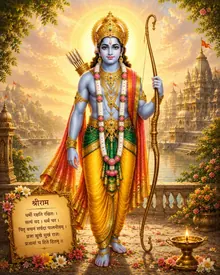
Shri Ram Aarti, Aarti Kije Shri Raghuvar Ji Ki, is the most widely sung aarti of Lord Rama, sung after reading the Ramcharitmanas and the Sundarkand, on Ram Navami and in the daily evening puja. The full text is given here with the meaning of every stanza.
Reading details
आरती कीजै श्री रघुबर की।
सत चित आनंद शिव सुंदर की॥
Aarti kijai Shri Raghubar ki. Sat chit anand Shiv sundar ki.
दशरथ-तनय कौसिला-नंदन,
सुर-मुनि-रक्षक दैत्य-निकंदन,
अनुगत-भक्त भक्त-उर-चंदन,
मर्यादा-पुरुषोत्तम वर की॥
Dashrath-tanay Kausila-nandan, sur-muni-rakshak daitya-nikandan, anugat-bhakt bhakt-ur-chandan, maryada-purushottam var ki.
निर्गुन-सगुन, अरूप-रूपनिधि,
सकल लोक-वंदित विभिन्न विधि,
हरण शोक-भय, दायक सब सिधि,
मायारहित दिव्य नर-वर की॥
Nirgun-sagun, arup-rupnidhi, sakal lok-vandit vibhinn vidhi, haran shok-bhay, dayak sab sidhi, mayarahit divya nar-var ki.
जानकिपति सुराधिपति जगपति,
अखिल लोक पालक त्रिलोक गति,
विश्ववंद्य अनवद्य अमित-मति,
एकमात्र गति सचराचर की॥
Jankipati suradhipati jagpati, akhil lok palak trilok gati, vishvavandya anavadya amit-mati, ekmatra gati sacharachar ki.
शरणागत-वत्सल-व्रतधारी,
भक्त कल्पतरु-वर असुरारी,
नाम लेत जग पावनकारी,
वानर-सखा दीन-दुख-हर की॥
Sharnagat-vatsal-vratdhari, bhakt kalptaru-var asurari, naam let jag pavankari, vanar-sakha deen-dukh-har ki.
For a vrat, some devotees read it several times in one sitting: 11, 21, or 108. Save your reading count with this counter.
How to Read Shri Ram Aarti
Every evening, on Ram Navami, or after reading the Ramcharitmanas and the Sundarkand, light a ghee lamp before a picture of Lord Ram, Mother Sita, Lakshman and Hanuman and perform the aarti. After every stanza repeat the refrain 'Aarti kijai Shri Raghubar ki, sat chit anand Shiv sundar ki'.
About Shri Ram Aarti
The Shri Ram Aarti, Aarti Kije Shri Raghuvar Ji Ki, has a refrain and four stanzas. It sings of Lord Ram as the son of Dashrath and Kaushalya, as both beyond qualities and endowed with them, as Janaki's husband and the refuge of the three worlds, and as the friend of the monkeys who has vowed to cherish all who seek his shelter. Its refrain calls him truth, consciousness and bliss.
This page gives the full text in Devanagari with a simple Hindi meaning for every stanza. The text follows the standard printed aarti collection; some websites carry variant readings such as 'anup rup nidhi' for 'arup-rupnidhi' and 'nav nidhi' for 'sab sidhi'.
No line of the Shri Ram Aarti, Aarti Kije Shri Raghuvar Ji Ki, names its composer, so it is held to be a traditional composition. It has long been printed in the standard aarti collections as the aarti of Lord Maryada Purushottam, and is sung most of all at Ramayan readings, the Sundarkand and Ram Navami.
Benefits of Reciting the Shri Ram Aarti
It is believed that performing this aarti with faith removes grief and fear, and by Lord Ram's grace brings every task to success, as the aarti itself says: 'haran shok-bhay, dayak sab sidhi'. Singing it after a Ramayan reading or the Sundarkand is held to complete the recitation.
Frequently asked questions
Which is the most widely sung aarti of Shri Ram?
'Aarti Kije Shri Raghuvar Ji Ki, Sat Chit Anand Shiv Sundar Ki' is the most widely sung aarti of Lord Ram, and it is the one printed as Ram's aarti in the aarti collections. Goswami Tulsidas's 'Shri Ramchandra Kripalu Bhajman' is also sung at aarti time, though it is properly a stuti.
When is this aarti sung?
In the daily evening puja, on Ram Navami and Vijayadashami, and at the end of a reading of the Ramcharitmanas, an Akhand Ramayan or the Sundarkand.
Who composed the Shri Ram Aarti?
No line of the aarti names its composer, so it is held to be a traditional composition.
Are the Shri Ram Aarti and the Ram Stuti the same?
No. The Ram Stuti, 'Shri Ramchandra Kripalu Bhajman', is a hymn from Goswami Tulsidas's Vinay Patrika, while this aarti, 'Aarti Kije Shri Raghuvar Ji Ki', is a separate traditional composition sung while offering the lamp.
What is the structure of the aarti?
A refrain and four stanzas. The refrain 'Aarti kijai Shri Raghubar ki' is repeated after every stanza.