
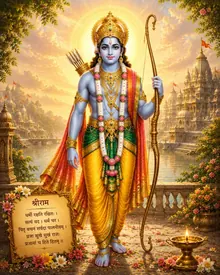
This festival is celebrated with special grandeur in Ayodhya and Janakpur (Nepal), where a grand wedding procession is taken out. Check a local panchang for the exact date.
Significance of Vivah Panchami
According to the Ramcharitmanas, King Janak had set the condition of breaking Shiva's bow for his daughter Sita's marriage. After the attempts of many kings and princes failed, Lord Shri Ram, accompanying his guru Vishwamitra to Janakpur, broke the bow with ease.
As soon as the bow broke, Mata Sita placed the wedding garland around Lord Shri Ram's neck, and King Janak, with great joy, had their wedding solemnized on Margashirsha Shukla Panchami. On this same occasion, Ram's three brothers, Bharat, Lakshman, and Shatrughna, were also married to Sita's sisters and cousins.
This wedding is regarded as the beginning of the ideal married life of Maryada Purushottam Shri Ram and Jagat Janani Sita, and devotees observe this day as an occasion to express their reverence for the divine couple.
How Vivah Panchami Is Celebrated
In Ayodhya and Janakpur (Nepal), a grand celebration is held on this day, where idols of Ram and Sita are decorated as bride and groom, and a grand wedding procession is taken out, along with a symbolic wedding ceremony.
At homes and temples, the Bal Kand of the Ramcharitmanas is recited, especially the episode of Sita's Swayamvar and the wedding, along with the aarti and worship of Lord Shri Ram and Mata Sita.
An interesting belief also holds that performing one's own wedding on Vivah Panchami is not considered auspicious, since Ram and Sita faced exile and many hardships after their wedding, so this day is meant for celebrating the divine wedding, not as a muhurat for ordinary weddings.
Vivah Panchami Puja Vidhi
Bathe in the morning and worship Lord Shri Ram and Mata Sita. Recite the episode of Sita's Swayamvar and wedding from the Bal Kand of the Ramcharitmanas. If possible, decorate idols of Ram and Sita as bride and groom, perform the aarti, and distribute prasad.
About Vivah Panchami
Vivah Panchami is celebrated on Margashirsha Shukla Panchami in remembrance of the wedding of Lord Shri Ram and Mata Sita. This page covers the festival's significance, the legend of Sita's Swayamvar, and the tradition of its celebration.
The information on this page is presented with easy-to-read sizing and print support.
Frequently Asked Questions
When is Vivah Panchami observed?
Vivah Panchami is observed every year on Margashirsha Shukla Panchami, the day on which Lord Shri Ram and Mata Sita were married.
Where is Vivah Panchami celebrated most grandly?
This festival is celebrated with the greatest grandeur in Ayodhya (Ram's birthplace) and Janakpur, Nepal (Sita's birthplace), where a wedding procession and special celebrations are organized.
Is it considered auspicious to marry on Vivah Panchami?
According to a common belief, marrying on this day is not considered auspicious, since Ram and Sita faced exile and hardship after their wedding, this day is observed only for celebrating the divine wedding.
What is recited on Vivah Panchami?
On this day, the episode of Sita's Swayamvar and the wedding, as described in the Bal Kand of the Ramcharitmanas, is recited, and the aarti of Lord Shri Ram and Mata Sita is performed.