
These follow the sunrise-tithi convention; the actual observance can shift by a day depending on region and tradition, so confirm with a local panchang closer to the date.
Significance of Shri Ram Navami
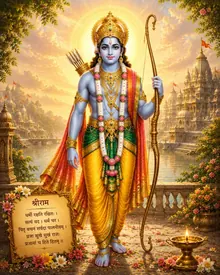
Ram Navami is celebrated to mark the birth of Shri Ram, the seventh incarnation of Lord Vishnu, born to King Dasharatha and Queen Kaushalya in Ayodhya. It is believed that Lord Vishnu himself took birth as Shri Ram to free the earth from Ravana's tyranny and to re-establish dharma. This festival falls on the Navami tithi of the Shukla Paksha of the Chaitra month, which is also the ninth and final day of Chaitra Navratri.
According to the legend, King Dasharatha remained without a child for a long time, after which he had the Putrakameshti Yagna performed under the guidance of sage Rishyasringa. Dasharatha distributed the kheer that appeared from the sacrificial fire among his three queens, Kaushalya, Kaikeyi, and Sumitra, from which Kaushalya bore Ram, Kaikeyi bore Bharat, and Sumitra bore the twins Lakshman and Shatrughna. Being an incarnation of Vishnu, Shri Ram is believed to have been born at Madhyahna Kaal, that is, at midday, which is why the worship on this day is also performed mainly around midday.
For devotees, Ram Navami symbolises the victory of dharma over adharma. Shri Ram is worshipped as Maryada Purushottam, the ideal man who upholds every duty and propriety, and this day is considered especially auspicious for remembering his exemplary life, sense of duty, and devotion to truth.
How Shri Ram Navami Is Celebrated
On Ram Navami, homes and temples are decorated. In many places, a nine-day recitation of the Ramayana or Ramcharitmanas is organised leading up to this day, concluding on Ram Navami itself. Temples set up a tableau of the infant Shri Ram amid devotional singing, and his birth is celebrated at midday to the sound of conch shells and bells.
Many devotees observe a fast on this day, some keep a nirjala (waterless) fast, others a phalahar (fruit-only) fast, breaking it only after the midday aarti. In Ayodhya, especially large numbers of devotees gather on this day, and a shobha yatra procession is taken out. In Andhra Pradesh and Telangana, 'Sri Rama Navami Kalyanam', a ceremonial re-enactment of the wedding of Shri Ram and Sita, is celebrated as a major event.
Acts of charity, the distribution of prasad, and community feasts are also part of the tradition on this day. In South India, special offerings such as panakam and kosambari are distributed, which are believed to bring relief from the summer heat.
Shri Ram Navami Puja Vidhi
On Ram Navami, bathe in the morning and wear clean clothes. Set up an image or idol of Shri Ram, Mother Sita, Lakshman, and Hanuman at home or in a temple, and perform the worship. Celebrate Shri Ram's birth at midday with an aarti and an offering of bhog. A nirjala or phalahar fast is kept according to one's faith and capacity, and the Ramcharitmanas or Ramayana is recited through the day.
About Shri Ram Navami
Ram Navami is the festival marking the birth of Lord Rama, observed on the Navami tithi of the Chaitra Shukla Paksha. This page covers Ram Navami's significance, the background of King Dasharatha's Putrakameshti Yagna and Shri Ram's birth, the day's customs such as the decorated tableau, fasting, Ramcharitmanas recitation, and the special traditions of Ayodhya and South India, along with the puja vidhi for observing it at home.
This festival arrives with the conclusion of Chaitra Navratri, and is a day to remember Shri Ram's exemplary life as Maryada Purushottam. The information on this page is presented with easy-to-read sizing and print support.
Frequently Asked Questions
When is Ram Navami observed?
Ram Navami is observed every year on the Navami tithi of the Shukla Paksha of the Chaitra month, which is the ninth and final day of Chaitra Navratri.
Why is Ram Navami celebrated?
This festival is celebrated to mark the birth of Shri Ram, the seventh incarnation of Lord Vishnu, to King Dasharatha and Queen Kaushalya in Ayodhya.
At what time is Ram Navami puja performed?
Shri Ram is believed to have been born at Madhyahna Kaal, that is, at midday, so the main worship and birth celebration on this day are also performed around midday.
Is a fast observed on Ram Navami?
Yes, many devotees observe a nirjala or phalahar fast on this day, breaking it only after the midday aarti, the type of fast depends on one's faith and capacity.
What is Sri Rama Navami Kalyanam?
It is a major celebration observed in Andhra Pradesh and Telangana, in which the wedding of Lord Rama and Sita is ceremonially re-enacted.