 Astha SangrahASTHA SANGRAHhttps://asthasangrah.com
Shri Paush Putrada Ekadashi Vrat Katha
The Paush Putrada Ekadashi Vrat Katha is the story of Putrada Ekadashi in Paush's bright fortnight, in which King Suketuman, grieving for want of a son, wanders the forest, meets the Vishvedeva sages at a lake, keeps this vow that very day at their word, and is blessed with a son.
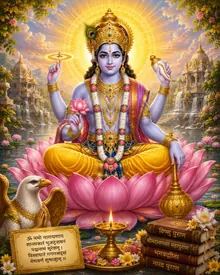
Chapter 1 · The Glory of Putrada, and King Suketuman's Grief
Yudhishthira said, 'Krishna, you have described the auspicious Saphala Ekadashi. Now kindly tell me which Ekadashi falls in Paush's bright fortnight, what its name is, what its rites are and which god is worshipped on it? Supreme person, with whom is Hrishikesha pleased on it?' Shri Krishna said, 'Listen, O king; wishing the good of the people, I will tell you of the Ekadashi of Paush's bright fortnight. O king, it should be kept with care by the rite described before. Its name is Putrada, and it is a supreme tithi that removes every sin. Its presiding deity is Lord Narayana, giver of wishes and success; in the three worlds, with all that moves and is still, there is no tithi greater. By it Hari makes a person learned and renowned. O king, hear its sin-destroying story.'
'Long ago in the city of Bhadravati there was a king named Suketuman, and his queen was named Champaka. The sonless king's years passed in longing, but he got no son to carry on his line. That righteous king brooded for a long time: what shall I do, where shall I go, how shall I get a son? Neither in his kingdom nor in his city did King Suketuman find happiness, and he lived ever sorrowful with his wife. Husband and wife were always sunk in worry and grief. His ancestors drank the water he offered them as though it were warm, and grieved, thinking: after the king we see no one who will satisfy us.'
'Neither kinsmen nor friends, ministers nor companions, elephants, horses nor foot-soldiers gave the king any joy. Despair stayed always in his mind: for a sonless man, birth bears no fruit. A sonless man's house is empty and his heart forever sad; without a son there is no release from the debts owed to the ancestors, the gods and men. So a person should strive with every effort to have a son; such people gain fame in this world and a good end in the next. In the homes of the virtuous where a son is born dwell long life, health and wealth. O king, without merit and devotion to Vishnu, sons, wealth and learning are not gained; this is my conviction. Thinking so, the king found no peace. Through the night and at dawn he brooded on it, and Suketuman even thought of taking his own life. But reflecting that suicide leads to a bad end, and seeing his body declining and himself still sonless, the king again turned his mind to what would be for his good.'
Chapter 2 · Wandering the Forest, and the Sages' Lake
'Then the king mounted his horse and rode into the deep forest. None of his priests or others knew where the king had gone. In that dense forest, full of deer and birds, the king wandered, looking at the trees: banyan, pipal, bel, date palm, jackfruit, bakula, saptaparna, tendu, tilaka, sal, palmyra, tamala, sarala, ingudi, arjuna, lasora, sallaki, karonda, patala, ber, ashoka and palasha. He saw jackals, hares, wild cats, buffaloes, porcupines and yak-deer, snakes coming out of anthills, and wild elephants in rut roaming with their calves, and four-tusked herd-leaders amid bands of she-elephants. Seeing them, the king remembered his own elephants.'
'Wandering among them, the king looked splendid, and he saw that forest full of great wonders. On the path, hearing the cries of jackals and the calls of owls, seeing bears and deer, he roamed the forest. As he took in the forest so, the sun reached the middle of the sky, and the king, racked by hunger and thirst, ran this way and that. With his throat parched, the king began to think: what deed have I done that I should meet such suffering? I have satisfied the gods with sacrifices and worship, and the brahmins with gifts and sweet food. I have always cared for my people as my own sons. Why then has such terrible suffering come to me?'
'Sunk in this worry, the king went on into the forest, and by the power of his merit he saw an excellent lake, with fish swimming in it, adorned with lotuses and graced by waterfowl, chakravaka birds and royal swans, and full of crocodiles, many fish and other water creatures. Near that lake were many hermitages of sages. The king saw auspicious omens: his right eye and right hand began to throb, telling him of good fortune. Seeing sages chanting on the bank of the lake, the king was overjoyed, got down from his horse and stood before the sages. With folded hands, prostrating again and again, he bowed to each of those sages of praiseworthy vows. The sages said: O king, we are pleased. The king asked: who are you, what are your names, and why have you gathered here? Tell me truly.'
Chapter 3 · The Vishvedevas' Counsel, and the Birth of a Son
'The sages said: O king, we are the Vishvedevas and have come here to bathe; the month of Magh is near, five days from today. O king, today is the Ekadashi named Putrada; Lord Vishnu gives sons to those who keep Putrada. The king said: this is my very doubt, the great matter of having a son. If you are pleased, grant me a son. The sages said: O king, this very day is the one named Putrada; it is the renowned Ekadashi; keep this excellent vow. Lord of kings, by our blessing and Lord Keshava's grace you will surely gain a son.'
'At their word the king kept that excellent vow of Putrada with due rites, as the sages taught. Breaking the fast on Dwadashi and bowing to the sages again and again, the king returned home, and the queen conceived. When the time came, a radiant son was born as the fruit of that meritorious deed, who pleased his father and became the protector of the people.'
'So, O king, this excellent vow of Putrada should be kept; for the good of the people I have told it to you. Those who keep the Putrada vow with a focused mind gain sons in this world and go to heaven after death. O king, by reading and hearing this one gains the fruit of the Agnishtoma sacrifice.'
How to Read Shri Paush Putrada Ekadashi Vrat Katha
On Paush Shukla Ekadashi, keep the fast by the usual rite: a single meal on Dashami, and on Ekadashi a morning bath, the vow, worship of Lord Narayana and a night vigil. Couples wishing for a child keep this vow together, and break the fast the next day, Dwadashi, within the parana muhurat.
About Shri Paush Putrada Ekadashi Vrat Katha
The Paush Putrada Ekadashi Vrat Katha is told in three chapters. In the first, Krishna names this Ekadashi Putrada and describes the grief of King Suketuman and Queen Champaka of Bhadravati at having no son, so deep that the king even thinks of ending his life. In the second, the king wanders alone through a dense forest and, in the hunger and thirst of midday, comes upon sages' hermitages by a lake. In the third, the sages reveal themselves as the Vishvedevas and tell him that day is Putrada; he keeps the vow at their word and is blessed with a radiant son.
This vow is kept on the Ekadashi of Paush's bright fortnight. A second Ekadashi named Putrada falls in Shravan's bright fortnight, with a different story.
The Paush Putrada Ekadashi Vrat Katha has no named author. It is the forty-first chapter of the Uttara Khanda of the Padma Purana, in which Lord Krishna tells the story to Yudhishthira. The text given here is a verse-by-verse translation of that chapter's 53 Sanskrit verses.
Benefits of the Paush Putrada Ekadashi Vrat Katha
The katha closes by saying that those who keep the Putrada vow with a focused mind gain sons in this world and go to heaven after death, and that reading or hearing this katha brings the fruit of the Agnishtoma sacrifice.
Frequently asked questions
How many chapters does the Paush Putrada Ekadashi Vrat Katha have?
It has three chapters, based on the 53 verses of the forty-first chapter of the Padma Purana's Uttara Khanda.
Who told King Suketuman about the Putrada vow?
The Vishvedeva sages chanting on the bank of a forest lake, who had come there for the Magh bath. They told him that very day was Putrada Ekadashi, and the king kept the vow that same day.
How many times a year does Putrada Ekadashi come?
Twice: once in Paush's bright fortnight (this page's story), and again in Shravan's bright fortnight, whose story is that of King Mahijit. Both are kept with the wish for a child.
When is Paush Putrada Ekadashi in 2027?
Paush Putrada Ekadashi falls on Monday, 18 January 2027. The parana time will be given on the festival page as the date approaches.