 Astha SangrahASTHA SANGRAHhttps://asthasangrah.com
Shri Amalaki Ekadashi Vrat Katha
The Amalaki Ekadashi Vrat Katha is the story of Amalaki Ekadashi in Phalgun's bright fortnight, in which the sage Vasishtha tells King Mandhata how the amla tree came to be, and Lord Vishnu teaches the sages the rite of worshipping an image of Parashurama beneath the amla and keeping vigil there at night.
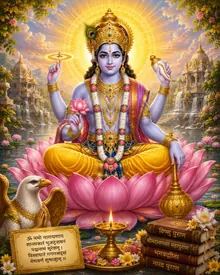
Chapter 1 · How the Amla Tree Came to Be
Yudhishthira said, 'Krishna, I have heard the glory of Vijaya, whose fruit is great. Now tell me the name of the Ekadashi of Phalgun's bright fortnight.' Shri Krishna said, 'Son of Dharma, fortunate one, listen; I will tell you what the great Vasishtha said to Mandhata when he was asked.' Vasishtha said, 'O king, the Ekadashi of Phalgun is spoken of above others: this vow of the amalaki is holy and bestows Vishnu's world. One should go beneath the amla tree and keep vigil there; by keeping vigil at night one gains the fruit of giving a thousand cows.' Mandhata said, 'Best of the twice-born, tell me all about where the amalaki came from, for I am very curious. Why is it holy and a destroyer of sin, and why does keeping vigil beside it bring the fruit of a thousand cows?'
Vasishtha said, 'Fortunate one, I will tell you how it came to be on earth. The amalaki is a great tree that destroys every sin. Long ago, when there was one ocean everywhere and all that moves and is still had perished, when gods, asuras, serpents and rakshasas had perished too, the god of gods, the eternal supreme Self, went to his own imperishable supreme state. Then, as Brahma awoke and spat, a drop as bright as the moon came from his mouth and fell upon the earth. From that drop arose the great amla tree, full of branches and twigs and bowed down with the weight of its fruit. It is called the first sprout among all trees. After this Brahma created all these beings: gods, danavas, gandharvas, yakshas, rakshasas, serpents and the spotless great sages.'
'The gods came to where the dhatri, the amla dear to Hari, stood. Seeing it, fortunate one, they were greatly amazed and stood there thinking: we do not know this tree. As they were thinking so, a bodiless voice spoke: this amalaki is the finest of trees and dear to Vishnu. Merely remembering it brings the fruit of giving a cow, touching it double that merit, and bearing its fruit triple; so the amalaki should always be served with every effort. It is called the remover of every sin, the sin-destroying one devoted to Vishnu. Vishnu dwells in its roots, Pitamaha Brahma above them, Lord Rudra the supreme lord in its trunk, all the sages in its branches, the deities in its twigs, the gods in its leaves, the Maruts in its flowers, and all the Prajapatis in its fruit. I have called this dhatri the dwelling of all the gods, so the devotees of Vishnu should worship it.'
Chapter 2 · Lord Vishnu Reveals Himself and Teaches the Vow
The sages said, 'Who are you? We do not know you. Why have you come? Are you a god or someone else? Tell us truly.' The voice said, 'He who is the maker of all beings and all worlds, who sees all, who is looking now upon the amazed sages: I am that eternal Vishnu.' Hearing the god of gods, the sages, sons of Brahma, their eyes wide, praised that god without beginning or end: 'Salutations to the Self of all beings, the supreme Self. Salutations ever to Achyuta, salutations to Ananta. Salutations to Damodara, the seer, the lord of sacrifice.' When the sages praised him so, Lord Hari was pleased and said, 'What wish shall I grant you?' The sages said, 'Lord, if you are pleased, then for our good tell us of a vow that gives the fruit of heaven and liberation, gives wealth and grain, is holy and satisfies the soul, takes little effort and bears much fruit, is the finest of vows, and by keeping which a person is honoured in Vishnu's world.'
Vishnu said, 'If in Phalgun's bright fortnight the Dwadashi is joined with the Pushya nakshatra, it gives great merit and destroys grave sins. Best of brahmins, hear what should be done on it above all: go to an amalaki and keep vigil there. One who does so is freed from every sin and gains the fruit of a thousand cows. O brahmins, I have told you the finest of vows; worshipping Lord Achyuta there on that day, a person attains Vishnu's world.' The sages said, 'Tell us the rite of this vow; how is it made complete? What are its mantras and salutations, and which deity is named for it? How should gifts be given, how should one bathe, what is the rite of worship, and what is the mantra of the arghya? Tell us all this exactly.'
Chapter 3 · The Bath, Parashurama's Image and Worship Beneath the Amla
Vishnu said, 'Best of brahmins, hear rightly the rite of this vow. After cleaning the teeth, take this vow: lotus-eyed Achyuta, today, on Ekadashi, I will stay without food and eat tomorrow; be my refuge. Do not speak with the fallen, thieves, heretics, the ill-behaved, those who break all bounds and those who wrong their teacher's wife. Then in the afternoon, self-restrained, bathe by rite in a river, pond, well or at home. Before bathing, apply clay and say this mantra: O earth, trodden by horses, by chariots and by Vishnu's feet, O clay, take away the sins and misdeeds I have done. Then say to the water: you are the life of all beings and the protector of the body; lord of the creatures born of sweat and of the earth, god of the waters, salutations to you. The bath in every tirtha, lake, spring, river and divine pool, may it be mine.'
'Then have a golden image of the sage Jamadagnya, Parashurama, made from a masha of gold, or half or a quarter of that. Returning home, perform worship and homa, then take all the materials and go to the amalaki. Cleaning all around the amalaki, install with mantras a whole, unbroken kalash containing the five gems and divine fragrances, set out with an umbrella and shoes, smeared with white sandal, a garland about its neck and perfumed with incense. Set a very lovely row of lamps all around it. On it place a vessel filled with divine puffed grain, and on the vessel install the image of Lord Jamadagnya of great radiance.'
'Then worship him limb by limb with these mantras: saying Vishokaya namah worship the feet; Vishvarupine the knees; Ugraya the thighs; Damodaraya the waist; Padmanabhaya the belly; Shrivatsadharine the chest; Chakrine the left arm; Gadine the right arm; Vaikunthaya the neck; Yajnamukhaya the mouth; Vishokanidhaye the nose; Vasudevaya the eyes; Vamanaya the forehead; Ramaya the brows; and saying Sarvatmane namah, the head. These are the mantras of worship. Then, with a heart full of devotion, offer arghya to the god of gods with a fine fruit.'
Chapter 4 · The Vigil, Circumambulation, Gifts and the Vow's Fruit
'Then keep the vigil with a heart full of devotion: spend the whole night in dance, song and music, in stories of dharma, hymns and tales of Vishnu. Chanting Vishnu's names, circle the dhatri one hundred and eight or twenty-eight times. At dawn perform Hari's arati, honour a brahmin and offer him everything: the kalash with Parashurama, a pair of garments and shoes, saying: in the form of Jamadagnya may Lord Keshava be pleased with me. Then touch the amalaki and circle it, bathe by rite and feed brahmins, and after that eat yourself, surrounded by your family.'
'I will tell you all the merit that comes of doing this: whatever merit lies in every tirtha, whatever fruit in every gift, and more than that of every sacrifice, all this he surely gains. I have told you all this finest of vows.' Saying this much, the lord of the gods vanished on the spot, and all those sages carried it all out. Vasishtha said, 'So, lord of kings, you too should keep this mighty vow, which frees one from every sin.'
How to Read Shri Amalaki Ekadashi Vrat Katha
On Ekadashi, after cleaning the teeth, take the vow of fasting, and in the afternoon apply clay and bathe by rite. Have a small golden image of Parashurama made, worship and offer homa at home, then go to an amla tree; clean the ground, install a water-filled kalash with the five gems, place a vessel of puffed grain and the image on it, light lamps, worship limb by limb with mantras such as 'Vishokaya namah' and offer arghya with a fruit. Keep vigil all night, circle the amla 108 or 28 times, at dawn perform arati and give a brahmin the kalash, garments and shoes, feed brahmins, then break the fast with your family.
About Shri Amalaki Ekadashi Vrat Katha
The Amalaki Ekadashi Vrat Katha is told in four chapters. In the first, Vasishtha tells how, after the dissolution, the amla tree grew from a drop that fell from the mouth of the newly woken Brahma, and how all the gods dwell in it from root to fruit. In the second, Lord Vishnu appears before the sages and teaches the vow of Phalgun Shukla Dwadashi joined with Pushya, and the vigil beside the amla. The third gives the bathing mantras, the golden image of Parashurama, the installation of the kalash and the mantras for worshipping each limb. The fourth covers the night vigil, the circumambulation, the gifts and the fruit of the vow.
This vow is kept on the Ekadashi of Phalgun's bright fortnight, between Maha Shivratri and Holi. In Kashi, Rangbhari Ekadashi is celebrated on this same day.
The Amalaki Ekadashi Vrat Katha has no named author. It is the forty-fifth chapter of the Uttara Khanda of the Padma Purana, in which Lord Krishna tells Yudhishthira the dialogue in which the sage Vasishtha tells King Mandhata how the amla came to be and the rite of this vow. The text given here is a verse-by-verse translation of that chapter's 63 Sanskrit verses.
Benefits of the Amalaki Ekadashi Vrat Katha
According to the katha, remembering the amla brings the merit of giving a cow, touching it double and bearing its fruit triple; one who keeps vigil beside the amla is freed from every sin and gains the fruit of a thousand cows; and the merit of this vow is said to exceed that of every tirtha, every gift and every sacrifice.
Frequently asked questions
How many chapters does the Amalaki Ekadashi Vrat Katha have?
It has four chapters, based on the 63 verses of the forty-fifth chapter of the Padma Purana's Uttara Khanda.
According to the Padma Purana, how did the amla tree come to be?
After the dissolution, when Brahma awoke and spat, a drop shining like the moon fell from his mouth to the earth, and from it the great amla tree arose, which is called the first of all trees.
Why is Parashurama worshipped on Amalaki Ekadashi?
In the katha Lord Vishnu himself prescribes worship of a golden image of Jamadagnya, Parashurama, set on a kalash beneath the amla, and says that at dawn, when giving the kalash away, one should say: in the form of Jamadagnya may Lord Keshava be pleased.
How many times should the amla be circled?
According to the katha, during the night vigil one should circle the amla one hundred and eight or twenty-eight times while chanting Vishnu's names, and in the morning, after the gifts, touch the amla and circle it once more.