 Astha SangrahASTHA SANGRAHhttps://asthasangrah.com
Shri Papmochani Ekadashi Vrat Katha
The Papmochani Ekadashi Vrat Katha is the story of Papmochani Ekadashi in Chaitra's dark fortnight, in which the sage Lomasha tells King Mandhata how the apsara Manjughosha broke the austerity of Medhavi, son of the sage Chyavana, how Medhavi cursed her to become a pishachi, and how this very vow freed them both from their sin.
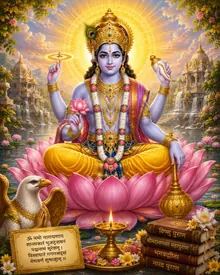
Chapter 1 · Medhavi and Manjughosha in the Chaitraratha Forest
Yudhishthira said, 'I have heard the glory of Amalaki Ekadashi in Phalgun's bright fortnight. Now which Ekadashi falls in the dark fortnight of Chaitra?' Shri Krishna said, 'Listen, king of kings; I will tell you the sin-destroying account that the sage Lomasha gave when the emperor Mandhata asked him.' Mandhata said, 'Lord, for the good of the people I wish to hear what the Ekadashi in Chaitra's first fortnight is called, what its rite is and what its fruit. Tell me, out of your grace.' Lomasha said, 'The Ekadashi of Chaitra's dark fortnight is renowned by the name Papmochani, and it destroys the state of a pishacha. O king, hear its wondrous story, which grants wishes and success, is auspicious, destroys sin and bestows dharma.'
'Long ago, in the Chaitraratha forest that the apsaras frequent, when spring had come and the woods were humming with bees, the daughters of the Gandharvas made merry with the Kinnaras to the sound of instruments, and Indra and the other gods were at play. No place gave more delight than the Chaitraratha forest. In that forest the sages practised great austerity. There lived a celibate sage named Medhavi. A renowned apsara named Manjughosha set out to enchant that best of sages. Afraid of him, she stopped a kos away from the hermitage, and from there began to spread her charm.'
'She played the vina and sang very sweetly. Seeing her singing, adorned with flowers and sandal paste, Kama, born of the mind, who longed to conquer the sages devoted to Shiva, took up his dwelling in her body. Making her brows his bow, her sidelong glance the bowstring and her lashed eyes his arrows, and making her bosom his camp, Kama set out for victory. Manjughosha became Kama's very army. Seeing the sage Medhavi, she too was struck by desire. Medhavi, his body glowing with youth and wearing a white sacred thread, shone like a second god of love. He lived in the lovely hermitage of the sage Chyavana.'
'Staying there and gazing at that best of sages, Manjughosha fell under Kama's sway and began to sing softly. Seeing her sing, with jingling bangles, tinkling anklets and girdle, the great sage was forcibly carried into delusion by Kama and his army. Seeing the sage in that state, Manjughosha came near and enchanted him with gestures, moods and sidelong glances. Setting the vina down, she embraced the lord of sages as a creeper clings to a tree swaying in the force of the wind. Medhavi, best of sages, made love with her. There in that forest, seeing her lovely body, he lost hold of the Shiva principle within him and fell under the sway of desire.'
Chapter 2 · Fifty-Seven Years and the Curse of the Pishachi
'Lost in desire, the sage knew neither night nor day. Because the sage had let his discipline lapse, many years went by. Then Manjughosha made ready to go to the world of the gods, and as she was leaving she said to the great sage, who was still delighting in her: Brahmin, give me leave to go to my own land. Medhavi said: Fair-faced one, you came only this evening. Stay with me until the morning sandhya has come. Hearing the sage's words, she was afraid. Best of kings, for fear of the sage's curse, she went on delighting him for many years more. So she stayed with him fifty-five years, nine months and three days, and to the sage it all seemed like half a night. When that time had passed she said to the sage again: Brahmin, give me leave; I must go to my home.'
'Medhavi said: It is only now dawn; listen to me. Stay until I have performed my sandhya worship. Hearing the sage say this, she was filled with mirth, and smiling a little, she replied: Best of brahmins, sinless one, how long does your sandhya last? Be kind to me and consider how much time has passed. Hearing her, the great brahmin's eyes went wide with astonishment, and he reckoned the time that had gone: fifty-seven years had passed with her. Then he blazed at her with anger like a wreath of flames. Shooting sparks from his eyes, the sage in his fury saw her as the very form of Time, the destroyer of his austerity.'
'Seeing the austerity he had earned with such toil destroyed with her, the sage, his lips trembling and his senses in turmoil, spoke, and Medhavi cursed her: Become a pishachi. Shame on you, sinful one, wicked one, faithless one, lover of sin. Scorched by his curse, she stood bowed in humility, and seeking his grace she said to the sage: Best of brahmins, have mercy on me; soften this curse. Friendship with the good is made by just seven words spoken or seven steps walked together, and Brahmin, I have spent many years with you. For this reason, my lord, keeper of good vows, have mercy on me.'
Chapter 3 · Release Through the Papmochani Vow and Its Fruit
'The sage said: Good woman, hear my words that will free you from the curse. Sinful one, what can I do? You have destroyed my great austerity. In the dark fortnight of Chaitra there falls an auspicious Ekadashi named Papmochani, which wipes out every sin. Lovely one, when you keep its vow your state as a pishachi will pass away. Saying this, Medhavi went to his father's hermitage. Seeing him arrive, Chyavana said to him: Son, what is this you have done? You have destroyed your own merit.'
'Medhavi said: Father, I have sinned; I took my pleasure with an apsara. Father, tell me an atonement by which the sin may be destroyed. Chyavana said: In the dark fortnight of Chaitra there falls the Ekadashi named Papmochani. Son, when its vow is kept, a heap of sins is destroyed. Hearing his father's words, Medhavi kept that excellent vow. His sin was destroyed and he was once again endowed with austerity. In the same way Manjughosha too kept this excellent vow. Through the vow of Papmochani she was freed from the state of a pishachi, and taking on a divine form, that finest of apsaras went to heaven.'
Lomasha said, 'O king, the noble people who keep the vow of Papmochani have every sin of theirs destroyed. O king, reading or hearing this brings the fruit of giving a thousand cows. Even one who has killed a brahmin, stolen gold, drunk liquor or gone to the teacher's wife is freed from sin by keeping this vow. Kept, this excellent vow bestows great merit.'
How to Read Shri Papmochani Ekadashi Vrat Katha
On Chaitra Krishna Ekadashi, bathe in the morning, take the vow of fasting and worship Lord Vishnu. In the katha, Medhavi kept this vow as an atonement at the word of his father Chyavana; keep the fast in that spirit, read or hear this katha, remember the Lord at night, and break the fast the next day, Dwadashi, within the parana muhurat.
About Shri Papmochani Ekadashi Vrat Katha
The Papmochani Ekadashi Vrat Katha is told in three chapters. In the first, in the Chaitraratha forest in spring, the apsara Manjughosha enchants Medhavi, son of the sage Chyavana. In the second, fifty-seven years seem to Medhavi like half a night, and when he realises how much time has passed he curses her to become a pishachi. In the third, Medhavi tells her of the Papmochani Ekadashi vow, receives the same atonement from his father Chyavana, and both are freed from sin by this vow.
This vow is kept on the Ekadashi of Chaitra's dark fortnight, between Holi and Chaitra Navratri. It is the last Ekadashi before the Hindu new year on Chaitra Shukla Pratipada.
The Papmochani Ekadashi Vrat Katha has no named author. It is the forty-sixth chapter of the Uttara Khanda of the Padma Purana, in which Lord Krishna tells Yudhishthira the dialogue in which the sage Lomasha tells King Mandhata the story of Medhavi and Manjughosha. The text given here is a verse-by-verse translation of that chapter's 49 Sanskrit verses.
Benefits of the Papmochani Ekadashi Vrat Katha
According to the katha, Papmochani Ekadashi wipes out every sin and frees one from the state of a pishacha; reading and hearing this katha brings the fruit of giving a thousand cows; and even those who have committed grave sins such as killing a brahmin are freed by this vow.
Frequently asked questions
How many chapters does the Papmochani Ekadashi Vrat Katha have?
It has three chapters, based on the 49 verses of the forty-sixth chapter of the Padma Purana's Uttara Khanda.
Who was the sage Medhavi?
Medhavi was the son of the sage Chyavana, a celibate ascetic who practised austerity at his father's hermitage in the Chaitraratha forest. The apsara Manjughosha broke his austerity, and later, at his father Chyavana's word, he destroyed his sin by keeping the Papmochani Ekadashi vow.
How many years did Manjughosha stay with Medhavi?
Fifty-seven years in all, according to the Padma Purana. After Medhavi asked her to stay until morning, she stayed on another fifty-five years, nine months and three days, yet to the sage it all seemed like half a night.
What is the fruit of reading the Papmochani Ekadashi katha?
The sage Lomasha says that reading and hearing this katha brings the fruit of giving a thousand cows, and that all the sins of one who keeps the vow are destroyed.