 Astha SangrahASTHA SANGRAHhttps://asthasangrah.com
Tulsi Mata
Tulsi Mata is the sacred plant-form goddess most beloved to Lord Vishnu, without whom his worship is considered incomplete. Everything related to her, including chalisa, aarti, festivals, and legends, is gathered here in one place.
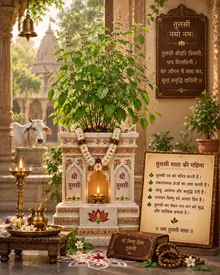
Tulsi Mata Mahatmya
According to legend, Tulsi originated from the ashes of Vrinda, a woman of supreme devotion and fidelity, and Lord Vishnu, honoring her unwavering devotion, vowed that he would always remain beside her in his Shaligram form. This is why, even today, Vishnu's worship is considered incomplete without offering a Tulsi leaf.
Most Hindu households grow a Tulsi plant in their courtyard, following a tradition of daily evening worship and lamp-lighting before it, considered highly auspicious. Tulsi Vivah, observed in the Kartik month, in which Tulsi is ceremonially wed to Shaligram or Lord Vishnu, also marks the end of Chaturmas and the start of the wedding season.
Tulsi is also held in high regard for its medicinal properties and is believed to purify the air around it, which is why it is grown in almost every Hindu home. From worship rituals to Ayurvedic remedies, every part of the plant is considered useful.
Readings Related to Tulsi Mata
चालीसा
Chalisaआरती
Aartiपर्व
Festivalsपौराणिक प्रसंग
PrasangAbout Tulsi Mata
This page is a single collection of everything related to Tulsi Mata, including chalisa, aarti, festivals, and mythological legends, gathered in one place.
The information on this page is presented with easy-to-read sizing and print support.
Frequently Asked Questions
How did Tulsi Mata originate?
It is believed that Lord Vishnu caused the Tulsi plant to spring from the ashes of Vrinda, a woman of supreme devotion, and vowed to always remain beside her.
What is Tulsi Vivah?
It is a festival observed in the Kartik month, in which Tulsi is ceremonially wed to Shaligram or Lord Vishnu, also marking the end of Chaturmas.
Why is Vishnu's worship considered incomplete without Tulsi?
It is believed that Lord Vishnu vowed, in honor of Vrinda's devotion, that his worship would remain incomplete without a Tulsi leaf, which is why offering one is still considered essential.
Why is the Tulsi plant grown at home?
It is regarded as highly auspicious and air-purifying, and its medicinal properties are another reason it is grown in almost every Hindu household's courtyard.