
Reading details
ॐ जय श्री श्याम हरे, बाबा जय श्री श्याम हरे।
खाटू धाम विराजत, अनुपम रूप धरे॥
Om jai Shri Shyam hare, baba jai Shri Shyam hare. Khatu dham virajat, anupam roop dhare.
रतन जड़ित सिंहासन, सिर पर चंवर ढुरे।
तन केसरिया बागो, कुण्डल श्रवण पड़े॥
Ratan jadit sinhasan, sir par chanvar dhure. Tan kesariya bago, kundal shravan pade.
गल पुष्पों की माला, सिर पर मुकुट धरे।
खेवत धूप अग्नि पर, दीपक ज्योति जले॥
Gal pushpon ki mala, sir par mukut dhare. Khevat dhoop agni par, deepak jyoti jale.
मोदक खीर चूरमा, सुवरण थाल भरे।
सेवक भोग लगावत, सेवा नित्य करे॥
Modak kheer churma, suvaran thal bhare. Sevak bhog lagavat, seva nitya kare.
झांझ कटोरा और घडियावल, शंख मृदंग घुरे।
भक्त आरती गावे, जय-जयकार करे॥
Jhaanjh katora aur ghadiyaval, shankh mridang ghure. Bhakt aarti gaave, jai-jaikar kare.
जो ध्यावे फल पावे, सब दुःख से उबरे।
सेवक जन निज मुख से, श्री श्याम-श्याम उचरे॥
Jo dhyaave phal paave, sab dukh se ubre. Sevak jan nij mukh se, Shri Shyam-Shyam uchare.
श्री श्याम बिहारी जी की आरती, जो कोई नर गावे।
कहत भक्त-जन, मनवांछित फल पावे॥
Shri Shyam Bihari ji ki aarti, jo koi nar gaave. Kahat bhakt-jan, manvaanchhit phal paave.
जय श्री श्याम हरे, बाबा जी श्री श्याम हरे।
निज भक्तों के तुमने, पूरण काज करे॥
Jai Shri Shyam hare, baba ji Shri Shyam hare. Nij bhakton ke tumne, pooran kaaj kare.
For a vrat, some devotees read it several times in one sitting: 11, 21, or 108. Save your reading count with this counter.
How to Read Shri Khatu Shyam Aarti
Read it in the evening on Ekadashi or a Tuesday, with a lamp lit. Repeat the refrain, 'Om Jai Shri Shyam Hare,' after every stanza and again at the very end.
About Shri Khatu Shyam Aarti
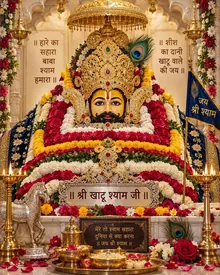
Khatu Shyam Aarti is the most widely sung hymn of praise to Baba Shyam, Barbarik, describing his jewel-studded throne at Khatu Dham, his adornment, and the offerings his devotees make to him. It is composed as a refrain followed by seven stanzas, with the refrain repeated after each one.
This page presents the full text in clean Devanagari, with a simple meaning for every stanza. Text size can be adjusted, and the full reading can also be printed.
Different printed versions name the composer differently, so it's regarded as a traditional composition. It describes Baba Shyam, Barbarik, enthroned at Khatu Dham on a jewel-studded seat, adorned and offered bhog by his devotees. It is sung especially by devotees on Ekadashi and Tuesdays.
Frequently asked questions
Who composed the Khatu Shyam Aarti?
Different printed versions name the composer differently, so it's regarded as a traditional composition.
What is the structure of the aarti?
It has one refrain and seven stanzas. The refrain is repeated after every stanza.
What is the best time to read the Khatu Shyam Aarti?
Singing it in the evening, with a lamp lit, on Ekadashi or a Tuesday, is considered ideal.
Is it necessary to know the meaning?
Not necessary, but reading it with the meaning makes the devotion clearer. This page includes a simple meaning alongside every stanza.