 Astha SangrahASTHA SANGRAHhttps://asthasangrah.com
Shyam Baba Vardan Katha
The Shyam Baba Vardan Katha tells how the head of Barbarik, who had already gifted his head, watched all eighteen days of the Mahabharata war from a hilltop, and how, by speaking an impartial truth when the Pandavas disputed over who deserved credit for the victory, he won Lord Krishna's boon to be worshipped in the Kali age under the name 'Shyam,' and to be known as 'the refuge of the defeated.'
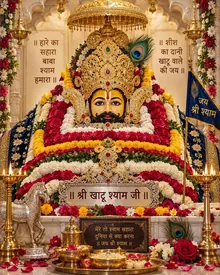
Chapter 1 · Eighteen Days of Watching the War, From a Hilltop
Barbarik had recognized Lord Krishna disguised as a Brahmin and gifted him his head, the full story of that sacrifice is told on its own separate page on this site. Pleased by this supreme gift, Lord Krishna granted Barbarik the boon that his head would remain alive and aware even after being severed, and that he would be able to watch the entire eighteen-day Mahabharata war to its very end. Krishna had the head respectfully placed atop a high hill near Kurukshetra, from where the whole battlefield lay clearly in view.
Read the Barbarik Shish Daan Katha →For all eighteen days, Barbarik's head watched every moment of the war from that hilltop, Bhishma Pitamah's resistance, the valor of Dronacharya and Karna, and the fierce destruction wrought by Arjuna and Bhima, all unfolded before his gaze. But at the end of each day, at every decisive moment, Barbarik saw the same truth: the war's true course was being decided not by any single warrior's personal valor, but by Lord Krishna's own strategy, resolve, and unseen divine power.
Chapter 2 · The Pandavas' Dispute, and Receiving the Boon
After the war ended, a dispute arose one day among the Pandava brothers over who truly deserved credit for the victory. Bhima credited the might of his mace, Arjuna spoke of the glory of his Gandiva bow, and each brother considered his own contribution the decisive one. When the dispute could not be resolved, Lord Krishna suggested that the most impartial answer could only come from the one who had watched the entire war from beginning to end, without bias, Barbarik's head.
When Barbarik's head was asked, it spoke the truth without fear, 'Across the entire battlefield, I saw only one power at work everywhere, Lord Krishna's own Sudarshan-power and his resolve. No warrior's personal strength was the cause of this victory; all of it unfolded through Krishna's own will and strategy.' Hearing this impartial answer, the pride of every Pandava was humbled.
Immensely pleased by Barbarik's fearless and impartial truth-telling, and by his earlier supreme sacrifice, Lord Krishna granted him the boon that in the Kali age he would be worshipped under Krishna's own name, 'Shyam.' He also recalled that Barbarik had always kept his vow to side with the weak and the losing, and so declared that anyone who came to him with a sincere heart, however defeated or hopeless in life, would surely receive his help. It is because of this very boon that he is worshipped today as 'Shyam Baba' and 'the refuge of the defeated,' and it was this same head that, centuries later, reappeared at Khatu village in Rajasthan and came to be enshrined in the grand temple that stands there today.
Read the Khatu Shyam Prakatya Katha →How to Read Shyam Baba Vardan Katha
On Ekadashi or a Tuesday, bathe in the morning, meditate on Baba Shyam, light a lamp, and recite the Khatu Shyam Chalisa and Aarti. Any devotee who feels hopeless or defeated in life should especially make it a point to hear this story with devotion.
About Shyam Baba Vardan Katha
This story is told across two chapters. The first tells of Barbarik's head being placed on a hilltop to watch the eighteen-day war. The second describes the Pandavas' dispute over credit for the victory, Barbarik's impartial answer, and the boon received from Lord Krishna.
This story is the concluding part of the three-part story cycle tied to Khatu Shyam, that is, Barbarik. This page presents both chapters' full text in plain Hindi, with adjustable text size and print support.
About A folk tradition tied to the Mahabharata
The Shyam Baba Vardan Katha has no single authoritative printed 'katha text', it is a medieval oral tradition tied to the Mahabharata, and the wording here has been composed independently. This page is the final part of a three-part story cycle tied to Khatu Shyam, the full story of the head's gifting is told in 'Barbarik Shish Daan Katha,' and the story of that same head's reappearance at Khatu village and the temple's founding, centuries later, is told in 'Khatu Shyam Prakatya Katha,' so only the events from after the gifting up to the receiving of the boon are told here.
Frequently asked questions
From where did Barbarik's head watch the war?
Lord Krishna had the head placed atop a high hill near Kurukshetra, from where it watched the entire eighteen-day war.
What dispute arose among the Pandavas?
After the war, the Pandava brothers disputed over who truly deserved credit for the victory, with each brother considering his own valor the decisive factor.
Who did Barbarik's head credit for the victory?
It impartially declared that only Lord Krishna's power and resolve were at work everywhere on the battlefield, and that no warrior's personal strength was the cause of the victory.
What boon did Krishna give Barbarik?
Krishna granted him the boon that in the Kali age he would be worshipped under Krishna's own name 'Shyam,' and would be known as the refuge of the defeated and the hopeless.