 Astha SangrahASTHA SANGRAHhttps://asthasangrah.com
Khatu Shyam Prakatya Katha
The Khatu Shyam Prakatya Katha tells how, centuries after the Mahabharata, Barbarik's head, buried and forgotten in the earth, was revealed at Khatu village in Rajasthan through a cow's miracle, and how King Roop Singh Chauhan, guided by a dream, founded a temple there, it is in memory of this very day of manifestation that the Falgun fair is held every year.
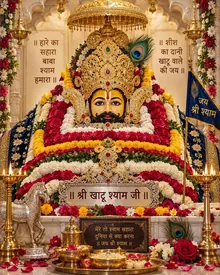
Chapter 1 · The Buried Head, and the Cow's Miracle
Before the Mahabharata war, Barbarik had gifted his head to Lord Krishna, and at the war's end, Krishna, pleased, granted him the boon of being worshipped in the Kali age under the name 'Shyam', that story of the head's gifting and the boon is told in full on this site's own separate pages, and is only recalled briefly here. As the boon foretold, the divine head passed into the earth after the war and lay buried for centuries beneath the soil of Khatu village, in the Sikar region of Rajasthan, until even the memory of it faded from people's minds.
Read the Barbarik Shish Daan Katha →In the Kali age, a cow grazing at Khatu village began going to the very same spot each day and pouring out her milk onto the ground there, of her own accord. This strange occurrence repeated for several days, leaving the cowherds and villagers astonished. When they dug at that spot, a radiant, otherworldly head emerged from the earth, its divine glow making it clear to everyone that this was no ordinary thing, but the head of some divine being.
The villagers handed this divine head over to a Brahmin of the village, who reverently installed it in his home and began worshipping it. Through meditation and devotion, the Brahmin came to realize that this was the head of Barbarik, Shyam himself, destined by Krishna's own boon to be worshipped in the Kali age, and this news soon spread across the whole region.
Chapter 2 · The King's Dream, and the Founding of the Temple
At that time, the Khatu region was ruled by King Roop Singh Chauhan. According to the legend, the king received a command in a dream to build a grand temple at the very spot where the divine head had appeared, so that devotees could behold Baba Shyam. Some versions of the tale hold that it was the king's queen, Narmada Kanwar, who received this dream instead, but despite this variation, every telling agrees that it was a dream-command that set the temple's construction in motion.
Following the dream, the king had a temple built at that very spot, and the pool near which the head had been found is still known today as 'Shyam Kund.' Tradition holds that this first temple was built around 1027 CE, and it has since been expanded and renovated many times over the centuries, today a grand marble temple stands there.
The day on which this divine head was revealed and installed at Khatu is held to be Phalgun Shukla Ekadashi, and this same date is observed every year as 'Prakatya Diwas,' the day of manifestation. It is on this occasion that the great Falgun fair fills Khatu, drawing millions of devotees from India and abroad to behold Baba Shyam. Because Barbarik had vowed to fight for whichever side was losing, devotees call him 'the refuge of the defeated,' believing that anyone who takes shelter in Baba Shyam, however hopeless their state, will surely find deliverance.
Read the Khatu Shyam Chalisa →How to Read Khatu Shyam Prakatya Katha
On Phalgun Shukla Ekadashi, or on any Ekadashi and Tuesday, bathe in the morning, meditate on Baba Shyam, light a lamp, and recite the Khatu Shyam Chalisa and Aarti. Where possible, it is also traditional to travel to Khatu Dham for darshan during the Falgun fair.
About Khatu Shyam Prakatya Katha
This story is told across two chapters. The first tells of Barbarik's head lying buried, its revelation through the cow's miracle, and its identification by the Brahmin. The second describes King Roop Singh Chauhan's dream, the founding of the temple, and the tradition of the Falgun fair.
This story is tied to the Khatu Shyam Temple in Sikar, Rajasthan, and is observed every year as Prakatya Diwas on Phalgun Shukla Ekadashi. This page presents both chapters' full text in plain Hindi, with adjustable text size and print support.
About Rajasthani folk tradition
The Khatu Shyam Prakatya Katha has no single authoritative printed 'katha text', it is an oral tradition of medieval Rajasthan, passed down as the temple-legend of Khatu Dham across generations, and the wording here has been composed independently. Note: the full story of Barbarik gifting his head to Krishna before the Mahabharata, including his boons, his three arrows, and Krishna's test in the guise of a Brahmin, and the story of the 'Shyam' boon he received from Krishna after the war, will each be covered on their own separate pages on this site, and so are only briefly recalled here, not retold in detail. This page is limited to the head's manifestation at Khatu, King Roop Singh Chauhan's dream, and the temple's founding.
Frequently asked questions
Where and how was Khatu Shyam's head found?
At Khatu village in Sikar district, Rajasthan, a cow began pouring her milk onto the same spot each day, and digging at that spot revealed Barbarik's divine head.
Who founded the Khatu Shyam Temple?
Guided by a dream, King Roop Singh Chauhan built a temple at the very spot, known as 'Shyam Kund', where Barbarik's head had appeared.
When is Prakatya Diwas observed?
Phalgun Shukla Ekadashi is observed as Prakatya Diwas, and it is on this occasion that the great Falgun fair fills Khatu.
Why is Barbarik called "the refuge of the defeated"?
Barbarik had vowed to fight for whichever side was losing in the Mahabharata, which is why devotees regard him as the refuge of the defeated and the hopeless.