
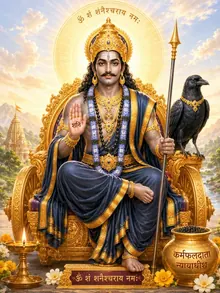
Shani Jayanti falls on the same tithi as North India's Vat Savitri Vrat, since both are tied to Jyeshtha Amavasya. Check a local panchang for the exact date.
Significance of Shani Jayanti
According to legend, Surya Dev's wife Sanjna could not bear his intense radiance, so she appointed her shadow-double, Chhaya, to serve him while she herself withdrew for penance. The son born to Chhaya, Shani, was born with a dark complexion, owing to his mother's severe penance and her constant exposure to the Sun's intensity through her pregnancy.
Seeing his son's dark complexion, Surya doubted Chhaya's fidelity and cast an angry glance at the infant Shani. It is believed that this very disdainful glance from his father is what gave Shani Dev's own gaze its powerful, unerringly just quality. Shani Dev is worshipped not as a punisher but as the deity of justice, who grants each person the fruits of their own karma, impartially.
According to a well-known legend, Ravana had held Shani Dev captive, and Lord Hanuman freed him during the conquest of Lanka. Grateful, Shani Dev vowed to Hanuman that he would never bring misfortune upon Hanuman's true devotees. This is why worshipping Hanuman is considered especially effective for protection from Shani's Sade Sati and Dhaiya periods.
How Shani Jayanti Is Celebrated
Devotees visit a Shani temple on this day, especially the famous Shani Shingnapur temple in Maharashtra, and perform an abhishek of mustard oil on Shani Dev's idol or stone. Black sesame, black cloth, and iron items are also offered.
The Shani Chalisa and Shani Stotra are recited, and donating black urad dal, oil, clothes, and footwear to the poor is considered especially meritorious. There is also a tradition of feeding crows.
To ward off Shani's inauspicious effects, many devotees also recite the Hanuman Chalisa on this day, believing that Hanuman's grace pacifies any affliction from Shani.
Shani Jayanti Puja Vidhi
Bathe in the morning and wear black or dark blue clothes. Visit a Shani temple, or at home, perform an abhishek of mustard oil on an idol of Shani Dev. Recite the Shani Chalisa and Hanuman Chalisa, and donate black sesame, clothes, and iron items.
About Shani Jayanti
Shani Jayanti is the festival marking Lord Shani Dev's birth, observed on Jyeshtha Amavasya. This page covers the legend of Shani Dev's birth, his role as the deity of justice, and his connection to Lord Hanuman.
See the separate page for Vat Savitri Vrat, observed on this same tithi in North India. The information on this page is presented with easy-to-read sizing and print support.
Frequently Asked Questions
When is Shani Jayanti observed?
In the North Indian panchang tradition, Shani Jayanti is observed every year on Jyeshtha Amavasya, usually falling in May–June.
Why is Shani Dev's complexion believed to be dark?
It is believed that Shani Dev's dark complexion resulted from his mother Chhaya's severe penance and continuous exposure to the Sun's intensity during her pregnancy.
Why is worshipping Hanuman believed to help with Shani-related afflictions?
It is believed that Lord Hanuman freed Shani Dev from Ravana's captivity, in return for which Shani Dev vowed never to harm Hanuman's true devotees.
What should be donated on Shani Jayanti?
Donating black sesame, black urad dal, mustard oil, black clothes, iron items, and footwear is considered especially meritorious on this day.