
Reading details
जय जय श्री शनिदेव भक्तन हितकारी।
सूरज के पुत्र प्रभु छाया महतारी॥
Jai jai Shri Shanidev bhaktan hitkari, Suraj ke putra prabhu Chhaya mahatari.
श्याम अंक वक्र दृष्ट चतुर्भुजा धारी।
नीलाम्बर धार नाथ गज की असवारी॥
Shyam ank vakra drishta chaturbhuja dhari, Neelambar dhaar nath gaj ki asvari.
क्रीट मुकुट शीश रजित दिपत है लिलारी।
मुक्तन की माला गले शोभित बलिहारी॥
Kreet mukut sheesh rajit dipat hai lilari, Muktan ki mala gale shobhit balihari.
मोदक मिष्ठान पान चढ़त हैं सुपारी।
लोहा तिल तेल उड़द महिषी अति प्यारी॥
Modak mishthan paan chadhat hain supari, Loha til tel urad mahishi ati pyari.
देव दनुज ऋषि मुनि सुमरिन नर नारी।
विश्वनाथ धरत ध्यान शरण हैं तुम्हारी॥
Dev danuj rishi muni sumirin nar nari, Vishwanath dharat dhyan sharan hain tumhari.
For a vrat, some devotees read it several times in one sitting: 11, 21, or 108. Save your reading count with this counter.
How to Read Shri Shani Dev Aarti
Read it in the evening on a Saturday, with a mustard-oil lamp lit. Repeat the refrain, 'Jai jai Shri Shanidev bhaktan hitkari,' after every stanza and again at the very end.
About Shri Shani Dev Aarti
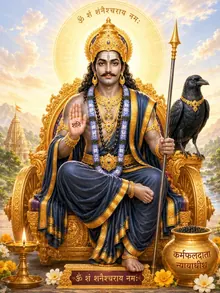
Jai Jai Shri Shanidev Bhaktan Hitkari is the most widely sung aarti to Shani Dev, describing his dark hue, four-armed form, elephant mount, the offerings dear to him, and his glory recognized throughout creation. It is composed as a refrain followed by four stanzas, with the refrain repeated after each one.
This page presents the full text in clean Devanagari, with a simple meaning for every stanza. Text size can be adjusted, and the full reading can also be printed.
No composer names himself within the aarti, so it's considered a traditional composition of unknown authorship. It describes Shani Dev's dark hue, four-armed form, his elephant mount, the offerings dear to him, and his glory recognized by all beings. The aarti is sung daily by Shani's devotees, and especially on Saturdays.
Frequently asked questions
Who composed the Shani Dev Aarti?
No composer names himself within the text, so it's considered a traditional composition of unknown authorship.
What is the structure of the aarti?
It has one refrain and four stanzas. The refrain is repeated after every stanza.
What is the best day and time to read the Shani Dev Aarti?
Singing it in the evening, with a mustard-oil lamp lit, on a Saturday is considered ideal.
Is it necessary to know the meaning?
Not necessary, but reading it with the meaning makes the devotion clearer. This page includes a simple meaning alongside every stanza.