
This Ekadashi falls a few days before Maha Shivratri. Check a local panchang for the exact date.
Significance of Vijaya Ekadashi
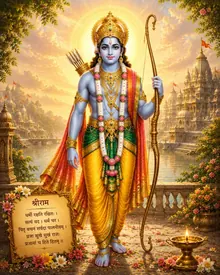
According to legend, when Lord Shri Ram reached the seashore to free Mata Sita from Ravana's Lanka, he grew anxious, seeing no way to cross the vast ocean. At that moment, he met the sage Bakadalbhya, who resided near the seashore.
The sage Bakadalbhya advised Lord Shri Ram to observe the vow of Phalguna Krishna Ekadashi, that is, Vijaya Ekadashi, with full rites, and told him that only through the power of this vow would he find a way to cross the ocean and attain victory over Lanka.
Lord Shri Ram observed this vow as the sage advised, after which the construction of the bridge under Nala and Nila's leadership became possible, and Lord Shri Ram achieved victory over Ravana. This is why this Ekadashi is named 'Vijaya Ekadashi', and it is regarded as highly effective for achieving victory in any difficult endeavor.
How Vijaya Ekadashi Is Celebrated
Devotees bathe in the morning and take the vow, observing a fruit-based or waterless fast through the day. Lord Vishnu is worshipped, and the legend of Vijaya Ekadashi is heard.
According to a special tradition, on this day, a clay pot filled with water and topped with a mango leaf is buried beneath a tree, regarded as a symbol of success and victory in one's endeavor.
The fast is broken the next day, on Dwadashi, within the scripturally prescribed Parana muhurat. This vow is observed especially by devotees wishing for victory in an important task, examination, or competition.
Vijaya Ekadashi Puja Vidhi
Bathe in the morning, take the vow, and observe a fruit-based fast. Worship Lord Vishnu and listen to the legend of Vijaya Ekadashi. If possible, bury a clay pot with water and a mango leaf beneath a tree. The next day, on Dwadashi, break the fast.
About Vijaya Ekadashi
Vijaya Ekadashi is the vow observed on Phalguna Krishna Ekadashi for victory in one's endeavors. This page covers the vow's significance, the legend of Lord Shri Ram's victory over Lanka, and the vidhi for observing it.
The information on this page is presented with easy-to-read sizing and print support.
Frequently Asked Questions
When is Vijaya Ekadashi observed?
This vow is observed every year on Phalguna Krishna Ekadashi, a few days before Maha Shivratri.
How is Vijaya Ekadashi connected to Lord Shri Ram?
Unable to find a way to cross the ocean, Lord Shri Ram observed the vow of Vijaya Ekadashi on the sage Bakadalbhya's advice, after which the bridge could be built and he achieved victory over Ravana.
Why is Vijaya Ekadashi named so?
Through the power of this vow, Lord Shri Ram attained victory over Lanka, which is why this Ekadashi is named 'Vijaya', meaning 'the one that grants victory'.
Who should observe Vijaya Ekadashi?
This vow is observed especially by devotees wishing for victory in an important task, examination, competition, or a major goal in life.