 Astha SangrahASTHA SANGRAHhttps://asthasangrah.com
Vasant Panchami
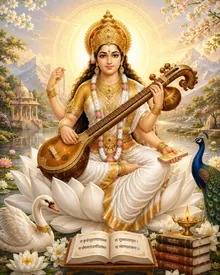
Vasant Panchami is observed on Magh Shukla Panchami, dedicated to the worship of Maa Saraswati, the goddess of knowledge and learning, welcoming the arrival of spring.
Depending on when Panchami tithi begins and ends, a one-day difference is possible in some years, so confirm with a local panchang. The day is also associated with the worship of Kamadeva and Rati, and in some regions is called 'Shri Panchami'.
Significance of Vasant Panchami
It is believed that after creation, Lord Brahma found the world silent and empty everywhere. He then sprinkled water from his kamandal, from which Maa Saraswati emerged, four-armed and holding a veena. When she played the veena's first note, speech and sound entered creation. Vasant Panchami is celebrated in remembrance of this day.
This day is considered especially auspicious for beginning one's education, which is why many families have children write their first letters on this day, in a ritual called 'Vidyarambham'. Schools and institutions of music and the arts also hold special worship of Maa Saraswati on this day.
Vasant Panchami also marks the arrival of spring, when fields fill with the yellow blossom of mustard flowers, which is why wearing yellow clothes and preparing yellow dishes is traditional on this day. The day is also associated with the worship of Kamadeva and Rati.
How Vasant Panchami Is Celebrated
In the morning, after bathing, yellow clothes are worn. Idols of Maa Saraswati are set up at home, in schools, and in temples, and worshipped with white and yellow flowers.
Children are made to write their first letters on a slate or board, performing the 'Vidyarambham' ritual. Books, musical instruments, and art materials are also worshipped, in the belief that Maa Saraswati's grace grants proficiency in knowledge and the arts.
Yellow dishes such as yellow rice, kesar halwa, and boondi are prepared. In Punjab, kite-flying is also celebrated on this day, and in Bengal, Saraswati Puja is observed with special grandeur in schools.
Vasant Panchami Puja Vidhi
Bathe in the morning and wear yellow clothes. Set up an idol of Maa Saraswati and offer white and yellow flowers, akshat, and yellow sweets. Perform the Vidyarambham ritual by having children write their first letters, and also worship books and musical instruments.
About Vasant Panchami
Vasant Panchami is observed on Magh Shukla Panchami, symbolizing Maa Saraswati's emergence and the arrival of spring. This page covers the festival's significance, the legend of Maa Saraswati's emergence, and the Vidyarambham tradition.
The information on this page is presented with easy-to-read sizing and print support.
Frequently Asked Questions
When is Vasant Panchami observed?
Vasant Panchami is observed every year on the Panchami tithi of the Magh Shukla Paksha, usually falling in January–February.
Why is yellow worn on Vasant Panchami?
Yellow is considered a symbol of the mustard flowers that bloom in spring and of the Sun's brilliance, which is why yellow clothes and dishes are traditional on this day.
What is the Vidyarambham ritual?
Vidyarambham is the tradition of teaching children to write their first letters on Vasant Panchami, in the belief that beginning one's education under Maa Saraswati's grace is auspicious.
What is the difference between Vasant Panchami and Saraswati Puja?
Both are observed on the same tithi, Magh Shukla Panchami. 'Saraswati Puja' points mainly to the worship of Maa Saraswati, while the name 'Vasant Panchami' also includes the arrival of spring.