
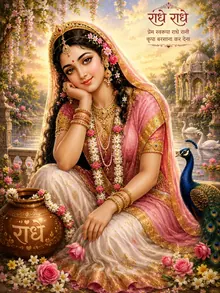
Radha Rani's birth is believed to have occurred at Madhyahna, that is, at midday, unlike Lord Krishna's own birth at midnight, which is why the main puja timing differs between the two birth celebrations.
Significance of Radha Ashtami
It is believed that Radha Rani was born in Barsana to Vrishabhanu and Kirti. According to a popular legend, Radha Rani was born with her eyes closed, and opened them only when Lord Krishna was shown to her, as though she were eager, from the very moment of birth, only for a glimpse of Krishna.
In the Vaishnav tradition, Radha Rani is regarded as the living embodiment of Lord Krishna's Hladini Shakti, his own divine potency of bliss. She is not merely Krishna's beloved but is also revered as the supreme symbol of selfless love and devotion, which is why devotees always utter her name before Krishna's.
Radha Ashtami is celebrated with special grandeur in Barsana, Vrindavan, and Mathura, home to Radha Rani's famous 'Shrijee Temple'. The festival falls fifteen days after Krishna Janmashtami, completing the worship of Radha and Krishna as a divine pair.
How Radha Ashtami Is Celebrated
Devotees observe a phalahar fast from the morning and perform special worship of Radha Rani at Madhyahna, just as the main puja on Krishna Janmashtami takes place at midnight.
An idol of the infant Radha Rani is placed in a decorated cradle, and the Radha Chalisa is recited amid devotional singing. Homes and temples adorn the paired idols of Radha-Krishna and offer a special bhog.
In Barsana, an especially grand celebration is held on this day, drawing devotees from far and wide for Radha Rani's darshan, with the temple specially decorated with flowers.
Radha Ashtami Puja Vidhi
Bathe in the morning and begin the phalahar fast. At Madhyahna, set up and adorn an idol of Radha Rani, recite the Radha Chalisa, offer bhog, and perform the aarti. Break the fast with phalahar only after the puja.
About Radha Ashtami
Radha Ashtami is observed on Bhadrapada Shukla Ashtami, commemorating the appearance of Radha Rani. This page covers Radha Ashtami's significance, the legend of Radha Rani's birth, and the midday puja vidhi.
See the separate page for Krishna Janmashtami, observed fifteen days before this festival. The information on this page is presented with easy-to-read sizing and print support.
Frequently Asked Questions
When is Radha Ashtami observed?
Radha Ashtami is observed every year on Bhadrapada Shukla Ashtami, fifteen days after Krishna Janmashtami.
Why is the Radha Ashtami puja performed at midday?
It is believed that Radha Rani was born at midday, unlike Krishna who was born at midnight, which is why Radha Ashtami's main puja is performed at Madhyahna.
Why is Radha Rani called the Hladini Shakti?
In the Vaishnav tradition, Radha Rani is regarded as the living embodiment of Lord Krishna's own divine potency of bliss, which is why she is called the Hladini Shakti.
Where is Radha Ashtami celebrated most grandly?
Radha Ashtami is celebrated most grandly in Barsana, home to Radha Rani's famous Shrijee Temple, and is also specially observed in Vrindavan and Mathura.