
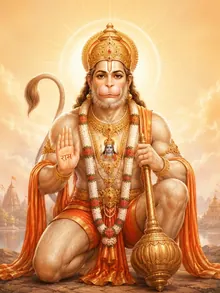
Hanuman Jayanti's date carries more regional variation than almost any other festival in India. North India observes it on Chaitra Purnima, while Andhra Pradesh and Telangana begin a 41-day deeksha on this same day, concluding on Vaishakha Krishna Dashami; Tamil Nadu and Kerala observe it on Margashirsha Amavasya; and Karnataka observes it on Margashirsha Shukla Trayodashi. Check your regional tradition and a local panchang for the exact date.
Significance of Hanuman Jayanti
According to legend, Lord Hanuman was born to Mother Anjana and the vanara king Kesari, pleased by their penance, through the grace of Vayu Dev and as a portion of Lord Shiva himself. This is why he is also called 'Pavanputra' (son of the wind), 'Anjaniputra', and 'Rudravatara'.
According to a well-known childhood legend, the infant Hanuman, mistaking the rising Sun for a fruit, attempted to swallow it, plunging the world into darkness. Enraged, Indra struck his jaw ('hanu') with his vajra, giving him a slightly crooked jaw and the name 'Hanuman'. When Vayu Dev, angered by this strike on his son, withheld the very flow of air, the assembled gods, to appease him, granted Hanuman numerous divine powers and immortality.
Lord Hanuman is regarded as the living embodiment of devotion, strength, celibacy, and selfless service, worshipped in the Ramayana as Lord Rama's supreme devotee and aide. He is considered 'Chiranjivi', an immortal being, which is why this festival is observed with devotion as a birth celebration even though, strictly, an immortal being has no death to mark a true 'jayanti' against.
How Hanuman Jayanti Is Celebrated
Devotees bathe in the morning and visit Hanuman temples, where the idol is anointed with sindoor and jasmine oil, believed to symbolize his immortality and strength.
Through the day, the Hanuman Chalisa, Sundarkand, and Bajrang Baan are recited, and many places hold continuous recitations and devotional singing. Boondi and besan laddus are especially offered as bhog.
Grand processions are taken out in many towns, including at Ayodhya's famous Hanumangarhi temple. In Andhra Pradesh and Telangana, devotees take a 41-day deeksha from this very day, observing strict rules through it, concluding on Vaishakha Krishna Dashami.
Hanuman Jayanti Puja Vidhi
Bathe in the morning and visit a Hanuman temple, or set up an idol of Hanuman at home. Offer an anointment of sindoor and jasmine oil, and recite the Hanuman Chalisa, Sundarkand, or Bajrang Baan. Offer boondi or besan laddus as bhog and perform the aarti.
About Hanuman Jayanti
Hanuman Jayanti is the festival marking Lord Hanuman's birth, observed on Chaitra Purnima in North India and on different tithis in other regions. This page covers the legend of Hanuman's birth and naming, his immortal (Chiranjivi) status, and the festival's regional traditions.
The information on this page is presented with easy-to-read sizing and print support.
Frequently Asked Questions
When is Hanuman Jayanti observed?
In North India, Hanuman Jayanti is observed on the Purnima tithi of the Chaitra month, usually falling in March–April. The date differs in other regions.
How did Hanuman get his name?
As a child, while attempting to swallow the Sun mistaking it for a fruit, Indra's vajra struck his jaw ('hanu'), leaving it slightly crooked, this is how he came to be called 'Hanuman'.
Why does Hanuman Jayanti's date differ by region?
Different regions follow different local traditions and panchang calculations tied to episodes of Hanuman's birth and life, which is why North India, Andhra Pradesh-Telangana, Tamil Nadu-Kerala, and Karnataka each observe the festival on a different tithi.
Why is Hanuman regarded as Chiranjivi (immortal)?
By Lord Rama's boon and the grace of the gods, Hanuman was granted immortality, which is why he is regarded as one of the eight Chiranjivis, believed to still walk the earth today.