 Astha SangrahASTHA SANGRAHhttps://asthasangrah.com
Hanuman Janma Katha
The Hanuman Janma Katha tells how the apsara Anjana, cursed to be born in vanara form, undertook fierce penance and won the boon of a son through the grace of Vayu Dev and Lord Shiv, and how the infant Hanuman, mistaking the sun for a fruit, tried to swallow it, after which the gods granted him many divine powers. It is in memory of this very birth that Hanuman Jayanti is observed.
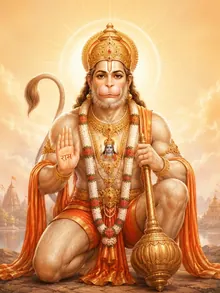
Chapter 1 · Anjana's Curse, Her Penance, and the Wind-Son's Origin
In a previous life, Anjana was Punjikasthala, an apsara of Indra's court. As a child, she playfully threw fruit at a meditating sage and disturbed his penance, and the enraged sage cursed her to be born in the form of a female vanara. When she pleaded desperately, the sage relented enough to add that a son of supreme radiance would be born to her, one who would make her name immortal forever.
Born on earth in vanara form, Anjana married the vanara king Kesari, himself a mighty and penance-devoted figure. Desiring a son, Anjana undertook twelve years of fierce penance atop Mount Narayana, under sage Matanga's guidance. Pleased by her austerity, Vayu Dev granted her the boon of a radiant, Veda-knowing, and immensely powerful son, and Lord Shiv too promised that he himself would take incarnation as her child.
Read the Hanuman Chalisa →Around the same time, King Dasharatha of Ayodhya was performing the Putrakameshti Yajna, during which Agni appeared and offered a divine payasam in a golden vessel, meant to be shared among his queens. According to the legend, a bird swooped down, snatched a portion of that very payasam, and dropped it into the hands of the still-penitent Anjana. Taking it as Shiv's own grace, Anjana consumed it, and in due time, on Chaitra Purnima, the child Hanuman was born to her.
Chapter 2 · The Attempt to Swallow the Sun, and the Gods' Boons
Not long after his birth, one morning, the hungry infant Hanuman mistook the rising sun for a ripe red fruit. With the power of flight granted by Vayu Dev, he leapt into the sky and rushed toward the sun. At that very moment, Rahu too had arrived near the sun to eclipse it, and seeing the child approaching, he fled in terror to Indra, complaining that another Rahu had come to snatch away his own meal.
Both Indra and Rahu descended before the infant. Hanuman attacked Rahu as well, and the enraged Indra struck the child with his vajra. The blow landed heavily on the infant's jaw (hanu), and he fell unconscious onto a mountainside. Enraged at this assault on his son, Vayu Dev withdrew the very flow of air from all creation, and every living being began to gasp and suffer, unable to breathe.
With all creation in peril, the gods, demons, and yakshas alike sought refuge with Brahma. Brahma revived the unconscious child and granted him the boon that no Brahmastra would ever harm him. In repentance, Indra placed a garland around the child's neck and declared that, since it was his jaw (hanu) that had been struck, he would be called 'Hanuman,' and that his own vajra would henceforth remain powerless against him. Surya granted him a portion of his own radiance and mastery of the sciences of arms, and all the other gods likewise blessed him with their own divine powers, making him invincible and immortal. Satisfied by the combined boons of all the gods, Vayu Dev restored the flow of air, and the crisis facing all creation was averted.
Read the Bajrang Baan →Because of these divine boons, the child Hanuman came to be worshipped under names such as 'Pavanputra' (son of the wind), 'Anjaniputra,' 'Maruti,' and 'Rudravatara.' His later, incomparable service to Ram and role in the conquest of Lanka, during which Ram himself granted him the boon of Chiranjivi immortality, is told in full elsewhere on this site. It is in memory of this very birth date that Hanuman Jayanti is observed, when devotees recite the Hanuman Chalisa and Bajrang Baan to receive his blessing.
Read about Hanuman Jayanti →How to Read Hanuman Janma Katha
On Hanuman Jayanti or every Tuesday and Saturday, bathe in the morning, anoint an image of Hanuman with sindoor and jasmine oil, light a lamp, recite the Hanuman Chalisa and Bajrang Baan, and hear this birth story. Offering boondi or besan laddus as bhog is considered especially fruitful.
About Hanuman Janma Katha
This story is told across two chapters. The first tells of Anjana's curse, her penance, and Hanuman's birth. The second describes the infant Hanuman's attempt to swallow the sun, Indra's vajra strike, and the boons received from the gods.
This story is connected to Hanuman Jayanti. This page presents both chapters' full text in plain Hindi, with adjustable text size and print support.
About A folk tale tied to the Valmiki Ramayana tradition
The Hanuman Janma Katha has no single authoritative printed 'katha text', it is a well-known Puranic legend tied to the Valmiki Ramayana tradition, and the wording here has been composed independently. Note: the Hanuman Jayanti page also carries a brief glimpse of this same birth episode, while this page tells it in full. In addition, the full stories of his post-childhood episodes, his service to Ram, the burning of Lanka, the Sanjeevani Parvat episode, are already available on their own separate pages elsewhere on this site, and so are not repeated here in detail.
Frequently asked questions
Who were Hanuman's parents?
Hanuman was the son of Mother Anjana and the vanara king Kesari, born through the grace of Vayu Dev and Lord Shiv, which is why he is also called Pavanputra.
Why was Anjana born in vanara form?
In a previous life, as the apsara Punjikasthala, she playfully disturbed a meditating sage's penance, and the enraged sage cursed her to be born in the form of a vanara.
How did Hanuman get his name?
While attempting to swallow the sun, mistaking it for a fruit, Indra's vajra struck his jaw ('hanu'), which is why Indra named him 'Hanuman.'
What did the gods do after the attempt to swallow the sun?
When the enraged Vayu Dev withheld the air, Brahma, Indra, Surya, and the other gods, to save all creation from peril, granted the infant Hanuman many divine boons, making him invincible and immortal.