
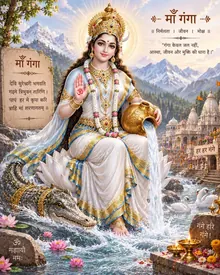
The auspicious time for Ganga snan is considered to be while Dashami tithi is active, and its exact timing changes every year, so check a local panchang. The festival is also known as 'Gangavataran'.
Significance of Ganga Dussehra
According to legend, after King Sagara's sixty thousand sons were reduced to ashes by sage Kapila's curse, their descendant King Bhagiratha performed years of severe penance to bring Maa Ganga down to earth to liberate their souls. Since the earth could not bear Ganga's tremendous force, Lord Shiva received her in his matted locks, releasing her gently onto the earth.
It is believed that Maa Ganga descended to earth on this very Jyeshtha Shukla Dashami, which is why the day is called 'Ganga Dussehra' or 'Gangavataran'. The waters of the Ganga are believed to destroy all sins and grant liberation.
The day is associated with the destruction of ten kinds of sins, which is why the word 'Dussehra', the removal of ten, appears in its name. Bathing on the banks of the Ganga and donating ten kinds of items is considered especially meritorious on this day.
How Ganga Dussehra Is Celebrated
In many towns along the Ganga's banks, including Haridwar, Varanasi, Rishikesh, and Prayagraj, large numbers of devotees gather on this day to bathe in the river.
Those who cannot reach the Ganga's banks bathe at home by mixing a little Gangajal into their water, and perform the aarti and worship of Maa Ganga.
On this day, there is a tradition of donating ten items, a water-filled pot, a fan, sandals, an umbrella, clothes, fruit, and dakshina among them, believed to carry special merit toward the destruction of the ten sins.
Ganga Dussehra Puja Vidhi
Bathe at the Ganga's banks if possible, or at home by mixing Gangajal into your water. Perform Maa Ganga's aarti and donate ten items, including a water-filled pot, a fan, clothes, fruit, and dakshina. Observe a phalahar fast through the day.
About Ganga Dussehra
Ganga Dussehra is observed on Jyeshtha Shukla Dashami, commemorating Maa Ganga's descent to earth. This page covers the festival's significance, the legend of King Bhagiratha's penance, and the tradition of Ganga snan and donating ten items.
The information on this page is presented with easy-to-read sizing and print support.
Frequently Asked Questions
When is Ganga Dussehra observed?
Ganga Dussehra is observed every year on the Dashami tithi of the Jyeshtha Shukla Paksha, usually falling in May–June.
Who was Bhagiratha?
Bhagiratha was a descendant of King Sagara, who performed years of severe penance to bring Maa Ganga down from heaven to earth, seeking the liberation of his sixty thousand ancestors' souls.
Why are ten items donated on Ganga Dussehra?
The day is believed to be linked to the destruction of ten kinds of sins, which is why donating ten items on this day is considered especially meritorious.
What is the difference between Ganga Dussehra and Gangavataran?
Both are names for the same festival, 'Gangavataran' points to Maa Ganga's descent, while 'Ganga Dussehra' points to the belief in the destruction of ten sins.