 Astha SangrahASTHA SANGRAHhttps://asthasangrah.com
Ganga Dussehra Vrat Katha
The Ganga Dussehra Vrat Katha is the story of King Sagara's sons being reduced to ashes, and of Maa Ganga's descent from heaven to earth through the penance of their descendant Bhagiratha, recited on Jyeshtha Shukla Dashami, presented here in full.
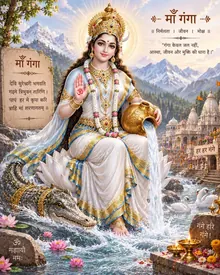
Chapter 1 · King Sagara's Yajna and the Sons' Incineration
In ancient times, King Sagara of Ayodhya arranged a grand Ashwamedha yajna, entrusting its entire conduct to his grandson Anshuman. Wishing to disrupt the sacrifice, Indra, king of the gods, stole the sacrificial horse and took it down to the netherworld, tying it up near the hermitage of the sage Kapila, who sat there in deep penance.
Searching for the horse, King Sagara's thousands of sons dug their way through the earth until they reached the netherworld, where they found their horse tethered near sage Kapila's hermitage. Without pausing to think, they accused the sage himself of the theft and tried to disgrace him, shattering his deep meditation. The instant the enraged sage opened his eyes, the fire of his wrath reduced every one of Sagara's thousands of sons to ashes in a moment.
Meanwhile, Anshuman himself, still searching for the horse, also arrived in the netherworld, where Lord Garuda told him of the terrible fate that had befallen his uncles. Garuda further explained that those incinerated souls could be freed only by the touch of the sacred waters of the celestial Ganga. Hearing this, Anshuman brought the sacrificial horse back and recounted the entire matter to King Sagara.
Chapter 2 · The Failed Attempts of Anshuman and Dilip
Once the yajna was completed, King Sagara himself made every effort to bring the Ganga down to earth, but did not succeed. After him, his grandson Anshuman, and then Anshuman's son Dilip, also strove hard toward this same goal, but neither of them was able to secure their ancestors' liberation.
Chapter 3 · Bhagiratha's Penance and Ganga's Descent
At last, King Dilip's son Bhagiratha, resolved upon his ancestors' liberation, performed extraordinarily severe penance for many years. Pleased by this austerity, the goddess Ganga appeared and asked Bhagiratha to name his wish. Bhagiratha begged her to descend to earth and grant liberation to his ancestors' souls. Ganga agreed, but warned him that if she fell straight from heaven to earth, the ground would never be able to bear the tremendous force of her descent.
To resolve this difficulty, Ganga advised Bhagiratha to worship Lord Shiva. Bhagiratha threw himself once more into devoted austerity, this time to Shiva, and, pleased by it, Mahadev himself appeared before him and asked him to name a boon. When Bhagiratha explained his predicament, Mahadev proposed a solution, he would receive Ganga into his own vast, matted locks. As she descended into his hair, her force was tamed, and Shiva then loosened a single lock, releasing her onto the earth divided into seven streams.
Thus, through Bhagiratha's tireless effort and penance, Maa Ganga descended to earth, and King Sagara's thousands of sons at last attained liberation for their souls. It is because of this singular exertion by Bhagiratha that the Ganga is also known on earth by the name 'Bhagirathi'.
How to Read Ganga Dussehra Vrat Katha
On Jyeshtha Shukla Dashami, bathe at the Ganga's banks if possible, or at home by mixing Gangajal into your water. Perform Maa Ganga's aarti and worship while listening to this katha, donate ten items, and observe a phalahar fast through the day.
About Ganga Dussehra Vrat Katha
The Ganga Dussehra Vrat Katha tells of King Sagara's thousands of sons being reduced to ashes by sage Kapila's wrath, the failed attempts of Anshuman and Dilip, and, at last, Maa Ganga's descent to earth through Bhagiratha's severe penance. This page has three chapters, the first covers King Sagara's yajna and the incineration of his sons, the second the failed attempts of Anshuman and Dilip, and the third Bhagiratha's penance and Ganga's descent.
This katha is recited on Jyeshtha Shukla Dashami, that is, on Ganga Dussehra, during the bathing and worship of Maa Ganga. This page presents the full text of all three chapters in plain Hindi, with adjustable text size and print support.
The Ganga Dussehra Vrat Katha has no single named author, it is the well-known Puranic legend of King Sagara's sons being reduced to ashes and of Ganga's descent through Bhagiratha's penance, recounted in the Ramayana, the Mahabharata, and several Puranas, and recited on the occasion of Ganga Dussehra. The story given here follows the events and sequence of this widely known account, but its wording has been composed independently, so that it is not a word-for-word copy of any single website's or publication's text.
Frequently asked questions
How many chapters does the Ganga Dussehra Vrat Katha have?
It has three chapters in total, traditionally read or heard together as one complete text.
Why were King Sagara's sons reduced to ashes?
While searching for the stolen sacrificial horse, Sagara's sons accused the meditating sage Kapila of the theft and disrupted his penance, and the enraged sage's wrath reduced them all to ashes.
How did Bhagiratha succeed in bringing Ganga to earth?
Bhagiratha first pleased the goddess Ganga, then Lord Shiva, through his severe penance. Shiva received Ganga into his matted locks, taming her tremendous force, and then released her onto the earth divided into seven streams.
Why is the Ganga also known as 'Bhagirathi'?
It was through King Bhagiratha's tireless effort and penance that Maa Ganga descended to earth, which is why, in his honour, she is also known as 'Bhagirathi'.