
This vow falls three or four days after Karva Chauth, and about a week before Diwali. In 2026 the fast is on Sunday, 1 November: the puja muhurat is 5:36 to 6:54 PM, the stars appear around 6:00 PM and the moon rises at 11:40 PM (New Delhi).
Significance of Ahoi Ashtami
According to the katha, a merchant's wife went to a quarry to fetch clay. While digging, her spade unknowingly killed the cubs of a Syahu (porcupine) living there. By the grieving Syahu's curse all seven of the merchant's sons died within a year, and the couple, overcome with grief, set out to give up their lives at a place of pilgrimage.
When the couple collapsed from exhaustion on the way, a divine voice told them this was the fruit of the Syahu cubs' death, and asked them to go home, serve a cow, show compassion to every creature and worship Ahoi Mata with due rites on Ahoi Ashtami. When they did so they were blessed with children again, and ever since, mothers have kept this vow for their children's protection and long life.
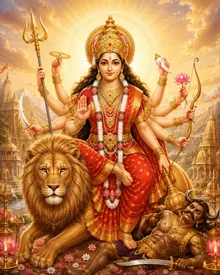
Mata Ahoi is regarded as a form of Goddess Parvati herself, worshipped especially as the deity of children's wellbeing, long life, and protection. This vow falls three or four days after Karva Chauth and about a week before Diwali, and is especially popular in North India.
How Ahoi Ashtami Is Celebrated
Mothers bathe in the morning and begin the waterless fast. An image of Mata Ahoi along with the Syahu and her cubs is drawn on the wall using red and yellow clay, or a printed image is used instead.
In the evening, after the puja, the Ahoi Ashtami legend is heard, and a silver-beaded necklace called 'Ahoi' is worn. The fast is broken only after the stars appear, offering them arghya of water.
In some places, mothers break the fast upon sighting the moon instead of the stars, depending on when the moon rises that day. After the puja, a meal is shared with the family.
In Braj there is a tradition of bathing in Radha Kund, near Mathura, on this night. It is believed that a childless couple who bathe in Radha Kund at midnight on Ahoi Ashtami are blessed with a child, so thousands of devotees gather there that night.
Ahoi Ashtami Puja Vidhi
Bathe in the morning and begin the waterless fast. Draw an image of Mata Ahoi and the Syahu's cubs on the wall, or use a printed image. In the evening, perform the puja and listen to the legend of Mata Ahoi, and break the fast by offering water as arghya upon sighting the stars or the moon.
About Ahoi Ashtami
Ahoi Ashtami is the vow observed by mothers on Kartik Krishna Ashtami for their children's wellbeing. This page covers the vow's significance, the legend of Mata Ahoi and the Syahu, and the tradition of offering arghya to the stars.
Frequently Asked Questions
When is Ahoi Ashtami observed?
Ahoi Ashtami is observed every year on Kartik Krishna Ashtami, three or four days after Karva Chauth.
What time will the stars appear on Ahoi Ashtami 2026?
In 2026 Ahoi Ashtami is on Sunday, 1 November. The stars will begin to appear around 6:00 PM, and the puja muhurat is 5:36 to 6:54 PM. For mothers who offer arghya to the moon, moonrise is at 11:40 PM (New Delhi). Ashtami tithi runs from 2:51 PM on 1 November to 1:10 PM on 2 November.
When is the Ahoi Ashtami fast broken?
The fast is broken in the evening upon sighting the stars, offering them arghya of water, in some places, it is broken upon moonrise instead.
Who is Mata Ahoi?
Mata Ahoi is regarded as a form of Goddess Parvati, worshipped as the deity of children's wellbeing, long life, and protection.
What is the Ahoi necklace?
The Ahoi mala (Syahu mala) is a string of a silver Syahu and beads threaded on moli, which mothers put on after the puja. By custom a new bead or Ahoi pendant is added to it on the birth of each child, and on a son's wedding too.