
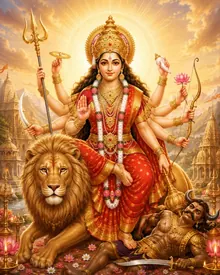
Chapter 1 · The Vrat Vidhan and Puja
This vow is observed on the Krishna Paksha Ashtami of the Kartik month. This vow is performed for the attainment of good health and for having long-lived children.
This vow is observed by women who remain without food through the day. At night, after moonrise, a lota filled with water should be placed before the image of Ahoi Mata drawn on the wall. A silver image of Syahu and two dolls should be threaded into a moli (sacred thread). Then worship them with roli and akshat (vermilion and rice grains). After the worship, offer them naivedya of milk-rice, halwa, and the like.
After this, offer arghya to the moon with the water-filled vessel that was set aside earlier. Then, holding seven grains of wheat in the hand, listen to the katha of Ahoi Mata. After hearing the katha, wear the Ahoi Mata threaded into the moli around the neck. Give the offered naivedya in charity to a Brahmin. If no Brahmin is available, give it to one's mother-in-law instead. After this, eat food oneself.
After each childbirth, have another image of Ahoi Mata made and add it to the moli already threaded. Repeat this same act after each son's wedding as well. Whenever there is a need to remove the Ahoi pendant from the neck, do so on some auspicious day, offer it naivedya of jaggery and the like, give it a sip of water (achaman), and set it aside. Doing this increases one's offspring. After Ahoi Ashtami worship, giving a kushmand (ash gourd) in charity to a Brahmin brings special merit.
Chapter 2 · The Merchant Couple's Story
In a certain city lived a merchant. He had seven sons. One day the merchant's wife went to a quarry to dig and bring back clay. As soon as she struck the spade to dig the clay, a Syahu's cubs living within were struck and killed. When the merchant's wife saw the Syahu covered in blood, she felt immense grief at the death of the cubs. But what was to happen had already happened. This mistake had occurred unknowingly on her part. So, with a heavy heart, she returned home. Out of remorse, she did not even bring back the clay.
After this, when Syahu returned home, she found her cubs dead. Overcome with grief, she began to lament greatly. She prayed to God that whoever had killed her cubs should suffer the very same grief and sorrow. By Syahu's curse, within a year, all seven sons of the merchant's wife met their death, one by one. Seeing this sorrowful turn of events, the merchant and his wife became utterly grief-stricken.
The couple resolved in their hearts to go to some place of pilgrimage and give up their lives there. Having made up their minds so, the merchant and his wife set out on foot from home toward the pilgrimage site. They kept moving forward until their bodies became utterly weak. When they became completely unable to walk any further, they fainted and fell to the ground along the way. Seeing their pitiable state, the merciful Lord was moved with compassion for them, and a divine voice spoke: 'O merchant! Your wife unknowingly killed the cubs of a Syahu while digging clay. That is why you too have had to suffer the loss of your children.'
The Lord commanded: 'Now both of you go home, serve a cow, and when Ahoi Ashtami comes, worship Ahoi Mata with full rites and love. Hold compassion for all living beings, and cause harm to no one. If you conduct yourselves as I have said, you will be blessed with the joy of children.' Hearing this divine voice, the merchant and his wife found some solace, and remembering the Goddess, the two of them set out for home.
On reaching home, they began to act as the divine voice had instructed. Along with this, they began to hold compassion for all beings, free of jealousy and malice. By the Lord's grace, the merchant and his wife once again became blessed with sons, enjoyed every happiness, and in the end attained heaven.
Chapter 3 · The Merchant's Daughter-in-Law's Story
A certain merchant had seven sons, seven daughters-in-law, and one daughter. On Kartik Krishna Ashtami, his daughters-in-law went into the forest along with his daughter (their nanad) to bring clay for the worship of Ahoi Mata. At the very spot where they were digging clay, there was a Syahu's den. While digging the clay, the nanad's hand struck and killed a Syahu cub. The mother Syahu said, 'Now I shall bind your womb', meaning, 'I shall now leave you without children.' Hearing this, the nanad urged all her sisters-in-law to take this binding upon themselves in her place, but all of them refused her request. However, her youngest sister-in-law, after some thought, agreed to have her own womb bound instead.
After this, whatever children were born to that sister-in-law would die after just seven days. One day, a pandit was called and the reason for this was sought. The pandit said: worship the black cow; the black cow is related to Syahu as her sister. If she releases your womb, your children may live. Hearing the pandit's words, the youngest daughter-in-law began serving the black cow from the very next day. Every morning, she would rise early and clean up the cow's dung and so on.
The cow thought to herself, I shall find out who is doing this work. The next day, rising at dawn, the mother cow saw that one of the merchant's daughters-in-law was sweeping and cleaning that very spot. The mother cow asked the daughter-in-law why she was serving her so much, and what she wanted from her, whatever her wish was, she could ask for it. The merchant's daughter-in-law said: Mother Syahu has bound my womb, because of which my children do not survive. If you have my womb released, I shall be greatly indebted to you. The mother cow agreed to her request, and taking her along, set off across the seven seas to Mother Syahu. Along the way, overcome by the harsh sun, the two of them sat down in the shade of a tree.
On the very tree under which the two of them sat, a young Garuda bird lived. Shortly after, a snake came and began to attack the chick. Seeing this, the merchant's daughter-in-law killed the snake and hid it beneath a branch, saving the young Garuda from death. After this, the bird's mother, seeing blood there, began to strike the merchant's daughter-in-law with her beak. Then the daughter-in-law said: I have not killed your child. A snake had come to bite your child; I killed it and saved your child. The dead snake lies hidden beneath the branch. Pleased by the daughter-in-law's words, the mother bird said: ask of me whatever you wish. The daughter-in-law said to her, Mother Syahu lives across the seven seas; carry me across to her. Then that Garuda hen bird seated the two of them upon her back and carried them across the ocean to Mother Syahu.
Seeing them, Mother Syahu said: come, sister, you have come after so many days. She said again, lice have fallen in my hair, remove them for me. At the black cow's urging, the merchant's daughter-in-law removed all the lice from Mother Syahu's hair with a pin. At this, Mother Syahu became greatly pleased. Mother Syahu said to the merchant's daughter-in-law, may you have seven sons and seven daughters-in-law. Hearing this, the daughter-in-law said: I do not even have a single son, where would seven come from? Mother Syahu asked: what is the reason for this? She said, if you give me your word, I can tell you the reason. Mother Syahu gave her word. Having bound her to this promise, the merchant's daughter-in-law said: my womb lies bound with you; please release it.
Mother Syahu said: I was deceived by your words. Now I must release your womb. Saying this, Mother Syahu continued, now go home, you shall have seven sons and seven daughters-in-law. On reaching home, perform the udyapan of Ahoi Mata, make seven Ahoi images each and give seven kadhais (pots). When she returned home, she found her seven sons and seven daughters-in-law sitting there. She was overwhelmed with joy. She performed the udyapan by making seven Ahoi images and giving seven kadhais. It was only after this that Diwali arrived.
Her elder sisters-in-law began saying to one another, let everyone finish the worship quickly; it should not happen that the youngest daughter-in-law, remembering her children, starts weeping and wailing, or else the joy of the occasion will be spoiled. To find out, they sent their children to the youngest daughter-in-law's house, since she was not weeping. The children went and returned to report that she was there kneading dough, and that the udyapan ceremony was underway. On hearing this, all the elder sisters-in-law came to her and asked how her womb had been released. She said: Mother Syahu, out of grace, released my womb. Everyone began to sing the praises of Mother Ahoi. Just as Mother Ahoi released the womb of that merchant's daughter-in-law, may she fulfill the wishes of all women who observe this vow.
How to Read Ahoi Ashtami Vrat Katha
Observe a day-long fast without food, and in the evening draw an image of Ahoi Mata on the wall, threading a silver Syahu image and two dolls into a moli for worship. At moonrise, hold seven wheat grains in hand while hearing the katha, offer arghya to the moon to break the fast, and wear the Ahoi Mata moli around the neck. The full vidhi is given in detail in this page's first chapter.
About Ahoi Ashtami Vrat Katha
The Ahoi Ashtami Vrat Katha is a collection of two stories for this vow observed by mothers for their children's wellbeing. The first chapter covers the vrat's vidhi and puja, the second tells the story of the merchant couple whose sons died by a Syahu's curse, and the third tells the story of the merchant's daughter-in-law who traveled across seven seas to Mother Syahu to have her bound womb released.
This vow is observed mainly in North India by mothers, wishing for their children's long life and wellbeing. This page presents the full text of all three chapters in plain Hindi, with adjustable text size and print support.
The Ahoi Ashtami Vrat Katha has no single named author. Another story for this vow also circulates in India, linked to Radha Kund in Vrindavan, which is not included on this page. The two stories presented here, the merchant couple's story and the merchant's daughter-in-law's story, are printed together in a single published Hindi vrat-katha collection booklet, and are transcribed faithfully here, with only clear printing errors corrected and no change made to the stories themselves. Other printed editions may use different wording.
Frequently asked questions
How many chapters does the Ahoi Ashtami Vrat Katha have?
It has three chapters in total, the vrat vidhan and puja, the merchant couple's story, and the merchant's daughter-in-law's story, traditionally read or heard together as one complete text.
When is Ahoi Ashtami observed?
This vow is observed every year on Kartik Krishna Paksha Ashtami, which falls four days after Karva Chauth.
Is there only one Ahoi Ashtami katha in circulation?
No, besides the two stories given on this page, another story linked to Radha Kund in Vrindavan also circulates in India, which is not included on this page.
What is the significance of donating a Kushmand?
According to the vrat vidhan, giving a kushmand (ash gourd) in charity to a Brahmin after Ahoi Ashtami worship brings special merit, as stated in this katha.