
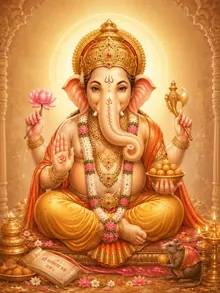
Chapter 1 · The Sakat Chauth Vrat Vidhan
The festival of Sakat is observed on Magh Krishna Chaturthi. On this day, Ganapati Ganesh, the remover of Sakat (hardship), is worshipped. Observing this vow removes all suffering and fulfills every wish and desire.
On this day, women observe a waterless fast through the day and take a fruit meal in the evening. The next morning, they take as prasad the puris and dishes that were offered to Sakat Mata. Sesame is roasted and pounded together with jaggery. A goat figure is also made of this pounded sesame-jaggery (tilkut). After worshipping it, a child of the house cuts off the neck of the tilkut goat. This is given as prasad to everyone. The katha is heard after the worship.
Chapter 2 · The Story of the Potter and the Old Woman
In a certain city lived a potter. Once, having made his pots, he fired the kiln, but the kiln would not bake them. Defeated, he went to the king and pleaded for help. The king summoned the royal priest and asked the reason, and the priest said that each time the kiln was fired, the sacrifice of a child would make it bake properly.
The king gave his order, and the sacrifices began. Whichever family's turn came, that family would send one of its children for the sacrifice. In this way, some days later, on the day of Sakat, the turn came for an old woman's son. He was her only support in life, but no one had any power against the king's command. The grieving old woman thought to herself, I have only this one son, and even he will be taken from me on the day of Sakat.
The old woman gave her son a token of vermilion and durva grass, and said: 'Sit inside the kiln taking the Lord's name; Sakat Mata will protect you.' The boy was seated inside the kiln, and the old woman sat before Sakat Mata and began her worship. Previously, it used to take many days for the kiln to bake, but this time, by Sakat Mata's grace, the kiln baked in a single night.
In the morning, when the potter looked, he was astonished, the kiln had baked, and the old woman's son, along with the other children, was alive and safe. The people of the city acknowledged Sakat Mata's glory, and regarded the boy as blessed. By Sakat Mata's grace, the other children of the city were saved as well.
How to Read Sakat Chauth Vrat Katha
On Sakat Chauth, observe a waterless fast through the day and take a fruit meal in the evening. The next morning, take the puris and dishes offered to Sakat Mata as prasad. Make a tilkut goat from sesame and jaggery, worship it and offer it, and listen to the katha. The full vidhi is given in this page's first chapter.
About Sakat Chauth Vrat Katha
The Sakat Chauth Vrat Katha tells the story of an old woman's only son, whose turn came for sacrifice, but whom Sakat Mata kept safe inside a potter's burning kiln. This page has two chapters, the first gives the vrat's vidhan, and the second tells the complete story of the potter and the old woman.
This vow is observed mainly in North India by mothers, wishing for their children's wellbeing. This page presents the full text of both chapters in plain Hindi, with adjustable text size and print support.
The Sakat Chauth Vrat Katha has no single named author. Several differently named stories for this vow circulate across India, such as one linked to King Harishchandra, another of a merchant and his wife, and one of Lord Mahadev and Parvati, which are not included on this page. The text presented here is a faithful transcription of the potter and old woman's story as printed in a published Hindi vrat-katha collection booklet, with only clear printing errors corrected and no change made to the story itself. Other printed editions may use different wording.
Frequently asked questions
How many chapters does the Sakat Chauth Vrat Katha have?
It has two chapters in total, the vrat vidhan, and the story of the potter and the old woman, traditionally read or heard together as one complete text.
When is Sakat Chauth observed?
This vow is observed every year on Magh Krishna Chaturthi.
Is there only one Sakat Chauth katha in circulation?
No, several Sakat Chauth kathas circulate across India, such as one linked to King Harishchandra and one of Mahadev and Parvati. This page presents the widely told story of the potter and the old woman.
Why is a goat made from tilkut?
On Sakat Chauth, a goat figure is shaped from sesame and jaggery and worshipped, and a child of the house cuts off its neck and distributes it as prasad, as described in this katha's vrat-vidhan chapter.