 Astha SangrahASTHA SANGRAHhttps://asthasangrah.com
Gangaur Vrat Katha
The Gangaur Vrat Katha is the story of Mata Parvati giving suhaag-ras to the women of a village on Chaitra Shukla Tritiya, and of Lord Shiva's boon, recited on the occasion of Gangaur worship, presented here in full.
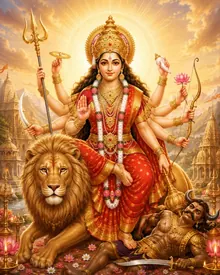
Chapter 1 · Giving Suhaag-Ras to the Poor and the Rich Women
According to the story, Lord Shankar once set out to roam the earth together with Mata Parvati and Narada. Wandering along, the three of them arrived at a village on Chaitra Shukla Tritiya. As word of their arrival spread, the poor women of the village hurried over at once with plates of turmeric and unbroken rice, eager to welcome and worship them.
Sensing the depth of their faith, Parvati sprinkled the entirety of her own suhaag-ras upon them, and they went home carrying an unbroken good fortune. Not long after, the wealthy women of the town also arrived, their gold and silver plates laden with all manner of delicacies.
Seeing them, Lord Shankar asked Parvati, you have already given your whole suhaag-ras to the poor women; what is left for these? Parvati answered, my lord, the rasa I gave them was made from ordinary substances, so it will fade away once washed off. For these wealthy women, I shall cut my own finger and give them the suhaag-ras of my blood, so that their good fortune too remains as unbreakable as mine.
As soon as the women finished their worship, Parvati did just as she had said: she cut her finger and sprinkled the drops of blood over them, and each woman's fortune matched the drop that fell on her. Having done this, Parvati sought her husband's leave and set off to bathe in the river.
Chapter 2 · Parvati's Worship of Shiva and His Boon
After bathing, she fashioned a Shivling there out of sand, worshipped it in due form and offered it bhog, then, while circumambulating it, took a little prasad and applied a tilak to her forehead. At that very instant, Shiva himself appeared out of that sand lingam.
He blessed Parvati, saying that any woman who worships him and keeps Parvati's vow on this date would see her husband granted a long life and, in the end, moksha. Having said this, Shiva vanished from that place.
All of this took a good while. Returning, she reached the spot where she had left Shiva and Narada. Asked why she had taken so long, Parvati explained, I ran into my brother and sister-in-law by the riverbank, and they held me back to feed me milk and rice, which is why I was delayed.
Chapter 3 · The Illusion of the Natal Home and Narada's Praise
Hearing this, the all-knowing Shiva, tempted himself by the mention of milk and rice, headed toward the river. Parvati, silently meditating on Shiva, prayed within her heart, O Lord, uphold the honour of this your servant, and followed close behind him. A little further on, by the riverbank, a grand palace conjured by her maya came into view, where the illusory brother and sister-in-law gave the two of them a warm welcome.
Two days passed there. On the third day, Parvati proposed that they leave, but Shiva was unwilling to budge. Annoyed, Parvati set off alone, leaving Shiva with no choice but to follow her, and Narada came along as well.
Along the way, Shiva remembered that he had left his mala behind at Parvati's natal home. Parvati was ready to go back and fetch it herself, but Shiva decided to send Narada in her place instead.
But when Narada arrived there, no palace was to be seen at all, only dense forest stretched in every direction. Just then lightning flashed, and in its light he spotted Shiva's mala hanging from a tree. He retrieved it and returned, recounting to Shiva the whole strange story of his journey.
Hearing this, Shiva smiled and said that all of it was Parvati's own maya. Parvati, in turn, said humbly that she had no power of her own in this, it was entirely Shiva's grace. Grasping the full meaning of the episode, Narada praised Parvati's wifely devotion at great length.
How to Read Gangaur Vrat Katha
On Chaitra Shukla Tritiya, bathe, make images of Gangaur (Mata Gauri) and Isar (Lord Shiva) out of clay or sand, adorn them with ornaments and flowers, worship them with turmeric, akshat, and bhog, and read or listen to this katha. Offer items of suhaag, and finally immerse the images in a body of water.
About Gangaur Vrat Katha
The Gangaur Vrat Katha tells of Mata Parvati giving suhaag-ras to the poor and rich women of a village on Chaitra Shukla Tritiya, of Lord Shiva's boon upon her worship of a sand Shivling, and of the illusion at her natal home. This page has three chapters, the first covers the giving of suhaag-ras to the poor and rich women, the second Parvati's worship of Shiva and his boon, and the third the illusion of the natal home and Narada's praise.
This katha is recited on Chaitra Shukla Tritiya, that is, on the day of Gangaur, during the worship of Mata Gauri and Lord Isar. This page presents the full text of all three chapters in plain Hindi, with adjustable text size and print support.
The Gangaur Vrat Katha has no single named author or self-cited Puranic source, it is a traditional narrative about Lord Shiva and Mata Parvati, circulated both orally and in print around the occasion of Gangaur worship. The story given here follows the events, characters, and sequence of this circulating account, but its wording has been composed independently, so that it is not a word-for-word copy of any single website's or publication's text. Note that the general account of Gangaur's origin given in this page's own significance section, of Parvati being consumed in Holi's fire, being reborn, and doing penance to reunite with Shiva, does not appear in this story, which instead recounts an independent episode of suhaag-ras and the illusion at her natal home. Both are well-known traditions associated with Gangaur, and this page presents only the second tradition in narrative form.
Frequently asked questions
How many chapters does the Gangaur Vrat Katha have?
It has three chapters in total, traditionally read or heard together as one complete text.
Why did Mata Parvati give different suhaag-ras to the poor and the rich women?
The poor women worshipped with true devotion, so Parvati gave them the whole of her suhaag-ras. When the wealthy women arrived later and no more rasa remained to give, Parvati cut her own finger and gave them the suhaag-ras of her blood instead, making them fortunate as well.
What boon did Lord Shiva grant upon the worship of the sand Shivling?
Pleased by Parvati's worship of the sand Shivling, Lord Shiva granted a boon that any woman who worships him and observes Parvati's vow on that day will see her husband live a long life and ultimately attain moksha.
What does the episode of the illusion at the natal home teach?
This episode illustrates Mata Parvati's power as a devoted wife and her mastery of maya, when Lord Shiva, tempted, walked toward the riverbank, Parvati conjured the scene of her natal home there through her own maya, and Narada, seeing this, praised her wholeheartedly.