
Chapter 1 · King Priyavrata and the Appearance of Goddess Shashthi
In ancient times there lived a king named Priyavrata, whose queen was named Malini. The couple had long been denied the joy of a child, and this sorrow gnawed at them year after year. Longing for a child, the king had the sage Kashyap perform the Putreshti Yagna on his behalf, and by its power, Queen Malini conceived.
When nine months had passed and the time of birth arrived, the queen gave birth to a stillborn son. Losing his child in this way, the king sank into grief and began to contemplate ending his own life. At that very moment, a goddess of extraordinary radiance appeared before him, and stopped him from this tragic act.
The goddess said to the king, 'O king, I have arisen from the sixth part of primordial Nature herself, and so I am known as Shashthi. I am the protector of children, and whoever worships me with devotion, I fulfil every wish they hold for their offspring. Set aside your grief, and worship me instead.'
Reassured by the goddess's words, King Priyavrata's courage returned. Together with Queen Malini, he worshipped Goddess Shashthi according to the proper rites on the Shukla Shashthi of the Kartik month. Through this worship, they were blessed once more with a healthy, long-lived son. In remembrance of this very event, the tradition of worshipping Goddess Shashthi on Kartik Shukla Shashthi began, which in time came to be known as the festival of Chhath.
Chapter 2 · Karna's Tradition of Offering Arghya
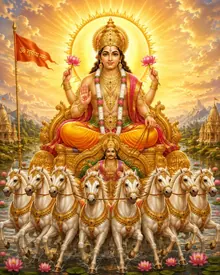
The tradition of worshipping the Sun during Chhath also carries an episode from the Mahabharata era. Karna, son of Surya, was a supreme devotee of his father, and stood waist-deep in water every day to offer him arghya. It is said that this daily practice of his became the very foundation of the custom of standing in water to offer arghya to the Sun, which today is considered the most important rite of the Chhath festival.
Chapter 3 · Draupadi's Chhath Vow
Another story tied to the Chhath vow comes from yet another episode of the Mahabharata. When the Pandavas lost their entire kingdom in a game of dice, Draupadi, on Lord Krishna's counsel, observed the Chhath vow, worshipping Surya and Mother Shashthi. Through the power of this vow, the Pandavas eventually regained their lost kingdom. For this reason, the vow is also regarded as a symbol of reclaiming both family happiness and worldly prosperity.
Chapter 4 · The Glory of the Vow
The Chhath vow is regarded as extremely rigorous and richly rewarding. It is believed that Mother Shashthi, also regarded as Goddess Usha or the Sun's own sister, protects the long life and health of children. For this reason, the vow is observed chiefly for the wellbeing of one's children, though any devotee seeking happiness and prosperity for their family may observe it as well.
Whoever observes the vow according to the proper rites has the fortune of offering arghya to the Sun both as he sets and as he rises, considered a symbol of gratitude for every aspect of life. It is because of this devotion and rigorous discipline that Chhath is given the name Mahaparv, the great festival.
How to Read Chhath Puja Vrat Katha
The Chhath vow is completed over four days, Nahay Khay on the first day, Kharna on the second, arghya to the setting Sun in the evening of the third, and arghya to the rising Sun on the morning of the fourth, after which the fast is broken. A waterless fast of about 36 hours is kept between the third and fourth days.
About Chhath Puja Vrat Katha
The Chhath Puja Vrat Katha is told across four chapters. The first has the main story of King Priyavrata and Queen Malini's quest for a child, and the appearance of Goddess Shashthi. The second tells of Karna's tradition of offering arghya, and the third, the story of Draupadi's Chhath vow. The fourth chapter describes the glory of the vow.
This vow is observed over four days, from Kartik Shukla Chaturthi to Saptami. This page presents the full text of all four chapters in plain Hindi, with adjustable text size and print support.
No old printed original text for the Chhath Puja Vrat Katha could be found on archive.org, the one seemingly relevant source there turned out to be a copy of a modern website article, and another available source was only a booklet of Sanskrit worship mantras, with no narrative portion at all. The story given here is therefore based on the well-known Puranic legend of King Priyavrata, Malini, and Goddess Shashthi, along with the Mahabharata-era episodes tied to Karna and Draupadi, recounted across many Hindi websites. It follows the events, characters, and sequence of these widely circulating accounts, but its wording has been composed independently, so that it is not a word-for-word copy of any single website's text.
Frequently asked questions
How many chapters does the Chhath Puja Vrat Katha have?
It has four chapters in total, traditionally read or heard together as one complete text.
Who is Goddess Shashthi in the Chhath Puja Vrat Katha?
As the story describes, Goddess Shashthi arose from the sixth part of primordial Nature, and is regarded as the protector goddess of children.
Are there multiple stories tied to Chhath Puja?
Yes, the story of King Priyavrata and Goddess Shashthi is considered the main story, while Karna's tradition of offering arghya and Draupadi's Chhath vow are additional Mahabharata-era episodes, given here in their own separate chapters on this same page.
When is Chhath Puja observed?
It is observed over four days, from Kartik Shukla Chaturthi to Saptami, with the main day falling on Shashthi tithi.