 Astha SangrahASTHA SANGRAHhttps://asthasangrah.com
Shri Siddhivinayak Aarti
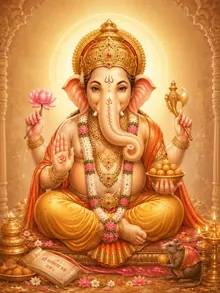
Siddhivinayak Aarti, Sukhkarta Dukhharta, is Samarth Ramdas's most beloved Marathi aarti to Lord Ganesh, whose very sight is believed to fulfil every wish, presented here in full with a simple meaning for every line.
Reading details
जय देव जय देव जय मंगलमूर्ती।
दर्शनमात्रे मन कामना पूर्ती॥
Jai dev jai dev jai mangalmurti. Darshanmatre man kamana purti.
सुखकर्ता दुःखहर्ता, वार्ता विघ्नांची।
नुरवी पुरवी प्रेम, कृपा जयाची॥
सर्वांगी सुंदर, उटी शेंदुराची।
कंठी झळके माळ, मुक्ताफळांची॥
Sukhkarta dukhharta, varta vighnanchi. Nurvi purvi prem, kripa jayachi. Sarvangi sundar, uti shendurachi. Kanthi jhalke mal, muktaphalanchi.
रत्नखचित फरा, तुज गौरीकुमरा।
चंदनाची उटी, कुंकुमकेशरा॥
हिरेजडित मुकुट, शोभतो बरा।
रुणझुणती नूपुरे, चरणी घागरिया॥
Ratnakhachit fara, tuj Gaurikumara. Chandanachi uti, kunkumkeshara. Hirejadit mukut, shobhato bara. Runjhunti nupure, charani ghagariya.
लंबोदर पीतांबर, फणिवरबंधना।
सरळ सोंड वक्रतुंड, त्रिनयना॥
दास रामाचा वाट पाहे, सदना।
संकटी पावावे निर्वाणी रक्षावे, सुरवरवंदना॥
Lambodar pitambar, phanivarbandhana. Saral sond vakratunda, trinayana. Das Ramacha vat pahe, sadana. Sankati pavave nirvani rakshave, survarvandana.
For a vrat, some devotees read it several times in one sitting: 11, 21, or 108. Save your reading count with this counter.
How to Read Shri Siddhivinayak Aarti
Read it on Wednesdays, Sankashti Chaturthi, or Ganesh Chaturthi, with a lamp lit. Repeat the refrain, 'Jai Dev Jai Dev,' after every stanza.
About Shri Siddhivinayak Aarti
Siddhivinayak Aarti, also known by its opening line as "Sukhkarta Dukhharta," is Samarth Ramdas's Marathi aarti to Lord Ganesh, describing his form, ornaments, and grace. The composition opens with a refrain, continues through three stanzas, repeats the refrain after each one, and closes with the poet's own signature, "Das Ramacha" (Ramdas, the servant).
This page presents the full text in clean Devanagari, with a simple meaning for every stanza. Text size can be adjusted, and the full reading can also be printed.
Benefits of Reciting the Siddhivinayak Aarti
It is believed that reciting this aarti daily with devotion removes obstacles from one's life, and that the mere sight of Ganesh fulfils every wish of the heart; reciting it especially on Wednesdays, Sankashti Chaturthi, and Ganesh Chaturthi is considered particularly beneficial.
About Samarth Ramdas
Samarth Ramdas (1608–1682 CE) was a celebrated saint-poet of Maharashtra and the spiritual guide of Chhatrapati Shivaji Maharaj. He composed this aarti in Marathi, and it has become the most widely sung aarti in Ganesh worship today, especially at Mumbai's famed Siddhivinayak Temple. The original composition is said to run to seven stanzas, but only three are commonly sung today, and those are presented on this page.
Frequently asked questions
Who composed the Siddhivinayak Aarti?
Samarth Ramdas (1608–1682 CE) composed it, a celebrated saint of Maharashtra and the spiritual guide of Chhatrapati Shivaji Maharaj. His signature, 'Das Ramacha', appears in the final stanza.
Are the Siddhivinayak Aarti and "Sukhkarta Dukhharta" the same?
Yes, they're the same aarti, it's also known by its opening line, "Sukhkarta Dukhharta," especially in Maharashtra.
What is the structure of the aarti?
It has one refrain and three stanzas, which are the ones commonly sung today. The original composition is said to run to seven stanzas.
What's the difference between the Ganesh Aarti and the Siddhivinayak Aarti?
Both are dedicated to Lord Ganesh, but they're two separate compositions. The Ganesh Aarti ("Jai Ganesh Jai Ganesh") is in Hindi, while the Siddhivinayak Aarti ("Sukhkarta Dukhharta") was composed in Marathi by Samarth Ramdas.
Is it necessary to know the meaning?
Not necessary, but reading it with the meaning makes the devotion clearer. This page includes a simple meaning alongside every stanza.
What are the benefits of the Siddhivinayak Aarti?
It is believed that reciting this aarti daily with devotion removes obstacles from one's life, and that the mere sight of Ganesh fulfils every wish of the heart; reciting it especially on Wednesdays, Sankashti Chaturthi, and Ganesh Chaturthi is considered particularly beneficial.